





The Meaning and Significance of the Hijrah
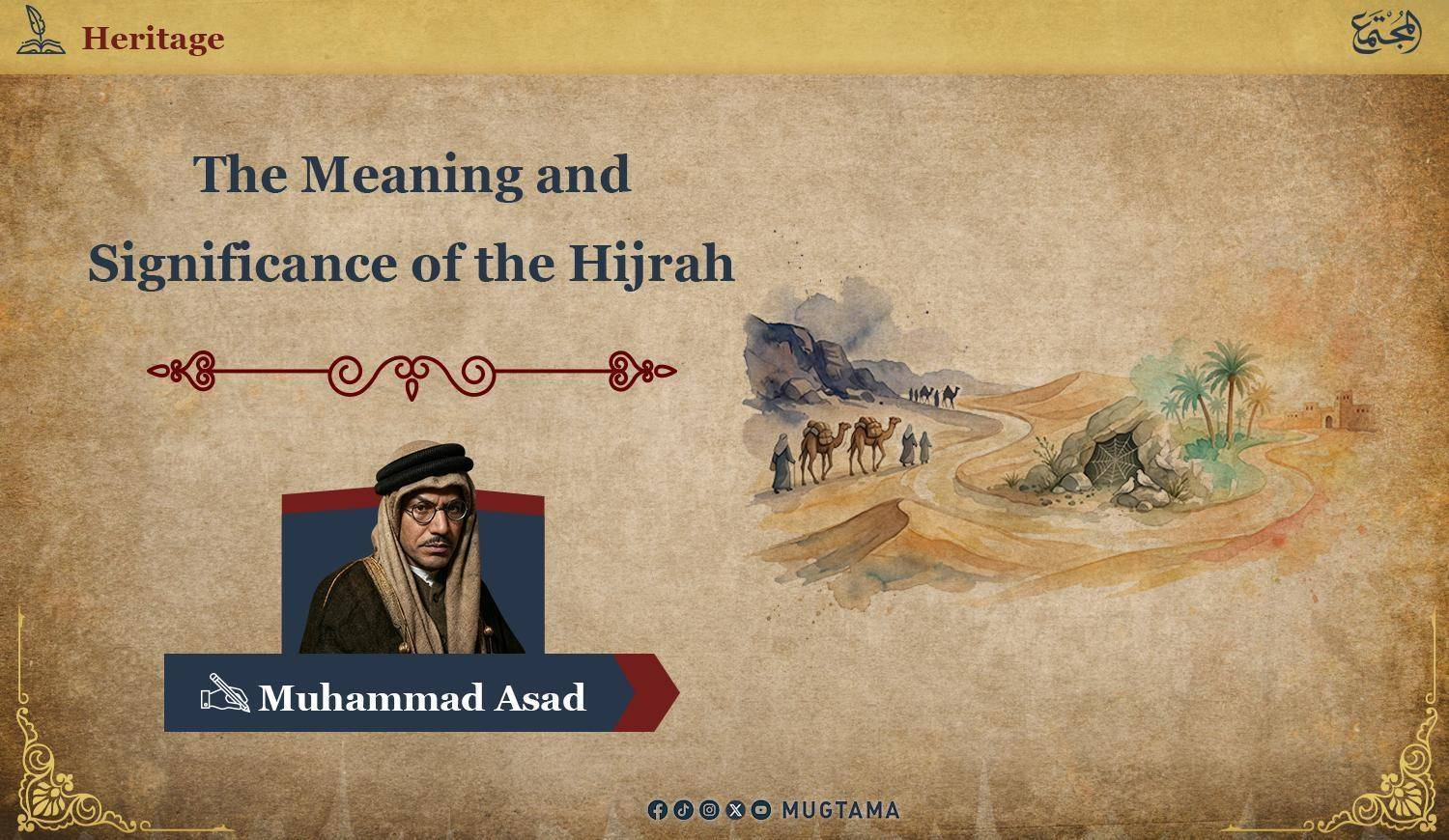
In its
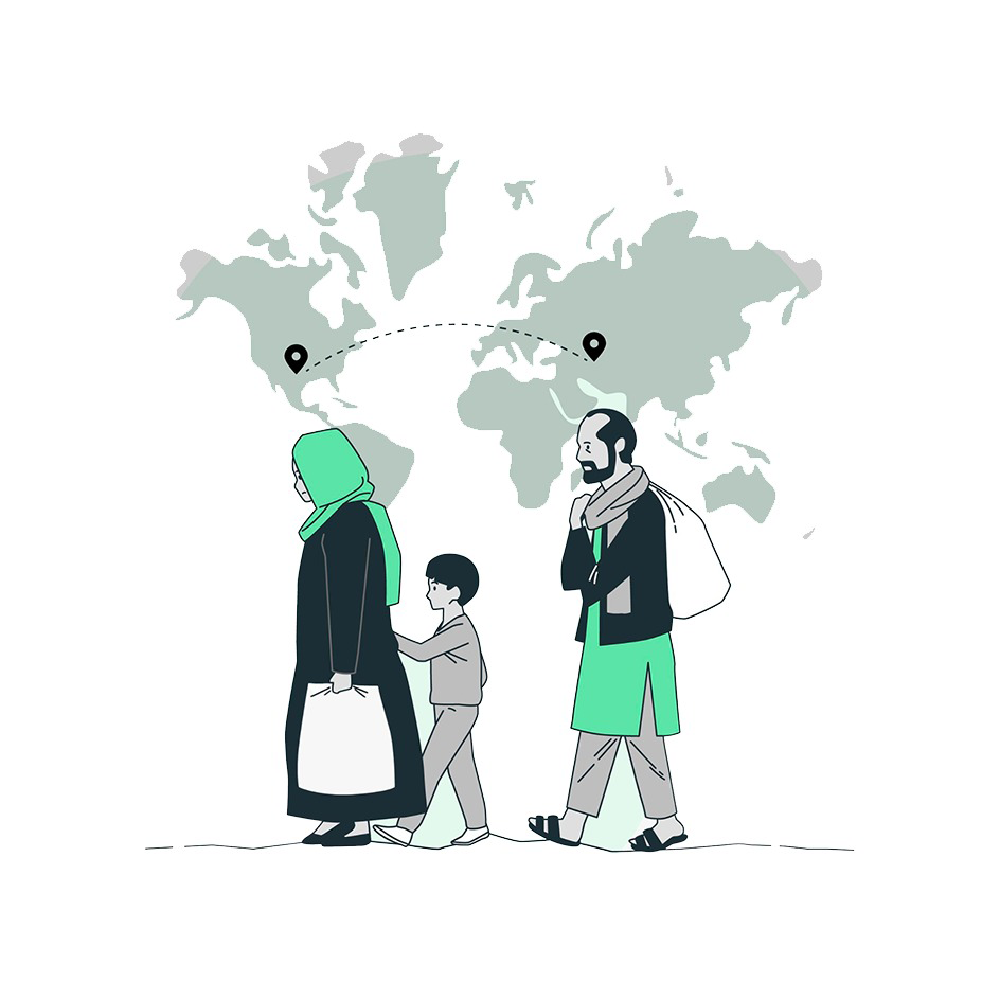
primary, general meaning the term hijrah denotes a person's or a social group's
migration from one physical environment or place to another, with the
linguistic stress on the act of leaving the former in the hope of reaching a
place or environment thought to be more conducive to the moral and material
well-being of the person or group concerned.
Hence, it
would seem that the Latin noun exodus—which has precisely this connotation and
is, moreover, fully incorporated as such in the linguistic usage of the
Occident owing to its Biblical associations—represents the closest possible
rendering of the Arabic word hijrah into any Western language.
Why the Prophet Muhammad Migrated from
Makkah to Madinah
This
definition of the term hijrah should be kept in mind whenever we use it to
describe the exodus of the Prophet Muhammad and his Companions from Makkah to Madinah;
for this exodus, taking place as it did after thirteen years of bitter
persecution of the Prophet and his followers by their pagan compatriots in Makkah,
was undertaken in the fervent hope that the city of Madinah—or rather, Yathrib,
as it was called in those days—would provide a fertile soil for the spread of
the religion based on the Quran and preached by the Prophet Muhammad: the
religion of Islam.
Thus, the
hijrah of the Prophet, which took place in the year 622 of the Christian era,
was most prominently characterized by the positive, selfless expectation of a
moral good to come which inspired the Prophet and his followers, and the
conviction fully expressed in the Prophet's prayer on leaving Makkah, the place
of his birth: “O God! Thou hast ordained that I
should leave the place which I loved: guide me, then, unto a place which is
beloved by Thee!” And so, the Prophet set out on his long journey to
Yathrib, which in the course of time came to be known as Madinat An-Nabi, “The
City of the Prophet”, or, more concisely, Al-Madinah, “The City”.
Keeping
all this in mind, one realizes that to refer to the Prophet's hijrah as a “flight”,
as is so often done by Occidental, non-Muslim writers, is not only erroneous
from the linguistic point of view, but also contradicts the innermost purport
and the historic significance of an occurrence which ushered in an entirely new
era in the history of mankind.
In order
to understand this fully, we must look back at the period which immediately
preceded the Prophet's hijrah: namely, the first thirteen years of his
apostolic mission—the years which historians describe as the “Makkah period”.
How the Quran Transformed the Early
Muslim Community
During
those thirteen years, beginning with the revelation of the first five verses of
the ninety-sixth surah of the Quran, almost all of the gradually unfolding
revelation was directed towards purely spiritual ends: that is to say, matters
of worldly concern (except such as were closely related to social ethics)
remained untouched for the time being, and the main accent lay on the
inculcation of a truly religious spirit in the believers.
The
development of moral consciousness; the cognition of man's responsibility to
and ultimate judgment by God, the One, the Unique, the All-Knowing; kindness
and compassion towards all living beings; patience in adversity and the
overcoming of the fear of death: these are some of the elements predominantly
stressed in the step-by-step revelations vouchsafed to the Prophet Muhammad
throughout the thirteen years of the Makkah period.
They
supplied the basis, the spiritual matrix, as it were, of all the social
teachings of the Quran that were yet to come thus anticipating the (much later)
Quranic dictum that {Verily, God does not change a
people's condition unless they change their inner selves}.
The Conflict Between Islam and
Pre-Islamic Arabian Society
As
already mentioned, this spiritual change in the followers of the Prophet
Muhammad expressed itself most clearly in their perception of God's oneness and uniqueness and, consequently, in their uncompromising rejection
of every concept, imagery and usage which contradicted this basic perception.
In social
terms, therefore, the attitude of the new religious community was diametrically
opposed to all the traditions which formed and characterized the much larger
pagan society of Makkah at the beginning of the seventh century of the
Christian era. The whole concept of that pre-Islamic Makkan society revolved
around a multiplicity of deities and idols, some of them of a purely tribal
import—that is to say, worshipped only by the people living in and around Makkah—while
others enjoyed a wider adherence, with a worship spread over most of the
Arabian Peninsula and permeating every manifestation of social life.
Although
almost all the pagan Arabs at that time seemed to have been vaguely agreed upon
the idea of a supreme, invisible God supposed to be ruling over the multitude
of the other deities (many of them represented by idols carved of stone or
wood, by trees, rocks, and all manner of fetishes), they were convinced that
this Supreme God could be approached by man only through the mediation of
certain female deities and angels, all of them regarded as “god's daughters”.
A direct
approach to Him was considered unthinkable. A call like that of the Prophet
Muhammad, who from the very beginning spoke of God as the One besides whom
there is no other deity, the All-Knowing who is aware of what is in the hearts
of man and, therefore, needs no mediator between Himself and any of His
creatures, appeared to them as bordering on madness.
Moreover,
the Prophet's emphatic negation of the existence of the various deities to
whose worship the Makkans were devoted implied also a rejection of the many
ceremonies and tribal usages connected with that worship: in short, it
threatened the—to them—time-honoured structure of Arabia's pagan society.
The fact
that the Prophet's followers were only a small minority in the midst of a large
pagan population, as well as the fact that this small minority was not in the
least aggressive and asked for no more than to be allowed to live quietly in
accordance with their religious beliefs, made no difference to the Makkans.
They felt acutely offended and morally threatened by the crass disregard of
their tribal traditions by a group of people who openly refused to conform to
their ancestral beliefs, and whose example seemed to be highly infectious among
what was regarded as the “lower strata” of Makkan society.
Why the Early Muslims Faced Persecution
in Makkah
It is,
therefore, not surprising that the preaching of the Prophet Muhammad met with
hostility on the part of most of his com patriots; and when it became obvious
to them that he was not prepared to compromise on his ethical principles, the
hostility of the pagan Makkans began to express itself in active persecution of
the new religious community.
In the
course of the years, this persecution became more and more virulent, gradually
leading to physical torture and eventually to the martyrdom of several of the
Prophet's followers.
The Invitation to Madinah and the Birth
of a New Muslim Community
And so,
after several unsuccessful attempts to find support in the mountain town of Ta’if,
and after having received a number of delegations from the citizens of Yathrib
inviting him and his community to make their home there, the Prophet enjoined
upon all his followers to emigrate with him to the city which was to become the
home of Islam in an entirely new aspect: the home of a community which had
become fully mature under the stress of persecution and was now ready to assume
the dynamic role envisaged for it in the Quran.
From Spiritual Preparation to Islamic
Civilization
Thus, the
hijrah of the Prophet from Makkah to Madinah—as Yathrib soon came to be
known—constitutes a clearly-marked watershed between two periods of early
Islam: the period of spiritual preparation in Makkah, and the period of
sociopolitical growth and organization in Madinah.
But
however distinct from one another, both of these periods may have been, they
are closely inter-linked and form, in reality, one unbroken whole—so much so
that neither can be fully understood without taking the other into account.
Without
the spiritual preparation during the thirteen years at Makkah, the subsequent
social development of the Muslim community, its growth into statehood, and its
very dynamism and expansion would have been unthinkable; and without the
dynamism and sociopolitical development at Madinah, the Prophet's preaching at Makkah
would have remained barren of its historic achievement.
How the Hijrah Changed the Course of
Human History
Hence, it
was in the Prophet's hijrah that Islam took the decisive step towards its inner
and outer fulfillment The Prophet's Companions were fully aware of this fact.
When the second Caliph, `Umar Ibn Al-Khattab, decided upon the establishment of
a purely Islamic calendar, he designated—with the consent of all the leaders of
the Muslim community—not the year in which the revelation of the Quran began,
but rather the year in which the hijrah took place, as Year One of the Islamic
reckoning.
For Further Reading:
- The Hijrah’s Methodology for Imminent Victory
- The Prophet's Migration (Hijra): Lessons for Today
- Solidarity, Compassion, and Unity: The Essential Pillars of any Islamic State
-------------------------------------------------------------
Taken from “This Law of Others” by Muhammad Asad