




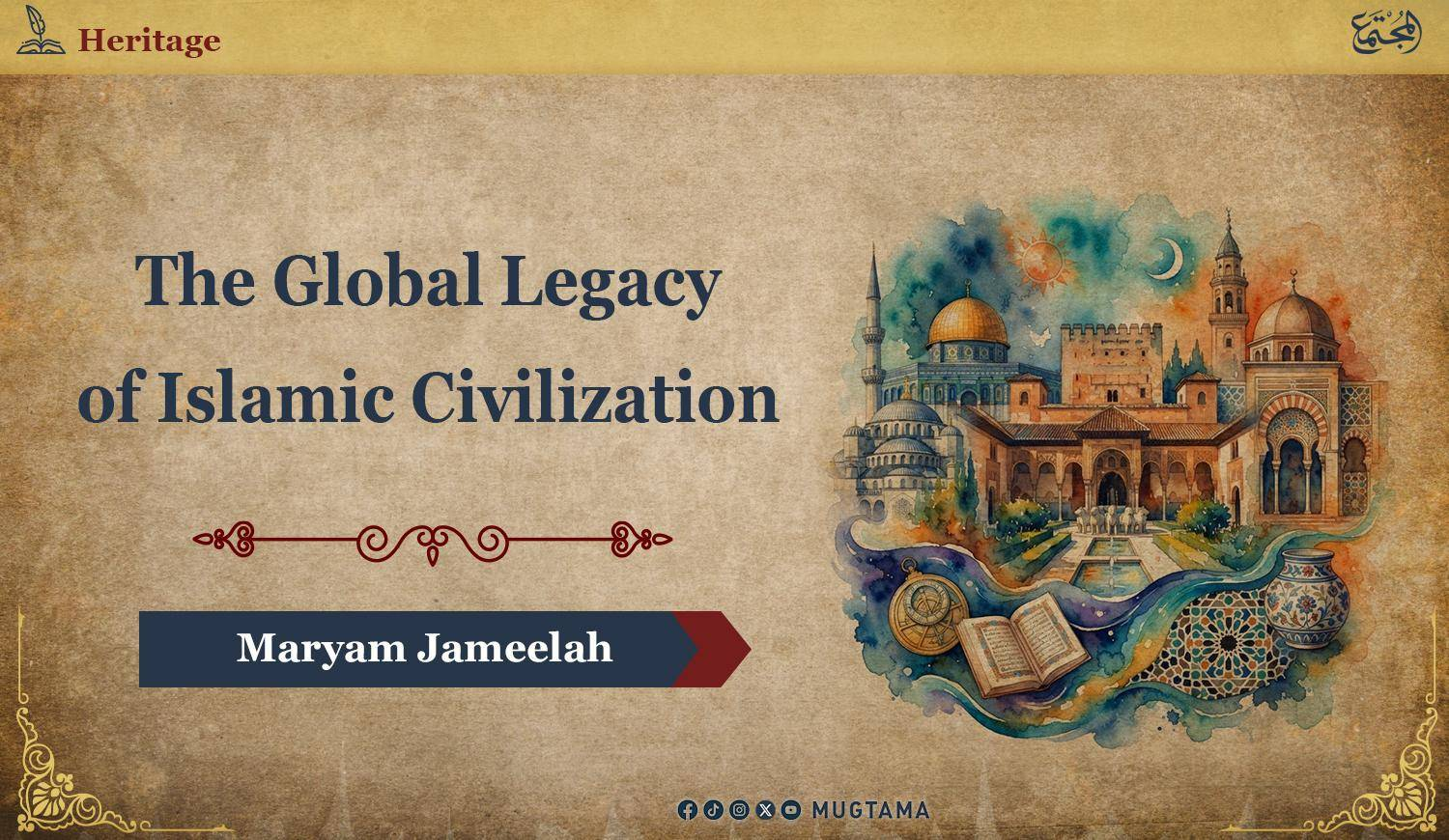
The Global Legacy of Islamic Civilization
Before
European imperialism arrived on the scene in the 16th century, the civilization produced by Islam was the most cosmopolitan, international, and
extensive in area that had ever appeared in recorded history. For more than a
thousand years, politically and culturally, Islam reigned supreme. Over all of
Northern Africa, Western Asia, and large areas of Central Asia, it spread
rapidly to India, even into China, and across the Pacific Ocean to Malaysia,
Indonesia, and the Philippines.
Spain was
under Islamic rule for seven centuries, and due to the rising power of the
Ottoman Turks, Islamic culture strongly influenced much of Southeastern Europe
as well. Converts flocked to the fold of Islam from all races—black, brown,
yellow, and white.
Economically,
the Islamic world prospered through its intensive, long-distance international
trade and commerce. Muslim merchants and tradesmen, who were often zealous
missionaries, were the most adventurous and daring travelers and explorers.
Only the Polar regions, Australia, and the New World were unknown to them.
The universality of Islam and the civilization it produced is all the more
remarkable because all this was achieved without the assistance of any of the
modern, mechanical means of communication and transportation.
Most of
the major historic religions and non-Western civilizations were and still are
parochial, Judaism and Hinduism being among the most extreme, excluding
outsiders on principle. Even Christianity, which is supposed to be an
international proselytizing faith with organized missionary activity
everywhere, is inextricably bound up with the history of Europe and shaped by
its cultural atmosphere.
To prove
that, historically, Western civilization and Christianity are inseparable, a
prominent American missionary writes: “The Roman Catholic and Protestant
missionary is not simply a Christian: he is always a Western Christian,
carrying with him the fresh and modern outlook of the Western world as well as
the Gospel of Christ. The missionary never fails to identify his Christian
faith with Progress and social concern, which Eastern religions seldom include.”
(The Lands Between: The Middle East, John S. Badeau, Friendship Press, New
York, 1958, p. 105)
Thus,
historic Christianity and Western cultural and political imperialism are
inseparable.
The Universality of Islam in the Quran
and Hadith
The
universality of Islam is proclaimed at the outset by the Divine revelation of
the Quran: {O mankind! We have created you male and
female and have made you nations and tribes that you may know and understand
one another. Lo! The noblest of you in the sight of Allah is the one who is
most righteous. Lo! Allah is Knower, Aware.} [Al-Hujurat 49:13]
The Quran
also repeatedly refers to the different races, colors, and languages of mankind
as among the signs of Divine Creation.
The
Hadith are even more explicit. The Prophet (peace be upon him) preached during
his historic Farewell Address
in Makkah during the Hajj: “O people! Verily,
your Lord is one and the forefather of all of you is one. All of you are
descended from Adam, and Adam was created from earth. There is no superiority
for an Arab over a non-Arab, nor a non-Arab over an Arab, nor a white skin over
a black skin except in piety. Verily, the noblest among you is he who is the
most pious.” (Narrated in The Opinions of Muhammad, Maulana
Ubaidullah Akbar, Shaikh Muhammad Ashraf, Lahore, 1955, pp. 95–96)
In
contrast to the materialistic outlook of Western culture, which is determined by the vagaries of opportunism
and expediency, releasing the sordid human instincts of greed, ambition, and
cruelty in full force, the supreme authority of the Quran as infallible Divine
revelation bestows on its believers a universal sense of values, human dignity
and self-respect, and a constructive meaning and purpose to life, transcending
all limitations of time and place.
The Shari`ah
is a universal law, excluding nobody—believer or non-believer—from its
all-embracing scope. So long as it was adhered to, the absolute, transcendental
authority based on the fear of God and reward and punishment in the Hereafter
as the source of ethical behavior safeguarded the Muslim community from all the
moral anarchy, social unrest and disruption, and human degradation we see
everywhere around us today.
Islam and Equality: A Civilization Open
to All Races
The
all-inclusiveness of Islam was evident from the start. Included among the most
esteemed Companions of the Prophet (peace be upon him) was Zaid, whom the Prophet
(peace be upon him) emancipated from slavery and then adopted as his son and
finally placed in command of the Muslim army, where he was martyred fighting in
Syria; Bilal, the Abyssinian, whom the Prophet (peace be upon him) appointed as
the first Muezzin to summon the people to prayer; Suhail, a Roman; and Salman,
the Persian—all of whom have always been respected by Muslims everywhere as
much as the Prophet’s (peace be upon him) Arab followers.
Among the
Mothers of the Believers, the Prophet’s (peace be upon him) wives, were Maria,
the Egyptian Copt, and Safiyyah, whose father was a Jewish chieftain.
Among the
masters of the Hadith, the Shariah, theologians and scholars, as well as
celebrities in the arts and sciences, there appear many more non-Arabs of
varied national and racial origins than Arabs, even though they wrote most of
their works in Arabic. This proves that people of all nationalities and races enthusiastically participated in Islamic civilization
on equal terms and that the blight of nationalism and imperialism was unknown
to them.
How Islam Spread Without Forced
Assimilation
Contrast
the ruthless policies of the “civilized” West toward Aboriginal peoples with
the humane, civilizing methods of the Muslims.
Writes an
English Orientalist: “The marvellous success that has been achieved in Africa
and Indonesia in propagating Islam and its way of life has been largely the
work of traders and merchants who have won the hearts of the natives by
learning their language, adopting their manners and customs, and settling down
and marrying their women, all the while quietly spreading the knowledge of
their faith, first by converting the native women they married and the persons
associated with them in their business relations. Instead of holding themselves
apart in proud isolation, they gradually melted into the mass of the
population, employing all the superiority of their intelligence and civilization
for the work of conversion.” (The Preaching of Islam, Thomas William Arnold,
Shaikh Muhammad Ashraf, Lahore, 1965, p. 409)
Thus,
many primitive peoples were civilized by the enlightenment of Islam without
resort to genocide or forced “assimilation,” racial persecution, or any of the
dehumanizing degradation and social disruption that have invariably accompanied
the westernization of non-Europeans.
-------------------------------------------------------------
Taken from “Is Western Civilization
Universal?” by Maryam Jameelah