






October 7: The Day That Changed the World
In the course of human
history, there are defining milestones measured not by the hours they took to
unfold, but by the magnitude of the political and moral seismic shifts they
leave in their wake.
The Sarajevo bullet that
killed Archduke Franz Ferdinand in 1914 was the spark that ignited World War I,
toppling great empires and redrawing the global map. In 1941, the attack on
Pearl Harbor thrust the United States into the heart of World War II, paving
the way for its hegemony over the international order.
Similarly, the 1945 atomic
bombings of Hiroshima and Nagasaki ushered humanity into the nuclear age,
forever altering the concept of warfare. And when the Berlin Wall fell in 1989,
an entire global system collapsed alongside it, bringing an end to the Cold War
and marking the dawn of a unipolar era.
October 7, 2023, when the Al-Aqsa Flood erupted, belongs to this rare category of historical events. The
"Flood" was not merely a military operation or a fleeting
confrontation, but rather a defining political, strategic, and moral moment
that reshaped the global discourse on Palestine, the occupation, international
law, and human rights. So much so that major Western newspapers and think
tanks, such as The Guardian and Foreign Policy, described the
event and its repercussions as "the day that changed the world" and
"the year that changed the Middle East."
From the Margins to Center Stage
Prior to October 7, the
prevailing Western consensus assumed the Palestinian cause was on a trajectory
toward gradual marginalization. Normalization initiatives and the Abraham
Accords were touted as the gateway to a "New Middle East"—a paradigm
in which Palestine would be downgraded from the central cause of the Arab and
Muslim worlds to a mere peripheral issue.
However, the events of that
day shattered this premise from its very roots. Within hours, Palestine was
thrust back to the forefront of news broadcasts, parliamentary debates,
university campuses, and international forums, emphatically reclaiming its
status as one of the most prominent issues on the global stage.
Bolstered by sweeping
political, military, and diplomatic support from the United States and various
Western powers, Israel operated under the assumption that the occupation, the
blockade, and settlement expansion had calcified into a permanent reality—a
status quo the world could simply tolerate.
Yet, the years following
October 7 proved precisely the opposite. Rather than consigning the Palestinian
cause to oblivion, the event catalyzed its global resurgence, propelling it to
the very core of international political, legal, and moral discourse.
Exposing Contradictions and Double Standards
Perhaps the most defining
aspect of October 7 as a history-altering event is how it laid bare—before
hundreds of millions worldwide—the glaring chasm between Western rhetoric on
democracy and human rights and the actual reality inflicted upon the
Palestinians. The global public bore daily witness to scenes of utter
devastation, carnage, mass displacement, and starvation in Gaza, as
international institutions increasingly sounded the alarm over an unprecedented
humanitarian crisis.
According to UNRWA figures,
the Palestinian death toll in Gaza has eclipsed 73,000, with the number of
wounded exceeding 173,000 since the outbreak of the war. Moreover, the conflict
has exacted a staggering toll on humanitarian efforts, claiming the lives of
hundreds of United Nations personnel and aid workers.
The Deliberate Targeting of Journalists and Aid Workers
United Nations
Secretary-General António Guterres described the carnage as the highest death
toll for UN personnel in the organization's history, emphasizing that more than
one in 50 UNRWA staff members in Gaza has been killed in the conflict.
The devastating toll was not
confined to civilians and humanitarian workers; it extended its lethal reach to
the press. The Committee to Protect Journalists (CPJ) declared 2024 the
deadliest year for media professionals since it began tracking casualties,
noting that nearly two-thirds of all journalists killed globally perished in
the context of the war on Gaza.
A Seismic Shift in the Halls of Justice
On the legal front, October 7
and its ensuing aftermath triggered an unprecedented seismic shift within the
halls of international justice. In December 2023, South Africa formally
instituted proceedings against Israel at the International Court of Justice
(ICJ), alleging violations of the Genocide Convention—a move widely
characterized by experts as one of the most consequential international legal
battles of the 21st century.
Concurrently, the
international recognition of the State of Palestine gained significant
momentum. In 2024, a coalition of UN experts urged all member states to
formally recognize the Palestinian State, highlighting that 146 nations had
already done so by that time.
The Turning of the Tide: A Western Grassroots Shift Toward Palestine
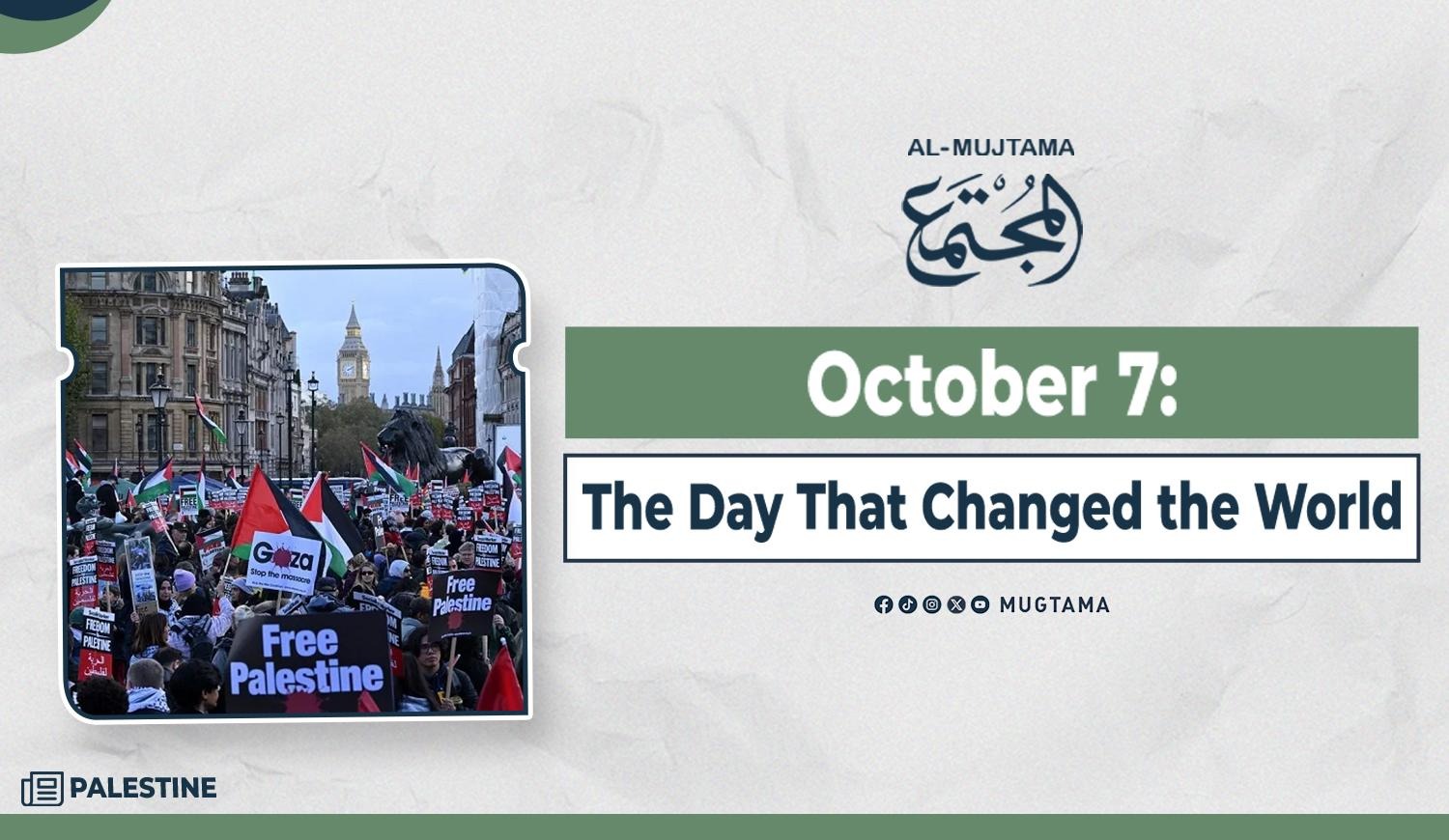
In the realm of global public
opinion, Western capitals have witnessed the largest wave of pro-Palestinian
grassroots mobilization in decades. Massive demonstrations erupted across the
United States, the United Kingdom, France, Spain, Germany, Canada, and
Australia. The Palestinian cause has morphed into a permanent fixture on
university campuses, within labor unions, and across the media landscape. Even
more strikingly, it has emerged as a pivotal factor shaping electoral campaigns
across Western democracies.
The transformations, however,
have not been exclusively political; they are profoundly moral. Today, the
international order is confronted with a question more acute and urgent than
ever before: Are the principles of international law applied universally, or
are they wielded solely against the weak? Furthermore, how can the global
discourse on human rights maintain any credibility while the world bears daily
witness to harrowing scenes of devastation, mass slaughter, and forced
displacement?
If the Sarajevo bullet redrew
the geopolitical map of Europe, if Pearl Harbor shifted the global balance of
power, if Hiroshima inaugurated the nuclear age, and if the fall of the Berlin
Wall brought the Cold War to a close, then October 7 has catapulted the
Palestinian cause back to the epicenter of world history. It exposed the limits
of Israeli power, notwithstanding its overwhelming military supremacy, and laid
bare the profound crisis of the international system, exposing its inability to
uphold the very standards it has long touted as universal values.
Ultimately, October 7 has crystallized into a watershed moment,
irrevocably redefining the Israeli-Palestinian conflict in the global
consciousness. And perhaps, as a growing chorus of scholars and observers now
contends, it is a turning point that will permanently bifurcate the political
history of the region—and indeed the world—into a definitive "before"
and "after."