



Muslims in India
Kashmiri Women: Struggle and Resilience in the Face of Hindu Tyranny
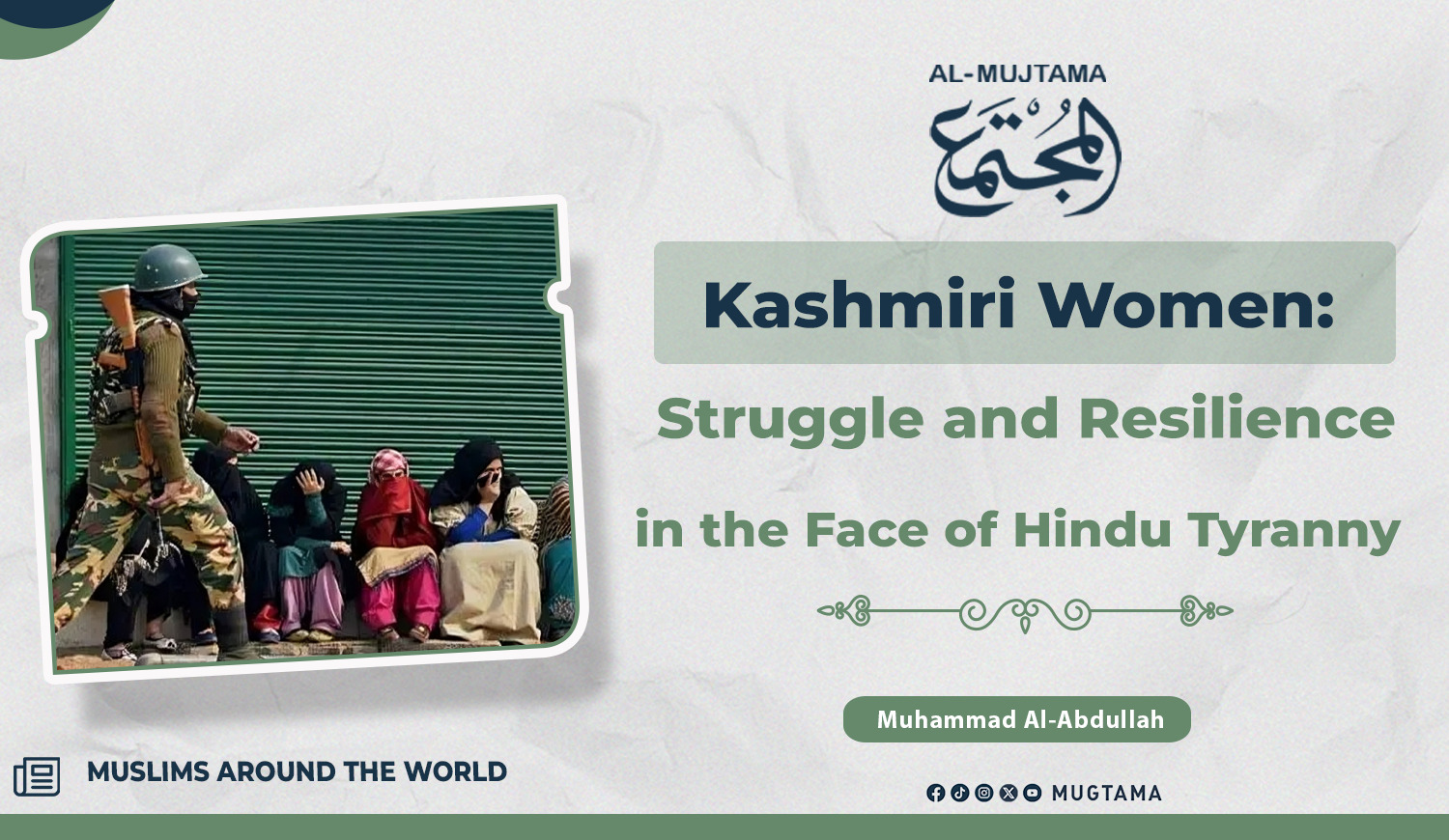
For over seven decades, Kashmiri women have suffered various forms of oppression at the hands of Hindus. Their pleas for justice have gone unheard by the international community, met only with hesitant resolutions and fearful hearts that have given Hindus free rein to commit unimaginable acts against Muslims, especially women.
Nevertheless, Kashmiri women remain
a model of struggle and resilience for their freedom. They stand by
their husbands, who are often forcibly disappeared by the Indians, or they
endure and fight within their homes in the absence or loss of their spouses.
This report from
"Al-Mujtama" highlights the facets of Kashmiri women's struggle and
the decades of oppression they have endured at the hands of Hindus.
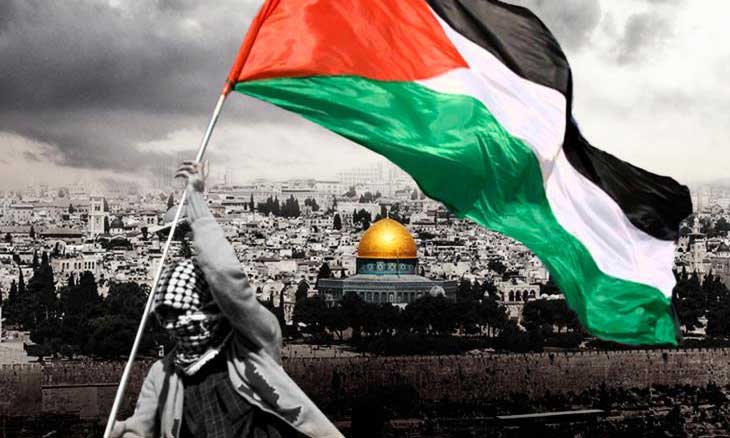
Kashmir and Gaza
A striking resemblance exists
between Kashmir and Palestine. For instance, the Kashmiri Nakba occurred
in 1947, immediately followed by the Palestinian Nakba in 1948. Even the
weapons used against Kashmiris, which cause blindness, are Zionist-made.
The Hindu occupation of Kashmir
also carries out actions similar to the Zionist occupation of Palestine. The
Indian occupation army police have arrested Muslim girls in Kashmir merely for
distributing copies of the Quran, making the distribution of the Quran and the
wearing of the hijab a crime punishable by years in prison.
The BBC reported that incendiary
speeches against Muslims in India have spread on Hindu accounts, calling for
Kashmir to be razed to the ground, just as "Israel" did in Gaza.
Killing, Arrest, and
Rape
Kashmiri women play a significant
role in challenging Hindu oppression by distributing copies of the Quran and
the lawful hijab in the streets of Kashmir. They advise their Muslim sisters to
remain steadfast and emulate the female companions of the Prophet Muhammad
(peace be upon him).
Given that women in Kashmir are the
most vulnerable, Hindu soldiers in Kashmir, like all occupiers of Muslim lands,
began harassing women as a prelude to a widespread campaign of oppression. One
Hindu soldier even forcibly removed the head covering of a Kashmiri Muslim
woman.
The situation for Kashmiri women
has escalated to the point where they are forbidden from leaving their homes
after Hindu army "wolves" have positioned themselves everywhere.
Politicians, religious figures, parliamentarians, and the extremist Indian
Prime Minister Narendra Modi incite these human predators.
Widely circulated images on social
media have exposed the brutality of Islamophobic Hindus. One Kashmiri was
arrested more than 300 times. During one raid on his home, the Indian army
killed his sister by throwing her from a window, which resulted in a broken
spine and her death.
A video clip that circulated years
ago showed Pakistan's representative to the United Nations breaking into deep
tears after mentioning that more than 10,000 Muslim women, including
girls as young as seven, had been raped by the Indian army in Kashmir.
The Struggle of
Kashmiri Women
Kashmiri Muslim women are at the
forefront of the ongoing struggle against the Indian government. They stand
firm, supporting the resistance men against the Hindu riot police.
Additionally, they stage sit-ins in front of the UN observer's office, demanding
a resolution to the conflict in favor of Muslims in Kashmir.
It is worth noting that a movement
known as "Daughters of the Nation" (Banaat al-Milla) has been
formed in Kashmir. This is a women's resistance movement in the Srinagar area
that adopts a moderate approach and embraces a firm belief in the Kashmiri
uprising against the Hindu occupier.
Half-Widows
The term "half-widows"
is one of the most famous and harsh terms that Kashmiri women experience and
confront, caught between the hope of finding their missing husbands and
starting a new life and marrying another.
One Kashmiri woman recounts how
life and its harsh conditions have crushed her, as her husband left for work
five years ago and has not returned since.
The Kashmiri woman describes her
suffering, stating that she supports her three children and their education
after her husband was arrested, leaving her without money, according to The
Guardian.
Five years since her
husband's disappearance, she has given up hope of tracing him in Indian army
camps or police stations, whose personnel and officers treat every woman
searching for her missing loved one with great provocation, pressure, and intimidation.
Aisha Gilana, a human rights
activist, expressed her sorrow over the oppression of widows in Kashmir,
saying: "I work with women whose husbands and sons have disappeared and
have no financial support, and I feel helpless, seeing them makes me cry."
According to the independent
Association of Parents of Disappeared Persons in Kashmir, the number of missing
persons has exceeded 10,000, including 2,000 recently married young
men arrested by Indian security forces.
For two decades, the Kashmiri
people have been subjected to a widespread campaign of daily violations,
including killing, torture, and the rape of women, resulting in hundreds of
thousands of injured, disabled, and detained individuals by Indian forces.
Human rights experts say that Indian authorities are well aware of the Kashmiri people's strong adherence to their Islamic religion and culture, which emphasizes the protection and preservation of women. Nevertheless, they resort to using rape against women to generally humiliate the Kashmiri people and extort information from them about their husbands and relatives who are resisting the Hindu occupation.
Declining Fertility
International experts confirm that
the ongoing conflict for over 70 years in Jammu and Kashmir has created
an environment of insecurity and played a significant role in lowering the
fertility rate in Kashmir.
The psychological pressures
resulting from the conflicts have harmed the physical health of girls,
especially their maternal health. Nearly 800,000 people suffer from
post-traumatic stress disorder, which is another factor responsible for
infertility in women.
The fertility level among Kashmiri
women has declined as a result of the conflict, after they were among the women
classified in Jammu and Kashmir as having the highest fertility rate, with a
birth rate of 1.4 children, according to human rights reports.