





8 MUSLIMS IN CONGRESS 97 MUSLIM WINS
How Muslims Achieved Biggest Electoral Breakthrough in U.S.
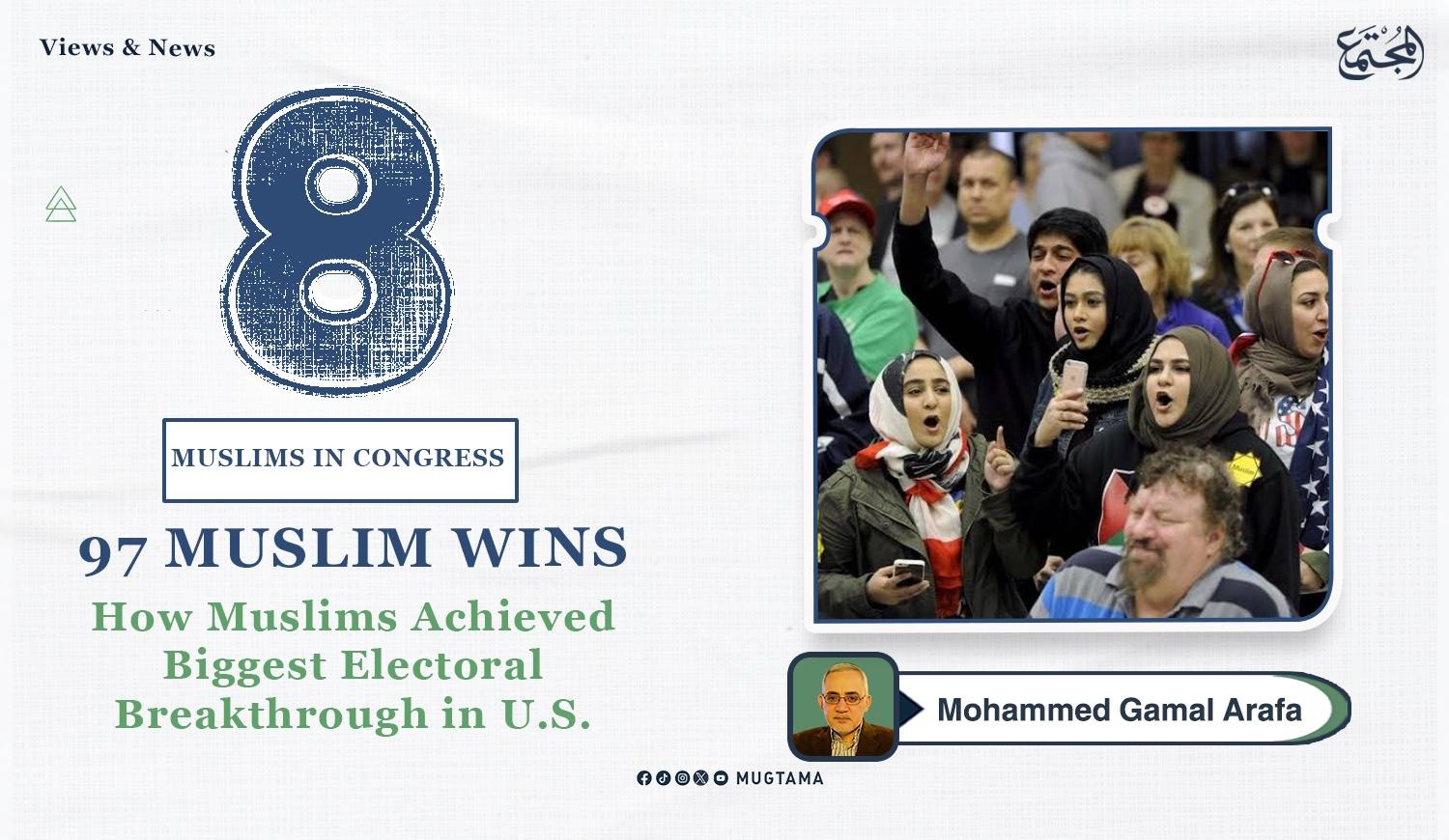
Dozens of Muslim Americans
(approximately 97 individuals) secured victories in the U.S. midterm elections
held on November 3, 2026, winning seats in Congress, state legislatures, local
offices, and the judiciary across roughly 23 states, amid particular focus on
candidates who made the war on Gaza and U.S. policy toward Israel
central issues in their campaigns.
These results surpass what Muslims achieved in the 2022 and
2020 elections. In 2022, American Muslims set a new record in the midterm
elections—which covered Congress (both the House of Representatives and the
Senate) as well as state legislatures—when approximately 82 of their 146 total
candidates won, following the victory of 71 candidates in the 2020 elections.
The Council on American-Islamic Relations (CAIR), the nation's
largest Muslim civil rights advocacy organization, alongside 'CAIR Action,' a
political non-profit organization, released preliminary tracking results for
the November 3 midterm elections, showing that at least 97 Muslim Americans won
races at the federal, state, and local levels across 21 states, including 38
who secured seats in state legislatures.
The council confirmed that 15 other Muslims are leading in
uncalled races, while 6 Muslim candidates are locked in contests that are too
close to call. Additionally, 50 Muslim candidates competed in races where they
did not succeed. The council projected that the total number of Muslim American
winners will surpass 100 once all ballots are counted.
This means that Muslim Americans are setting a new record in
these elections, with expectations that roughly 100 Muslims will secure
victories, compared to 82 winners in 2022—an increase of 18 seats (roughly
22%).
This year saw a higher number of Muslim contenders, with the
count of Muslim American candidates reaching 168—compared to 146 in the 2022
elections—who ran in the primaries before advancing to compete for local,
state, and federal offices during the 2026 election cycle.
A Political Seismic Shift
This year's elections delivered a political earthquake and
dealt a severe blow to opponents of Islam amid campaigns of Islamophobia, as
the number of Muslims in Congress (both the House of Representatives and the
Senate) rose from 4 to 8. Chief among them was Abdul El-Sayed, who won in
Michigan to become the first Muslim elected to the U.S. Senate in United States
history since its founding.
Muslims have previously won election to the House of
Representatives, with the current Congress including four Muslim
representatives (both men and women). Alongside these four, three others won,
bringing the total number of Muslims in the House of Representatives to seven,
and they are:
1. Adam Hamawy, U.S. Representative for New Jersey's 12th
Congressional District, and the first Muslim to represent the state in
Congress.
2. Darializa Avila Chevalier, an Afro-Latina Muslim
representing New York's 13th Congressional District.
3. Ilhan Omar, U.S. Representative for Minnesota's 5th
Congressional District (re-elected).
4. Rashida Tlaib, U.S. Representative for Michigan's 12th Congressional
District (re-elected).
5. André Carson, U.S. Representative for Indiana's 7th
Congressional District (re-elected).
6. Lateefah Simon, U.S. Representative for California's 12th
Congressional District (re-elected).
7. Aisha Wahab, who won election in California.
Dozens of others also won seats in state legislatures and city
councils, most notably Abeer Kawas and Ruwa Romman, both Palestinian Americans;
the former won a seat in the New York State Senate, while the latter secured a
seat in the Georgia State Senate.
Ironically, while President Donald Trump campaigned
aggressively against Somalis in Minnesota and sought to vilify Muslim
Representative Ilhan Omar, ten other Somali Americans—aside from Omar—triumphed
in U.S. legislative races, securing seats in statehouses: Omar Fateh and Zaynab
Mohamed (Minnesota State Senate); Mohamud Noor, Samakab Hussein, Anan
(Ansam/Angham) Mohamud, and Abdi Daisane (Minnesota House of Representatives);
Kayse Jama (Oregon State Senate); and Munira Abdullahi and Ismail Mohamed (Ohio
House of Representatives).
Tracking by Al-Mujtama indicates that the number of
Muslim winners at the state and legislative levels reached 39, compared to 38
in the 2022 elections. Among them were 21 incumbents who secured re-election, alongside
16 newcomers who achieved historic milestones.
Additionally, the number of winning Muslim judges reached
eight, including judges in the states of Michigan, Minnesota, North Carolina,
and Washington.
The number of Muslim winners at the county and municipal
levels also reached 16. Most prominent among them were Yousef Rabhi, Mayor of
Ann Arbor, Michigan; Mohamed Khairullah, Mayor of Prospect Park, New Jersey;
and Nabeela Syed, an Indian-American Muslim who won a seat in the Illinois
State Senate after defeating her Republican rival and flipping the seat,
becoming the youngest woman elected to the state legislature at the age of 27.
The number of Muslim winners in education and on school boards
reached 27, representing the largest category outside legislative offices. This
bracket includes members of boards of education, school districts, and
university trustees, with a prominent presence across Michigan, New Jersey, and
California.
These victories serve as a direct repudiation of anti-Muslim
smear campaigns that targeted candidates and their communities throughout the
election cycle. American voters—including Jewish and Christian
constituents—placed their trust in the leadership, vision, and dedication to
public service demonstrated by Muslim contenders.
The tally of winners—spanning 16 in municipal and local
offices and 27 across educational institutions and school boards—reflects a
critical trend in the evolution of Muslim American political participation,
shifting toward building electoral clout that expands from the grassroots level
up to state legislatures and Capitol Hill.
This landmark victory marks a historic watershed for American
Muslims, elevating them from a politically marginalized minority into an
empowered constituency that actively shapes the laws governing their daily
lives in the United States.
U.S. newspapers characterized this triumph as evidence of a
strategic shift toward direct political agency, moving beyond merely casting
ballots for other politicians who craft the policies that govern their
communities.
