







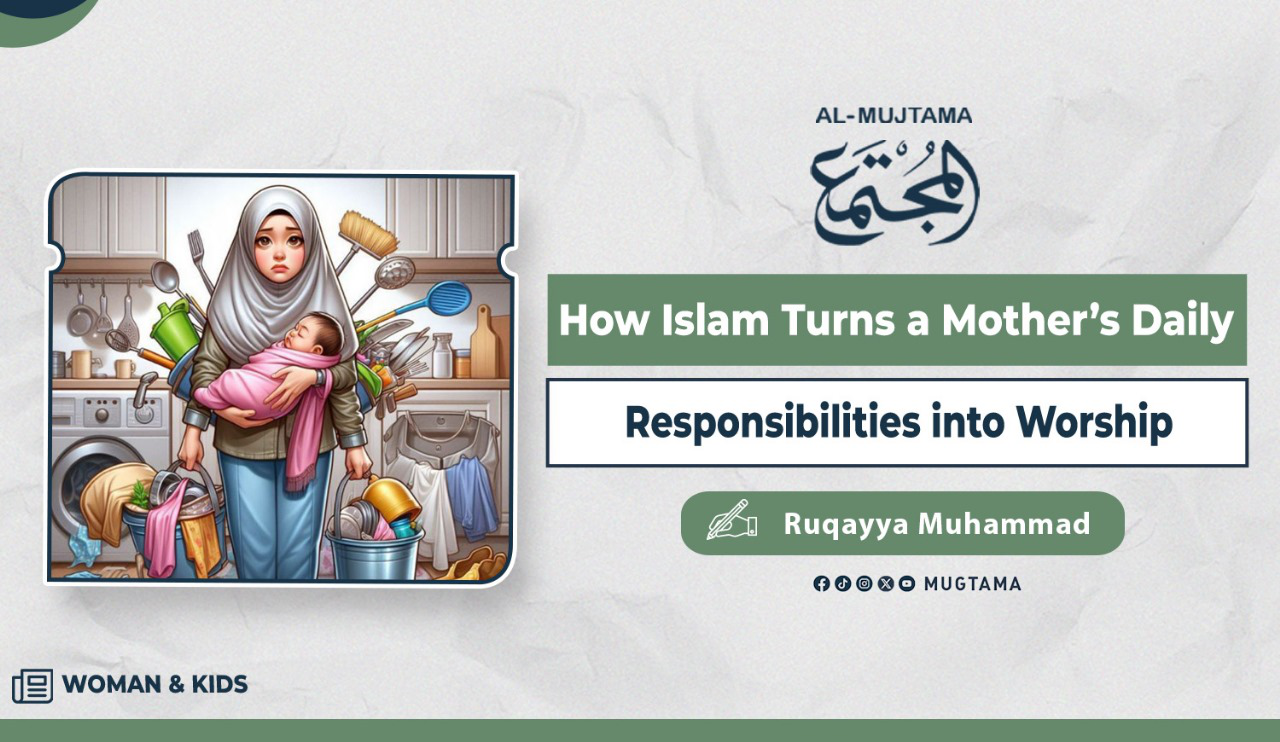
How Islam Turns a Mother’s Daily Responsibilities into Worship
Household
duties and caring for one’s husband and children occupy a large portion of a
mother’s time, which may cause her to feel that she is falling short in acts of
worship. However, many people do not realize that these tasks—often described
by some as mere daily routine—are, in reality, acts of worship of immense
reward if performed with a sincere intention and a heart seeking reward from
Allah. Among the manifestations of mercy of Allah toward His servants is that
He has made the paths of closeness to Him wide and expansive, encompassing
every righteous deed done for His sake. Among the widest of these paths is a wife’s work within her home, whether in caring for her husband, raising her
children, or managing the affairs of her household.
Turning Chores into Acts of Worship
Accordingly,
we will present below a clear Islamic perspective that helps a woman transform
her daily household efforts into a field of worship and obedience.
First: Sincere Intention
Intention
is the foundation of every act of worship. The Prophet (peace be
upon him) said: “Deeds
are to be judged only by intentions, and a man will have only what he intended.” (Narrated by Muslim, 1907).
Whoever
intends by his deeds to draw closer to Allah attains reward and recompense. Through intention,
the simplest habits—such as preparing food—are transformed into acts of
worship, if the wife intends by them to strengthen her household so they may
perform their acts of worship, and to maintain their health so they may be
strong Muslims.
Therefore,
all of a wife’s deeds—even the smallest of them—become rewarded acts of worship
if she intends by them obedience to Allah Almighty and His pleasure,
establishing a cohesive Muslim home, and safeguarding and caring for her
family. Thus, daily routine is transformed into accumulated acts of obedience
that raise her status with Allah Almighty.
Second: Obedience to and Care for the
Husband
Islam has
elevated the status of the righteous wife, honored her role within her home,
and made fulfilling the rights of her husband among the greatest acts of
closeness to Allah after the obligatory duties, and among the signs of her
righteousness. Allah Almighty Says, {And righteous
women are devoutly obedient and, when alone, protective of what Allah has
entrusted them with.} [An-Nisa’ 4:34]
Al-Wahidi
stated in his commentary: “The term qunut in the verse (devoutly obedient) indicates
obedience, and it is general, encompassing obedience to Allah and obedience to
husbands” (Al-Lubab Fi `Ulum Al-Kitab, 6/362)
Thus, a wife’s obedience to her husband in what he commands—so long as it is not disobedience
to Allah—earns her immense reward. Likewise, caring for him, fulfilling his
emotional and physical needs, assisting him in obedience to Allah and in
righteousness in his earnings and actions, and encouraging him to maintain
family ties—all of this causes the wife to share in the reward of her husband’s
righteous deeds, increasing her good deeds and elevating her ranks.
Third: Motherhood as a Path to Reward
The journey of motherhood and raising children is filled with hardships and
challenges that confront a woman and consume much of her time, energy, and
emotions. The Quran describes this hardship in the noble verse: {And We have commanded people to ˹honour˺ their parents. Their mothers bore them
through hardship upon hardship, and their weaning takes two years. So be
grateful to Me and your parents. To Me is the final return.} [Luqman 31:14]
What
makes this hardship and the long duration of upbringing bearable is that it is
the project of a lifetime. Is there anything greater than a servant passing
away while his deeds continue because of what he planted in his righteous child?
Everything
a mother does for her children—if she seeks reward for it—is an act of worship:
caring for their health, teaching them religion and morals, being patient with
their needs, staying awake to care for a sick child, cleaning them, soothing
them, showing gentleness and mercy toward them, and much more.
Fourth: Managing and Caring for the Home
The tasks
of organizing the home, managing it, and overseeing its affairs are not
marginal duties; rather, they are fundamental to family stability. A woman will
be questioned about this responsibility before Allah Almighty, as mentioned in
the hadith of the Prophet (peace be upon him): “…a woman is a
guardian of her husband's house and children and is responsible for them.”
(Narrated by Al-Bukhari, 2554)
Therefore,
every woman who arranges her home, maintains its cleanliness, beauty, and
order, draws closer to Allah through this excellence. Likewise, the
responsibilities included within the home—such as wise financial management and
monitoring the family’s needs—all fall under the scope of responsibility and
worship.
This
reflects the greatness of Islam, which emphasized the importance of this role for the wife
by linking its fulfillment to accountability and recompense in the Hereafter.
Preparing a calm and healthy environment is among the most important
foundations for building individuals who are psychologically and physically
sound. Let every woman look at her home and family and reflect: what has she
prepared as an answer to Allah Almighty when He asks her about that which He
entrusted to her?
Fifth: Patience in Fulfilling
Responsibilities
Family
life is never free from pressures and situations that require wisdom and
steadfastness. Whoever seeks patience and
wisdom, hoping for what is with Allah, will be recorded with immense reward and
will receive from the bounty of Allah what cannot be counted, as the Quran
affirms: {Only those who endure patiently will be
given their reward without limit.} [Az-Zumar 39:10]
A woman’s
patience manifests in many situations: patience in raising children, repeatedly
teaching and following up with them; patience with differing temperaments among
family members and accepting this with an open heart; patience and wisdom in
overcoming marital disputes, restraining anger, and controlling oneself at
times of rage; and patience in carrying the responsibility of the home and
children and safeguarding the trust when the husband is absent.
All
these—and similar acts of giving and sacrifice—open for the mother and wife a
vast door of tremendous reward.
Islam has
granted women a great opportunity by making their daily deeds—though they may
appear simple—a means to attaining the highest ranks. If she rectifies her
intention and seeks reward for her effort, every moment in her home becomes
renewed worship. What is required of a woman is not to increase her working
hours, but to change her perspective on her work.
With
sincere heartfelt devotion to Allah Almighty, burdens turn into acts of
closeness, routine becomes worship, and raising children becomes a form of
striving and ongoing charity. Thus, the Muslim woman lives every moment of her
family life connected to her Creator, realizing that the arena of her worship
is not a narrow room, but the spaciousness of her home and the breadth of her
heart.
Glad
tidings, then, to the woman who turned her home into places of worship, her
service to her family into acts of devotion, and her patience with them into a
treasure whose reward she will find on the Day of Reckoning.
For Further Reading:
- 5 Powerful Roles of Muslim Women in Shaping the Ummah’s Identity
- Rights and Duties Between Spouses in Islam
- Great Mothers Who Changed the Course of History
-------------------------------------------------------------