







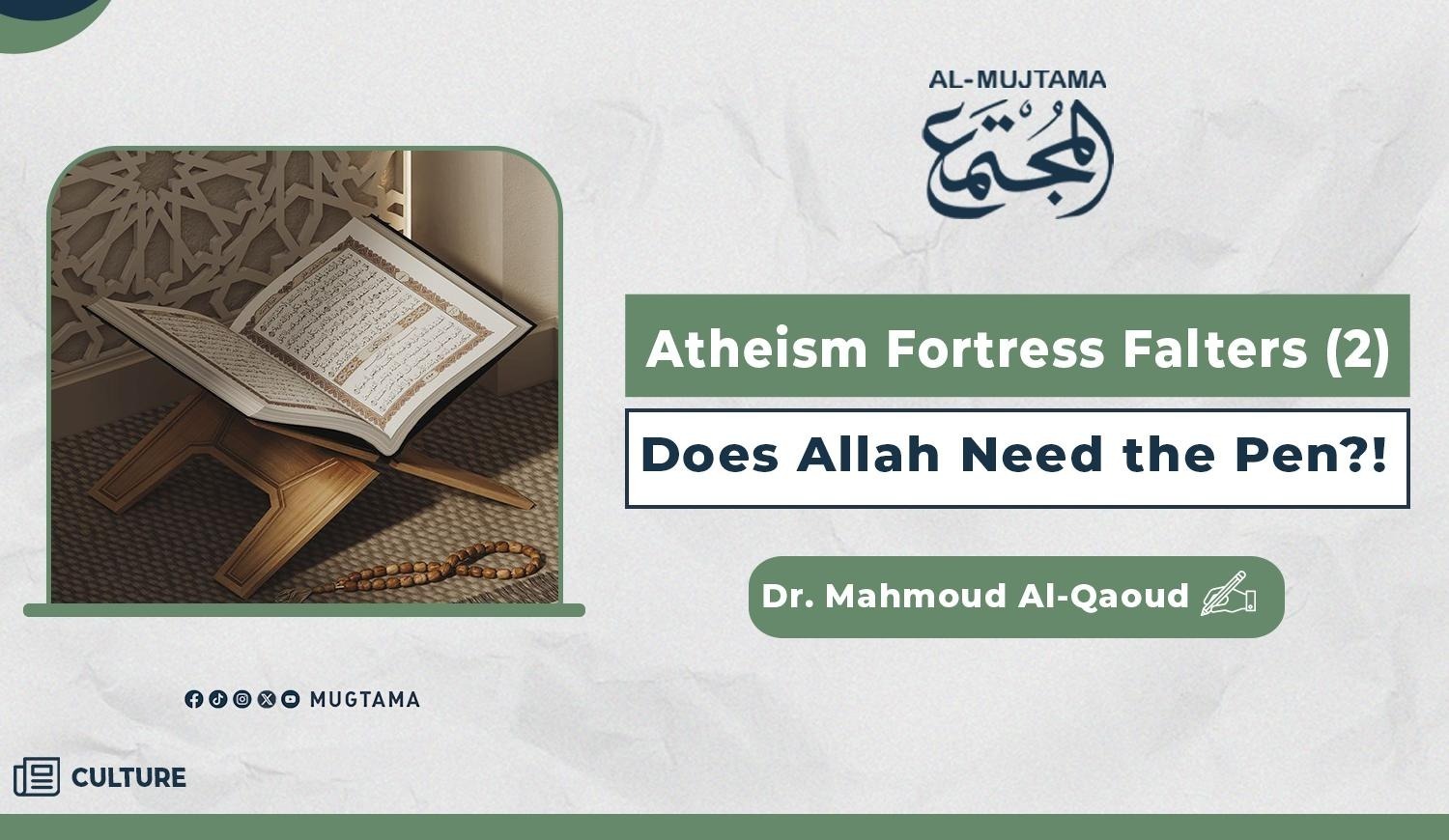
Atheism Fortress Falters (2) Does Allah Need the Pen?!

The enemies of Islam never tire of casting
doubts on our great religion—especially atheists, who have found in social
media a golden opportunity for spreading confusion.
Among the misconceptions they raise is the
objection to the creation of the Pen by Allah and His command for it to write.
They base this on a superficial analogy between human actions—which stem from
need and deficiency—and the actions of Allah, who is far above such traits.
The essence of the doubt is captured in the
question: “If Allah neither forgets nor needs, why did He create the Pen and
command it to write?” This question is rooted in a logical fallacy that
anthropomorphizes the Divine, ignoring the fundamental difference between the
limited human and the Perfect Creator in knowledge, power, and will.
The Text of the Doubt:
"They say that the first thing Allah
created was the Pen, and He commanded it to write everything that would happen.
But am I not entitled to wonder? We write because we forget and fear losing
information; we need to organize our thoughts. But Allah neither forgets nor
needs—so what is His need for a pen? If He created it to remind Himself of what
was written, that is a deficiency. If it was to organize events, that too
implies deficiency. So how do we resolve this dilemma?" (End of quote)
This misconception is based on the false
analogy between human actions and the actions of Allah, and it neglects the
essential distinction between human causality—which stems from need—and Divine
causality—which stems from wisdom and perfection.
1. The Difference Between
Human Need and Divine Will
The doubt assumes that the creation of the
Pen and the command to write came from a Divine need. This is logically false.
Humans write to make up for the limitations
of their memory or to organize their thoughts because they are dependent and
limited beings. Allah, on the other hand, is free of all need. His actions stem
from His free will and wisdom—not from deficiency. Allah says: “And Allah is the Free of need, while you are the needy.”
(Surah Muhammad: 38)
Thus, the creation of the Pen is an
expression of Divine Will that aims to fulfill a wise purpose—not to satisfy a
need.
Let us take an example: a person builds a
house to protect himself from external elements and dangers because he needs
shelter. But Allah created the heavens and the earth not out of need, but to
manifest His power and wisdom. Comparing the two actions is invalid due to the
fundamental difference between the nature of the doers.
2. Writing as a Manifestation
of Allah’s Absolute Knowledge
The writing commanded by Allah to the Pen
is not for remembrance—for Allah knows everything before its creation and from
eternity—but rather to manifest His absolute knowledge and justice before the
creation, including the angels.
Allah says: “No
disaster strikes upon the earth or among yourselves except that it is in a
register before We bring it into being—indeed that, for Allah, is easy.”
(Surah Al-Hadid: 22)
This verse affirms that writing precedes
creation and serves as a cosmic record reflecting Allah’s all-encompassing
knowledge and meticulous order.
Thus, the writing is directed toward
creation to understand that everything is predestined with prior knowledge—not
to compensate for a deficiency in the Divine.
According to Ibn Abbas: “The first
thing God created was the pen. He told it to write and when it asked Him what
it should write He told it to write what was decreed, so it wrote what had
taken place and what would take place to all eternity.” (Narrated
by al-Tirmidhi)
This hadith clarifies that the writing is
the execution of a Divine command and a record of destinies to reveal the
universal order.
3. Wisdom Behind Apparent
Causes
Allah uses apparent means such as the Pen
to fulfill wise ends—not because He needs them, but because they are part of
the cosmic order He has willed. This aligns with the philosophical notion of final
cause, where Divine actions are directed toward ends rooted in wisdom and
justice.
Just as Allah places the balances on the
Day of Judgment to manifest His justice— “And We place the scales of justice
for the Day of Resurrection” (Surah Al-Anbiya: 47) so too is
the writing of the Pen a manifestation of Divine order and justice.
To illustrate: a teacher writes on the
board to explain concepts to students, despite already knowing the content.
Likewise, Allah commands writing to manifest to creation the order of
decrees—not because He needs reminders or organization.
4. Denial of Need in Relation
to Allah
The attribute of absolute self-sufficiency
negates any assumption of need for Allah, the Lord of the Worlds. This doubt
starts from a flawed premise that any Divine act must have a human-like
justification.
Allah says: “And
Allah is the Free of need, while you are the needy.” (Surah
Muhammad: 38)
If one assumes that creating the Pen
implies a need, one would also have to claim that creating the angels or the
universe implies a need—which is clearly false, for Allah creates with wisdom
and will, not due to any deficiency.
Creating the angels to execute His commands
does not mean He needs them, but that His wisdom necessitated a structured
system. The Pen is part of that system.
5. The Cosmic Order and Means
of Execution
The universe is built on a precise system
involving means of execution such as the Pen, the Preserved Tablet, the angels,
the Throne, and the bearers of the Throne. These are not signs of deficiency
but of Divine order and perfection.
In this context, the Pen is a symbol of the
execution of Allah’s command to record decrees—just as the angels execute
Allah’s orders (like Jibreel peace be upon him conveying revelation).
To Allah belongs the highest example: just
as an engineer uses tools to implement a design, Allah uses means such as the
Pen to carry out His will—with the crucial distinction that the engineer
depends on his tools, while Allah is free of all need.
6. Critiquing the Language of
“What is His need?”
The question “What is His need?”
involves a linguistic and philosophical fallacy known as anthropomorphism—attributing
human traits to Allah. In philosophy, this analogy is invalid because Allah is
exalted above human attributes.
Allah says: “He
is not questioned about what He does, but they will be questioned.” (Surah Al-Anbiya: 23)
So if someone asks, “Why did Allah
create the sun?”—the answer is not “Because He needs light,” but “Because
His wisdom willed that the earth be illuminated.” The same logic applies to
the creation of the Pen.
Conclusion
It becomes clear that the doubt concerning
the creation of the Pen by Allah stems from a false analogy between human
actions and Divine actions, ignoring the fact that Allah acts out of wisdom and
perfection—not need.
Both rational and textual evidence confirm
that the creation of the Pen and its command to write are manifestations of
Allah’s absolute knowledge and the meticulously ordered universe—not
indications of deficiency.
The act of writing reveals to creation that
everything is decreed with prior knowledge, and it reflects Allah’s wisdom and
justice.
-------------------------------------------------------------