






Balancing Islamic Discourse During Times of Conflict

Every major conflict in the region
brings a crisis of understanding within religious discourse: how to comprehend
the true nature of the conflict, determine the appropriate religious position,
and develop a comprehensive, informed understanding of the events unfolding.
The aim is to produce discourse that raises public awareness, clears up the
ambiguities surrounding events, and helps Muslims arrive at a position free
from confusion and uncertainty.
In complex and ambiguous conflicts
that require intellectual effort alongside religious knowledge and faith, as
well as a deep understanding of reality, such as the war involving Iran, we
observe division and confusion within religious discourse. Each side claims to
possess the truth and invokes religious texts to support the legitimacy of its
position.
In such complex and interconnected
conflicts, religious discourse
needs to adopt a different approach that takes multiple dimensions into
account. Beyond intellectual analysis, it requires political insight, a
long-term perspective that considers both history and the future, and an
understanding of the international, regional, and legal environment in which
the conflict arose. It must also examine the interests of the parties involved,
the nature and strength of their alliances, and their ability to endure. Above
all, this approach must avoid wishful thinking and the uncritical reliance on
past experiences.
It may therefore be useful to examine
historical examples of religious discourse during conflicts to understand how
such discourse has affected Muslims and Islam, both in the past and in the
future.
Al-Andalus and Its Final Agony
This historical experience illustrates how religious discourse contributed to a
crisis during one of the most critical moments in the final stages of the
conflict in Al-Andalus.
At that time, religious and legal
discourse failed to consider the full picture of the conflict in Al-Andalus.
The year 1610 witnessed the largest wave of expulsions of Andalusian Muslims.
The arguments of Christian extremists who advocated the theory of “purity of
blood” had prevailed, under the slogan “Leave no bad seed behind.”
Catholic authorities insisted on
purging Spain completely of Muslims. Approximately 275,000 Moriscos—the name
given to Muslims who remained in Spain after the collapse of Muslim political
rule in Al-Andalus—were expelled.
The period preceding these expulsions
had already witnessed confusion within religious and legal discourse over
whether Muslims could remain under the rule and authority of these fanatical
and violent Christians.
The situation was particularly
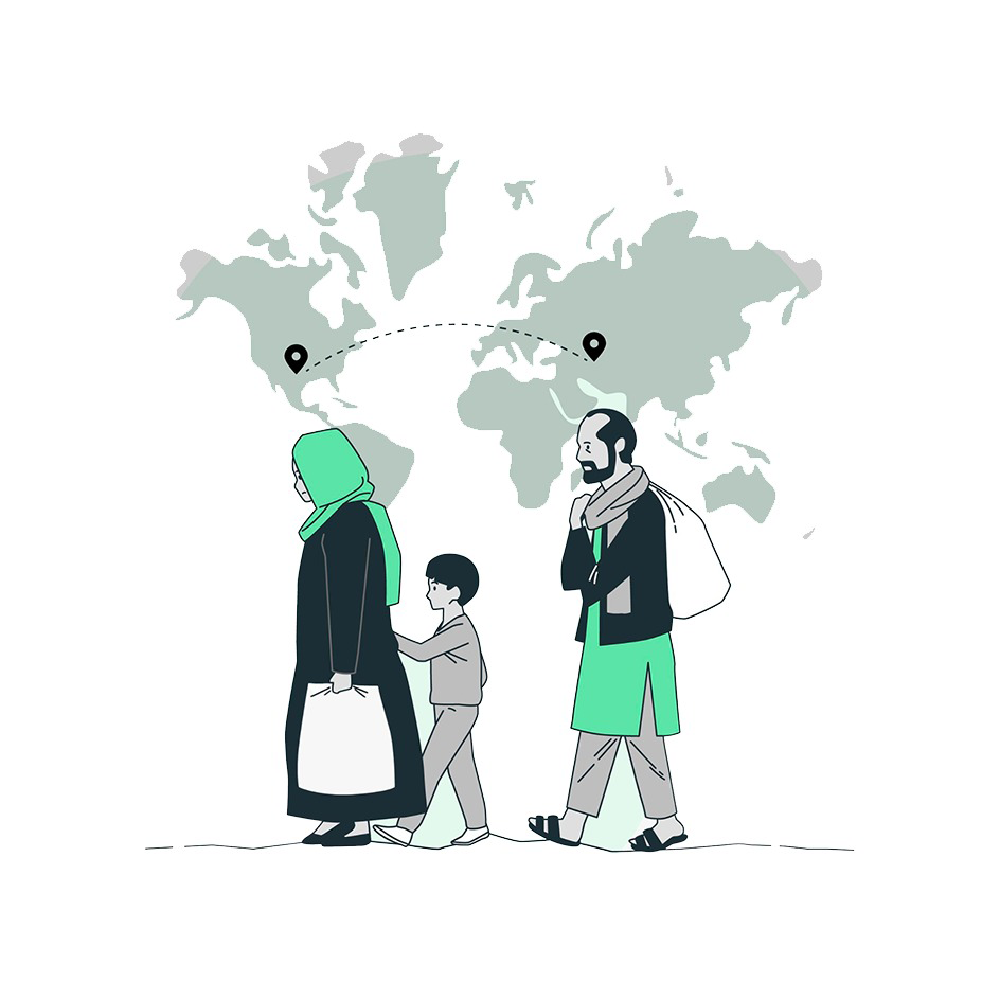
difficult because Andalusian Muslims who had migrated to the Moroccan coast
suffered severe hardships. Some even preferred to return to Castilian rule
rather than remain on those shores. One of the questions raised at the time
was: What is the ruling on someone who returns to the land of disbelief after
having reached the land of Islam?
This question was addressed by the
Algerian Maliki jurist Ahmad Ibn Yahya Al-Wansharishi (d. 1508), whose response
was included in a treatise entitled The Finest of Trade: An Explanation of
the Rulings Concerning Those Whose Homeland Has Been Overrun by Christians and
Who Have Not Migrated, and the Punishments and Deterrents That Follow.
His answer can be summarized as
follows:
1.
Migration
from the land of disbelief to the land of Islam is an obligation that remains
in force until the Day of Resurrection.
2. This obligatory migration cannot be waived, and anyone
capable of undertaking it has no excuse for failing to do so. He stated: “Those
who wrong themselves are those who abandon migration despite having the ability
to undertake it.”
3. The prohibition against remaining in these lands—that
is, territories taken over by Christians—is categorically established in
religion, like the prohibition against carrion, blood, pork, and unlawful
killing. Anyone who permits such residence, treats the matter lightly, or
considers its ruling insignificant has departed from the religion and separated
from the Muslim community.
In his scholarly examination of the
treatise, historian Dr. Hussein Mu’nis comments that scholarship in the far
western Islamic lands had, by the ninth century after the Hijrah, become
confined to collecting, memorizing, and repeating existing knowledge.
Independent scholars capable of exercising sound legal reasoning had
disappeared, leaving scholars who merely followed established opinions,
borrowing from different sources, making mistakes in analogical reasoning,
stretching such reasoning beyond its proper limits, and issuing rulings
indiscriminately without considering changing circumstances. They settled for
the most readily available references rather than undertaking the effort
required for thorough research and study.
Commenting on the author of The
Finest of Trade, Mu’nis writes that he did not bother to investigate the
circumstances of the people for whom and about whom he was issuing rulings. Nor
did he seek to understand the reasons that compelled them to remain in
Al-Andalus and prevented them from migrating to Morocco. He failed to
acknowledge that they were vulnerable human beings for whom leaving their
homelands and the places where they had built their lives over many years was
extremely difficult.
Mu’nis adds that the scholar in
question memorized texts without examining the realities they addressed,
treating his fellow Muslims harshly even though the circumstances of their time
had trapped them between two grinding millstones that crushed without mercy.
The consequences of this confusion
were painful. Wealthy people, scholars, and prominent figures migrated, while
ordinary people were left to face their terrifying fate in Al-Andalus without
leaders or guidance.
Mu’nis observes that Al-Wansharisi had
failed to recognize that the weak outnumber the strong, that those unable to
undertake a journey or migrate constituted the overwhelming majority, and that
migration at the time was no easy undertaking. Rather, it was a difficult
journey filled with hardship, danger, and suffering.
All these human considerations were
absent from the fatwa. Al-Wansharisi also failed to recognize that he and his
fellow scholars should have done something to rescue those people before
issuing such a ruling.
Conflicting Religious Fatwas During the
French Occupation of Algeria
Another example of confusion within
religious discourse emerged during the French campaigns to occupy Algeria in
the early nineteenth century.
The French spy Léon Roches played a
role in misleading religious and legal discourse in Algeria. He documented his
experience in his book Thirty-Two Years in Islam after managing to
become one of the men close to Emir Abdelkader of Algeria by falsely claiming
to have embraced Islam.
At the time, religious scholars and
legal authorities were divided over whether Muslims should migrate from areas
occupied by the French on the grounds that these territories constituted lands
of war. These fatwas influenced the population of Algiers, two-thirds of whom
left the city. Numerous fatwas and treatises emerged, most supporting migration
while others opposed it.
Algerians found themselves caught
between divided religious and legal positions, with each side invoking
religious evidence to support its arguments.
In 1843, Emir Abdelkader wrote a
treatise entitled The Sword of Religion for Refuting the Doubts of Apostates,
in which he ruled that migration was obligatory and described those who refused
to migrate as apostates.
The following year, several powerful
Algerian tribes, including the Banu Amir and the Hachem, migrated to Morocco.
Both were among Emir Abdelkader’s strongest allies.
An Algerian scholar who migrated to
Morocco, Sheikh Al-Arabi Al-Musharrafi, recorded the events surrounding his
migration in his book A Record of Events Concerning What Happened to Muslims
in Their Relations with Disbelievers at the End of the 1240s of the Thirteenth
Century. He issued a fatwa stating that those who did not migrate should
not be declared unbelievers.
Confusion within religious and legal
discourse continued for several decades, while migration proceeded at varying
rates until the beginning of the First World War in 1914.
One indication of this confusion is
that Emir Abdelkader himself later changed his position on migration. He
allowed some of his relatives to return to Algeria. When one of his friends
sought his opinion on migration, he said: “Do not listen to those who say, ‘Go
to Jerusalem and it will sanctify you.’ Understand that it is people who
sanctify places, not places that sanctify people.”
On the other side of the debate, some
scholars, including the jurist Qaddour Ibn Ruwaylah and Sheikh Ali Ibn
Al-Haffaf, considered migration obligatory. Others, including Mufti Mustafa Ibn
Al-Kababti and Muhammad Ibn Ash-Shahid, argued that the French had not
prevented Muslims from practicing their religion and that it was urgently
necessary for scholars to remain among ordinary people.
Each side presented its religious and
historical arguments, and the two sides exchanged accusations that eventually
extended to questioning one another’s faith.
Ibn Ruwaylah declared the scholars and
muftis who bid farewell to French troops and welcomed them when they departed
to fight Muslims to be unbelievers.
Ironically, Al-Kababti, who had firmly
opposed migration, eventually found himself compelled to leave in 1843
following a confrontation with French General Bugeaud. The dispute arose after
the French seized religious endowments and introduced the French language into
“Al-Katatib” (traditional Quranic schools).
As for the jurist Ibn Al-Shahid, he
argued that remaining among non-Muslims did not necessarily mean approving of
their rule. Rather, people remained because they had no alternative. He
expressed his anguish in the following words: “How can you imagine that we
accept disbelief and enjoy living among its people? Our prices have soared, our
trades have been disrupted, our shops have been destroyed, our livelihoods have
become increasingly difficult, our graves have been dug up, and the tombs of
our revered righteous have been desecrated. None of this would have happened
had they not entered our land. What dignity could we possibly find in these
circumstances that would make us accept them? By Allah, there is no deity
worthy of worship except Him, when we wake in the morning, we do not wish for
them to remain with us until evening; and when evening comes, we do not wish
for them to remain with us until morning.”
Ultimately, when those who assume
responsibility for religious guidance and the issuance of fatwas lack
sufficient knowledge of history, politics, and the realities on the ground,
their judgments can lead to confusion, crises, and even disasters in people’s
lives.
This danger becomes especially serious
during periods of crisis and conflict characterized by ambiguity and
complexity, when religious guidance requires not only knowledge of religious
texts but also sound judgment, historical understanding, political awareness,
and a careful consideration of people’s actual circumstances.
-------------------------------------------------------------