






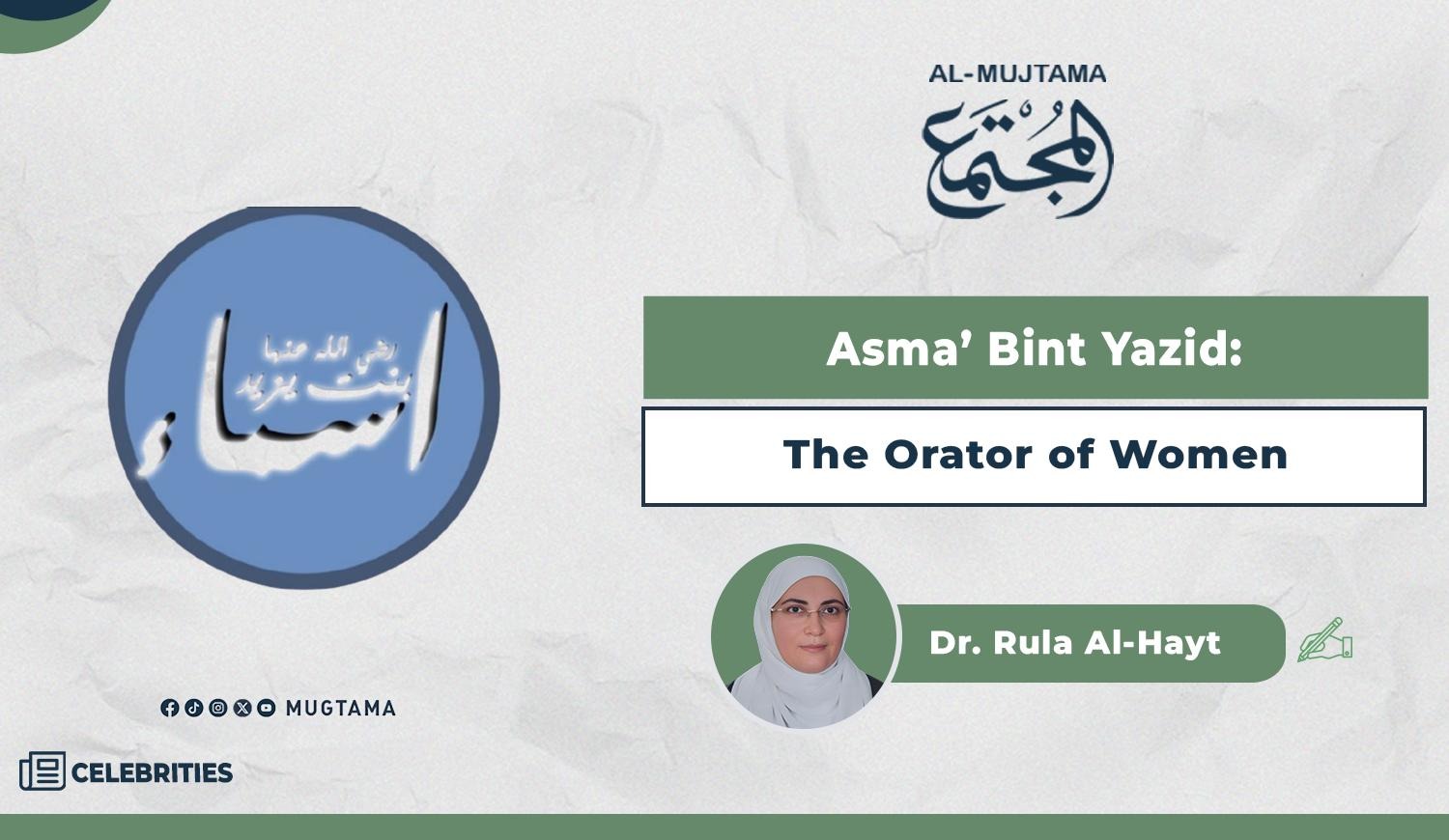
Asma’ Bint Yazid: The Orator of Women

She was renowned for her eloquence and
beautiful expression. The historian Ibn Al-Athir recounts in his book Asad Al-Ghabah:
Asma’ came to the Prophet (peace and blessings
be upon him) while he was among his Companions and said: “May my father and
mother be sacrificed for you, O Messenger of Allah! I have come as the
representative of women to you. Allah sent you to all men and women, and we
believed in you. We, the community of women, are confined to our homes, remain
within our households, fulfill your desires, and bear your children. Meanwhile,
you men have been given privileges over us through attending Friday and
congregational prayers, visiting the sick, attending funerals, performing
pilgrimage after pilgrimage, and, above all, striving in the cause of Allah.
When a man among you sets out for pilgrimage, a lesser pilgrimage, or to strive
in the cause of Allah, we look after your wealth, spin your garments, and raise
your children. Do we not, then, share in this reward and goodness?”
The Prophet
(peace and blessings be upon him) turned his entire face toward his Companions
and said: “Have you ever heard a woman ask a question about her religion better
than this one?” They replied: “O Messenger of Allah, we never thought a woman
could be guided to ask something like this.”
Then the
Prophet (peace and blessings be upon him) turned to her and said: “Understand
this, woman, and inform other women that a woman's good treatment of her
husband, her pursuit of his satisfaction, and her willingness to comply with
him are equal in reward to all of that.”
The woman then departed, proclaiming
Allah’s greatness and praising Him.
This distinguished female Companion
was Asma’ Bint Yazid Al-Ansariyyah, a unique model of Muslim womanhood. She
combined eloquence of expression, profound religious understanding, and the
courage of a warrior on the battlefield.
The Early Life of Asma’ Bint Yazid Al-Ansariyyah
She belonged to the Aws tribe of Al-Ansar
and was given the nickname Umm `Amir; some accounts say she was known as Umm
Salamah. She grew up in Madinah in a home where faith-based principles and
values prevailed. She pledged allegiance to the Prophet (peace and blessings be
upon him) at an early stage and was regarded as one of the most distinguished
and wisest women of Al-Ansar.
Asma’ embraced Islam at the hands of
Mus`ab Ibn `Umayr. Ibn Sa`d, the author of At-Tabaqat, reported from `Amr
Ibn Qatadah that the first women to pledge allegiance to the Prophet (peace and
blessings be upon him) were Kabshah Bint Rafi`, the mother of Sa`d Ibn Mu`adh; Asma’
Bint Yazid Ibn As-Sakan; and Hawwa’ Bint Yazid Ibn As-Sakan. Asma’ took pride
in being among the earliest to pledge allegiance, saying: “I was the first
woman to pledge allegiance to the Messenger of Allah.”
Her father was Yazid Ibn As-Sakan Al-Ansari,
who was martyred on the day of the Battle of Uhud. During that battle, Asma’
uncle, Ziyad Ibn As-Sakan, sustained severe wounds. The Messenger of Allah
(peace and blessings be upon him) said: “Bring
him closer to me.” He then placed
Ziyad’s head on his foot, and the man died a martyr with his cheek resting
against the Prophet’s foot.
Her brother, `Amir Ibn Yazid Ibn As-Sakan,
was also martyred in the same battle. He used his own body as a shield to
defend the Prophet (peace and blessings be upon him), thereby attaining martyrdom in the cause of Allah.
One remarkable example of Asma’ faith
and patience was that, when news of their martyrdom reached her, she went out
to make sure that the Messenger of Allah (peace and blessings be upon him) had
returned safely from Uhud. When she saw him unharmed, she said: “Every
calamity after you is insignificant.”
Why Asma’ Was Called the Orator of Women
Because of her eloquence, Asma’ Bint
Yazid al-Ansariyyah became known as “the Orator of Women.” Her second title was
“the Woman of the Waiting Period.” She earned this designation because she was
reportedly the first woman to observe the prescribed waiting period in Islam,
as the verse establishing the waiting period for divorced women was revealed
concerning her.
She is reported to have said: “I was divorced in the time of the Messenger of Allah (peace be upon
him). No waiting period was
prescribed for a divorced woman (at that time). When Asma’ was divorced, Allah,
the Exalted, sent down in Surah Al-Baqarah: {Divorced women must wait three
monthly cycles ˹before they can re-marry˺.} [Al-Baqarah 2:228]”
Asma’ prominent role was not limited
to public speaking and narrating hadiths. She also participated in military
campaigns. She narrated 81 hadiths and witnessed the Battles of the Trench and
Khaybar, as well as the Treaty of Hudaybiyyah. She also took part in the Battle
of Yarmouk.
She joined other women in providing
water to the wounded, tending to their injuries, and striking any enemy
soldiers she encountered. During the Battle of Yarmouk, it is reported that she
pulled out a tent pole and struck the heads of the Roman soldiers with it,
killing as many as nine of them.
Asma’ was known for her eloquence and
powerful expression. She further developed these qualities by learning as much
as she could from the Quran and the Prophetic hadiths. Consequently, she became
one of the women who narrated the greatest number of hadiths. A group of
prominent successors narrated hadiths from her, and the four major hadith
compilers—Abu Dawud, An-Nasa’i, At-Tirmidhi, and Ibn Majah—included narrations
from her in their collections. Al-Bukhari also included her narrations in Al-Adab
Al-Mufrad.
Asma’ Generosity and the Blessing in Her
Hospitality
Asma’ Bint Yazid Al-Ansariyyah was
generous and hospitable, a quality for which Al-Ansar were well known. Allah
had placed blessings in their food.
Ibn `Asakir recorded in his History,
with his chain of transmission, that Asma’ said: “I
saw the Messenger of Allah (peace and blessings be upon him) perform the sunset
prayer in our mosque. I then went home, brought him a roasted joint of meat and
some loaves of bread, and said: ‘May my father and mother be sacrificed for
you! Please have dinner.’
“He said to
his Companions: ‘Eat in the name of Allah.’ He ate, along with the Companions
who had accompanied him and whoever else was present in the house. By Him in
Whose Hand is my soul, I saw that the meat had not been stripped of its flesh
and most of the bread remained—that is, it remained through the blessing of the
Prophet (peace and blessings be upon him)—even though there were forty men
present.
“He then
drank from some water I had in a leather waterskin. After he left, I took that
waterskin and put it away. I would use it to give water to the sick and let
people drink from it from time to time, hoping to obtain its blessing.”
A Unique Role Model for Those Who Love
Knowledge
A great female Companion such as Asma’
Bint Yazid Al-Ansariyyah represents a model for everyone who loves their
religion and seeks knowledge. Perhaps
one of the most important lessons we can learn from her is her approach to
learning, asking questions, and engaging in dialogue.
When she approached the Prophet (peace
and blessings be upon him), she did so to ask him about the position of women
in comparison with men.
Asma’ did not approach the Prophet and
his Companions with an attitude of irritation, resentment, or complaint.
Rather, she came with love, refinement, and proper manners toward the Prophet
(peace and blessings be upon him). She understood the issue she wished to raise
and expressed women’s awareness of the nature of their role. This demonstrates
that women in the Muslim society of that time had agency and the freedom to
express their concerns. They were not an insignificant or marginalized group
whose voices were suppressed.
As the representative of women, Asma’
wanted the Prophet (peace and blessings be upon him) to make a clear statement
before an assembly of his Companions: that men and women are equal before the
law of Allah, according to the measure of justice, and that neither has
precedence over the other except through piety.
Allah, the Exalted, says, {But those who do good—whether male or female—and have
faith will enter Paradise and will never be wronged ˹even as much as˺ the speck on a date stone.} [An-Nisa’
4:124]
However, men and women differ in the nature
of their roles, as Allah says, {And the male is not
like the female.} [Ali `Imran 3:36]
They differ in their physical and
psychological constitution, their natural dispositions, their roles, and their
responsibilities. These differences in innate nature and physical and
psychological creation have resulted in differences in obligations and tasks.
This is a distinctive quality that
gives women their own particular role and shapes their path of devotion to
Allah. It does not imply inferiority or an inability to attain the status of
men. Women possess an innate capacity for kindness and mercy, because nurturing
life and raising human beings—as sons, fathers, and husbands—require a degree
of hardship and patience that women understand and appreciate deeply.
This hadith provides a profound
starting point for understanding the respective roles of men and women and how their responsibilities complement one
another.
Allah, the Exalted, entrusted women
with the responsibility of safeguarding and preserving the household, just as
He entrusted men with the duty of providing care and taking responsibility.
Both responsibilities are mentioned together in a single, uninterrupted verse: {Men are the caretakers of women, as men have been
provisioned by Allah over women and tasked with supporting them financially.
And righteous women are devoutly obedient and, when alone, protective of what
Allah has entrusted them with.} [An-Nisa’ 4:34]
There is no reason to fear for a
Muslim society in which women’s role as guardians and men’s responsibility as
caretakers complement one another. Participating in the duty of safeguarding
Allah’s religion, bearing its burdens, and supporting the building of society
is a shared responsibility between men and women.
Allah, the Exalted, says, {The believers, both men and women, are guardians of one
another. They encourage good and forbid evil, establish prayer and pay
alms-tax, and obey Allah and His Messenger. It is they who will be shown
Allah’s mercy. Surely Allah is Almighty, All-Wise.} [At-Tawbah 9:71]
May Allah be pleased with this
distinguished female Companion, Asma’ Bint Yazid Al-Ansariyyah, and may Allah
grant us the ability to follow her excellent example.
-------------------------------------------------------------
