








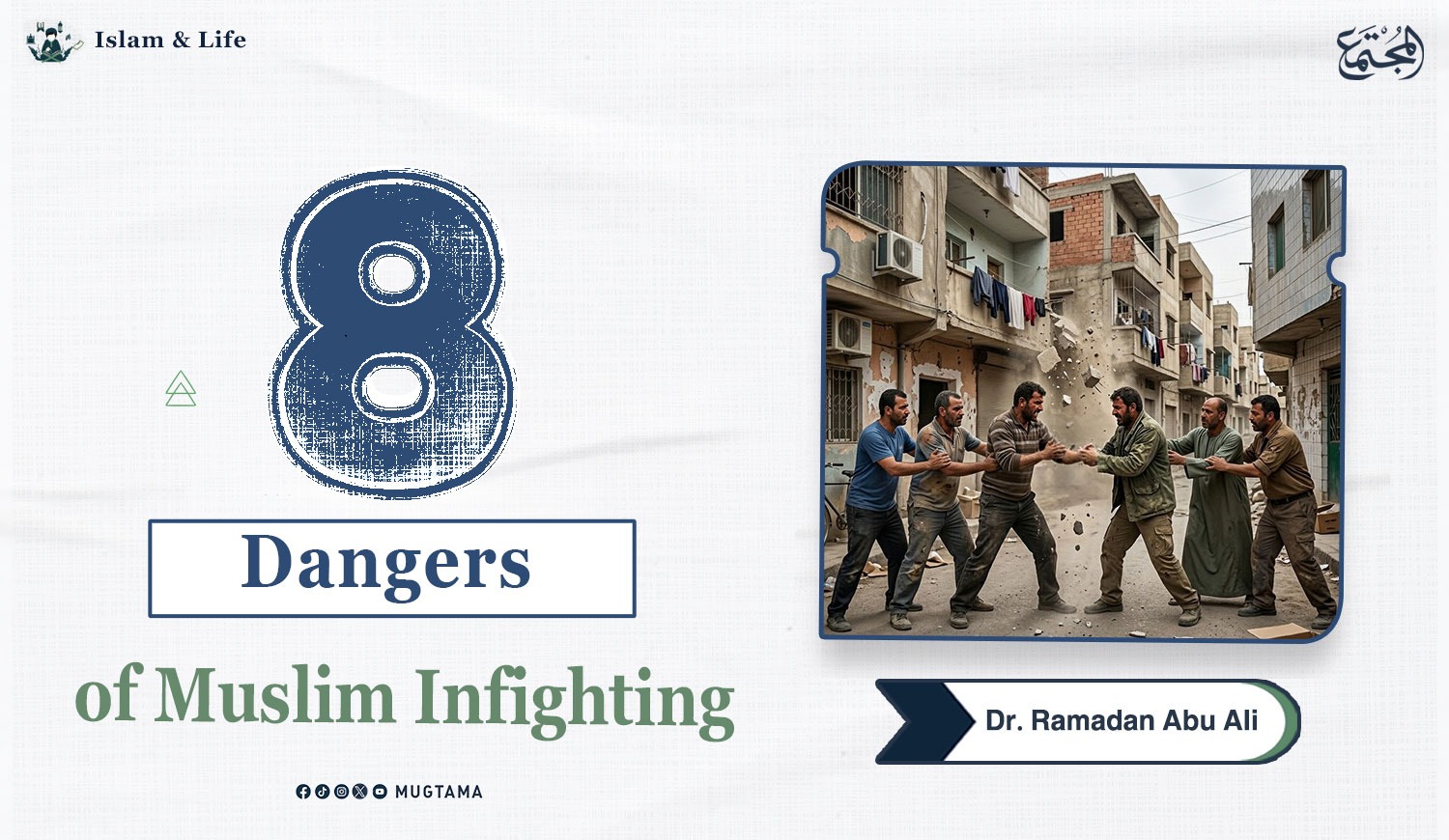
8 Dangers of Muslim Infighting
Allah Almighty said: (Obey God and His Messenger, and do not quarrel with
one another, or you may lose heart and your spirit may desert you. Be
steadfast: God is with the steadfast.) (Al-Anfal:46) This Quranic statement was revealed to highlight the dangers of conflict
among Muslims, emphasize the necessity of guarding against it, and urge the
sparing of no effort to overcome it.
Ibn
Manzur stated: "The root of naz' means pulling and uprooting, as in
the drawing out of a soul from the dying, or the drawing of a bow." (Lisan
al-Arab, 8/350)
Thus,
tanazu' (conflict) refers to disagreement and mutual pulling that leads
to dispute and strife.
As
for the meaning of the verse, Al-Maraghi said: "Let there be no division,
disagreement, or conflict among you, for that leads to failure, disappointment,
and the loss of strength, allowing your enemy to overpower you." (Tafsir
al-Maraghi, 10/10)
The Dangers of Conflict Among Muslims
The
dangers resulting from conflict among Muslims are numerous, and they include:
1- Failure and Defeatism:
Allah
Almighty said: "And do not dispute, lest you fail" (Al-Anfal:
46).
Ibn
Kathir stated: "Allah Almighty commanded them to stand firm when facing
their enemies, and forbade them from disputing among themselves, so that they
would not fall into disagreement, which would lead to their demoralization and
failure." (Tafsir Ibn Kathir, 4/72)
The
Quran has warned people against dispute and infighting among themselves, as
Allah Almighty said: (God fulfilled His
promise to you: you were routing them, with His permission, but then you
faltered, disputed the order, and disobeyed, once He had brought you within
sight of your goal- some of you desire the gains of this world and others
desire the world to come- and then He prevented you from [defeating] them as a
punishment. He has now forgiven you: God is most gracious to the believers.) ( Ali 'Imran:152), ([Prophet],
remember when God made you see them in your sleep as few: if He had shown them
to you [believers] as many, you would certainly have lost heart and argued
about it, but God saved you. He knows the secrets of the heart.) (Al-Anfal:43)
2- Loss of Strength and Unity:
Allah
Almighty said: "And do not dispute, lest you fail and your momentum
fades" (Al-Anfal: 46).
The
fading of momentum signifies the loss of strength and unity. (Tafsir
al-Qasimi, 5/305)
Al-Sa'di
said: "And do not dispute" — a dispute that causes hearts to
scatter and divide; "lest you fail" — meaning you become
cowardly; "and your momentum fades" — meaning your resolve
weakens and your power disperses." (Tafsir al-Sa'di, p. 323)
3- The Loss of Victory:
Mujahid
explained the meaning of Allah's words: "and your momentum fades"
as: your victory. Indeed, the momentum of the companions of Muhammad (PBUH)
faded when they disputed with him on the Day of Uhud.
Ibn
Zayd said: "The wind signifies victory. No victory was ever achieved
except through a wind sent by Allah that would strike the faces of the enemy,
and when that ceased, they had no strength to stand." (Al-Durr
al-Manthur by al-Suyuti, 4/76)
4- Empowering the Enemies:
Conflict
among Muslims leads to the empowerment of their enemies over them and their
domination. The failure mentioned in the verse may refer to: weakness and
cowardice in facing the enemy, and the collapse of the state through enemy
seizure. (Al-Bahr al-Muhit fi al-Tafsir, 5/332)
Division
and dispute are the primary causes of the enslavement of Muslims and the loss
of their lands. The fall of Andalusia and the enemy's seizure of it is not a
distant example to recall.
5- The Drain of Resources and Energies:
This
is among the most dangerous consequences of conflict among Muslims, where
capabilities that should have been directed toward construction and development
are turned into tools of destruction and strife. The nation thus loses both its
present and future simultaneously, as development rates decline and the
competitive capacity of the Muslim nation weakens due to the destruction of
vital infrastructure, the halting of economic projects, and the squandering of
human energies.
6- The Unlawful Shedding of Blood:
Allah
Almighty has forbidden the taking of life without just cause, as He said: (Do not take life, which God has made
sacred,) (Al-Isra:33)
Al-Nasa'i
reported in his Sunan on the authority of Abdullah ibn Amr, from the Prophet
(PBUH), who said: "The
destruction of the entire world is less significant to Allah than the killing
of a single Muslim man.
7- The Spread of Fear and Terror:
When
conflict and fighting break out among Muslims, the harm is not confined to the
battlefield alone, but spreads across every aspect of life. The fire of war
does not only burn those engaged in it, but extends to all. It is a tribulation
that does not afflict only the wrongdoers, but disrupts life entirely and
denies stability to the general population. Every person fears for himself and
his family, people avoid going out to work, and they live in constant
anticipation of danger. Thus, people transition from a state of tranquility to
one of fear and terror.
8- Deserving Punishment in the Hereafter
Conflict most often leads to killing,
which is the gravest of its consequences, as Allah Almighty said: (If anyone kills a believer deliberately, the
punishment for him is Hell, and there he will remain: God is angry with him,
and rejects him, and has prepared a tremendous torment for him.) (An-Nisa:93)
Al-Bukhari
and Muslim reported in their Sahihs, on the authority of Al-Ahnaf ibn Qays, who
said: "I set out intending to support this man, when Abu Bakra (may Allah
be pleased with him) met me and said: 'Where are you headed, O Ahnaf?' I said:
'I intend to support the cousin of the Messenger of Allah (PBUH)' — meaning Ali
ibn Abi Talib (may Allah be pleased with him). He said to me: 'O Ahnaf, turn
back, for I heard the Messenger of Allah (PBUH) say: "When two Muslims
face each other with their swords, both the killer and the killed are in the
Fire."' I said — or it was said: 'O Messenger of Allah, this is the
killer, but what of the killed?' He said: 'He had intended to kill his
companion.
You may also like:
10 Facts Exposing the Falsity of the "Military Bases Pretext" in Iranian Rhetoric
5 Motives for the Outbreak of Wars in the World
------------------------------------------------------------------