









5 Ethics of Muslim Teachers in Girls’ Schools
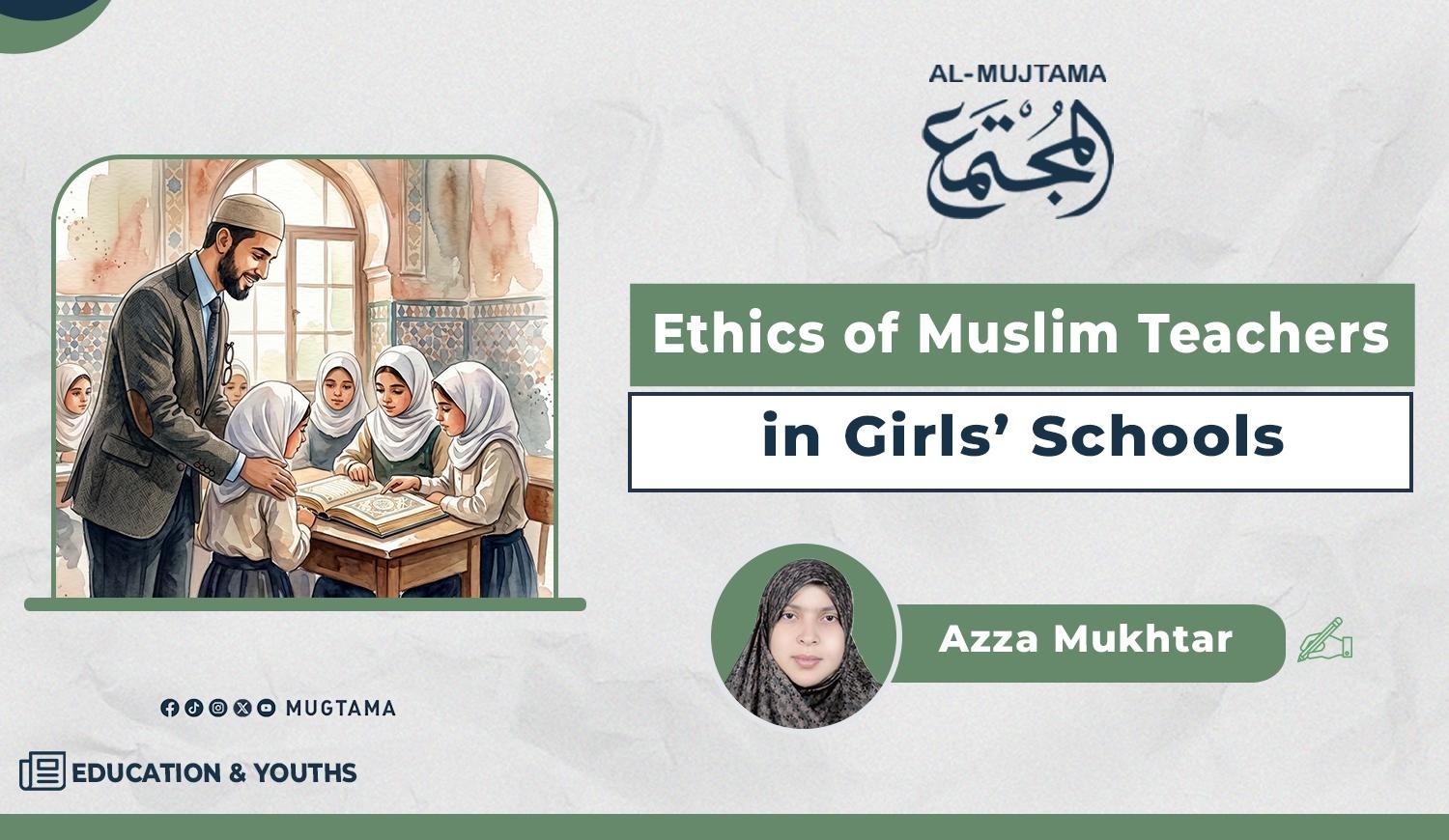
As the new
school year begins, the teacher’s role becomes especially important. Beyond
guiding the educational process, teachers can have a profound influence on
their students through their conduct, presence, and personal example.
This
responsibility becomes particularly significant when teaching adolescent girls,
a stage marked by major physical, psychological, social, and intellectual
changes. Teachers therefore need a strong sense of responsibility, discipline,
and awareness of how every word, action, and even glance directed toward a
student may affect her.
1.
Lowering the Gaze and Avoiding Undue Attention
Lowering the
gaze is an obligation that Allah has prescribed for believing men and women.
The Quran also warns against paths that may lead to immorality: {˹O Prophet!˺ Tell the believing men to lower their
gaze and guard their chastity. That is purer for them. Surely Allah is
All-Aware of what they do.} [An-Nur 24:30]
An intentional,
lustful gaze is sinful, particularly when it comes from a teacher toward a
student, or from a student toward a teacher. A teacher is responsible not only
for educating students but also for setting an example of Islamic character.
Lowering the
gaze does not mean that a teacher should enter the classroom looking stern or
uncomfortable, or allow disorder among the students by refusing to supervise or
correct inappropriate behavior. Rather, it means avoiding prolonged or
inappropriate attention to a student's face, appearance, or physical features
in a way that could make her feel singled out.
A seemingly
innocent glance, smile, or kind word can sometimes be interpreted differently
by an adolescent who is particularly sensitive to the attention of others. This
is why teachers should maintain clear and professional boundaries in their
interactions with students.
Ibn Al-Qayyim
wrote: “Know, may Allah guide you, that if you comply with the command to lower
your gaze after the first glance, you will be safe from countless afflictions.
But if you repeat the glance, you cannot be sure that it will not plant
something in your heart that will be difficult to uproot. If that has already
happened, the remedy is to restrain yourself by lowering your gaze thereafter.”
[1]
2.
Being a Good Role Model
A teacher can
have a profound influence on a student's character, particularly because
teachers spend many hours with young people during formative years. Every
interaction therefore requires awareness and care so that the teacher does not
unintentionally leave a harmful impression.
Likewise, every
piece of advice given to students should first be reflected in the teacher's
own conduct. Allah says: {O believers! Why do
you say what you do not do? How despicable it is in the sight of Allah that you
say what you do not do!} [As-Saff
61:2-3]
The Prophet
Muhammad was an example for Muslims in both his words and his conduct. When
Aisha was asked about his character, she said: “His character was the Quran.” (Muslim)
[2]
If a teacher
notices inappropriate behavior or harmful habits among students, they should
address them with wisdom and professionalism while ensuring that their own
response does not become verbally abusive, humiliating, or degrading toward any
student.
3.
Avoiding Seclusion, Even in the Name of Education
Private
tutoring has long been common in many societies. Yet Islamic teachings
establish clear boundaries between men and women who are not close relatives.
The Prophet
Muhammad said: “No person (man) should be alone with a woman except when there is a
Mahram with her.” (Bukhari and Muslim) He also said: “Whenever a man
is alone with a woman the devil makes a third.” (At-Tirmidhi)
Both narrations
are reported in the major hadith collections, with the first being agreed upon
by Al Bukhari and Muslim.
Seclusion
refers to a situation in which a man and a woman who are not close relatives
are alone together in a private or enclosed setting where there is a legitimate
concern about suspicion, impropriety, or circumstances that could lead to
immoral conduct. [3]
The emphasis
placed on avoiding such situations reflects the importance of preventing
circumstances that could give rise to suspicion or wrongdoing. This is
particularly relevant when dealing with adolescents, who are still developing
judgment and life experience and may experience strong emotions, imagination,
and attraction.
Accordingly,
teachers should exercise particular caution when dealing privately with younger
students and ensure that educational interactions take place in transparent and
appropriate settings. Such boundaries protect both the student and the teacher
and prevent situations that could lead to misunderstanding or misconduct.
4.
Understanding Adolescence
Adolescence is
a sensitive stage of development during which girls experience simultaneous
physical, emotional, social, and intellectual changes. Their awareness of
themselves increases, as does their sensitivity to how others perceive them. At
the same time, they often develop a stronger desire for independence and self
expression.
Teachers
therefore need to approach adolescents with understanding and flexibility. Not
every disagreement or emotional reaction should be interpreted as a sign of bad
character, nor should mistakes be addressed through humiliation or contempt.
A teacher must
distinguish between behavior that requires firm boundaries, emotions that
require understanding, and mistakes that require guidance.
This balance
allows discipline to coexist with compassion and ensures that correction
contributes to the student's development rather than damaging her dignity or
confidence.
5.
Kindness in Educational and Disciplinary Relationships
One of the
qualities adolescents need most during this stage is kindness, whether they are
being taught academic knowledge, values, or principles.
The Prophet
Muhammad established a broad principle for dealing with people: “Show
gentleness, for if gentleness is found in anything, it beautifies it and when
it is taken out from anything it damages it.” (Muslim) [4]
A teacher's
authority and dignity do not depend on shouting, physical punishment,
humiliation, or intimidation.
The Prophet's
interactions with young people provide important examples of compassionate
education. Muadh ibn Jabal reported that the Prophet once said to him: “O Mu'adh! By
Allah I love you, so I advise you to never forget to recite after every prayer:
"Allahumma a'inni ala dhikrika, wa shukrika, wa husni 'ibadatika (O Allah,
help me remember You, to be grateful to You, and to worship You in an excellent
manner).” (Ahmad)
The Prophet
began by expressing his affection for Muadh before giving him his advice. By
establishing trust and affection first, he created an environment in which the
young man could receive and benefit from the guidance that followed.
This is an
important model for teachers and educators: effective education is not limited
to transferring knowledge. It also involves building trust, protecting dignity,
understanding the student's stage of development, and guiding young people with
wisdom and compassion.
-------------------------------------------------------------