







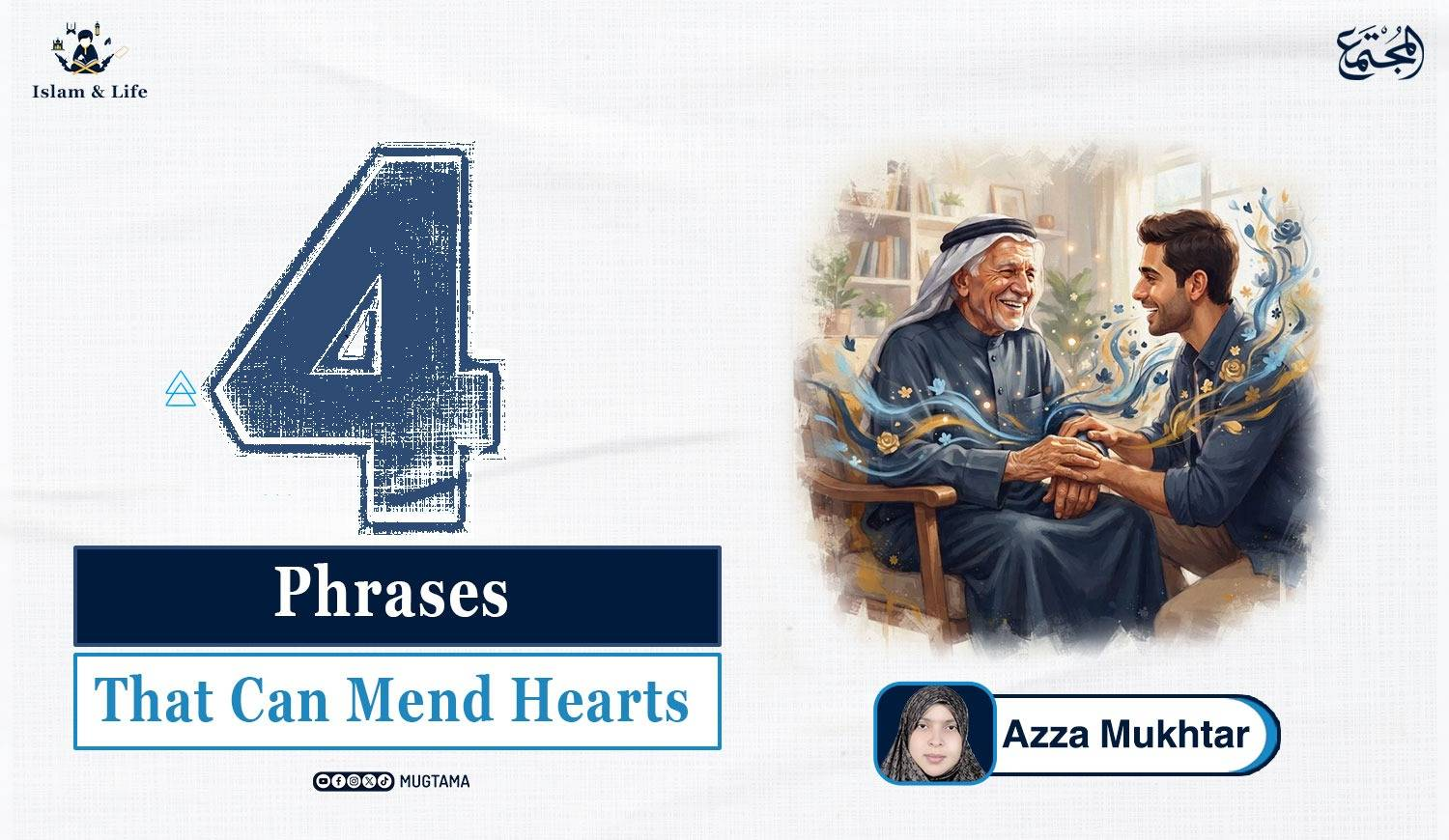
4 Phrases That Can Mend Hearts
Are you
worried about what will happen to your children after you are gone, especially
in an age of digital coldness, and have you failed to leave them any financial
provisions? Then be mindful of Allah and speak with words that are right and
just: {Let the guardians be as concerned ˹for the orphans˺ as they would if they were to ˹die and˺ leave ˹their
own˺ helpless children behind. So let them be mindful of Allah and speak
equitably.} [An-Nisa’ 4:9]
Are you
afraid that Satan may sow discord between you and your brethren? Then speak in
the best possible manner: {Tell My ˹believing˺ servants to say only what is best.
Satan certainly seeks to sow discord among them. Satan is indeed a sworn enemy
to humankind.} [Al-Isra’ 17:53]
And do
you wish to be among the servants of the Most Merciful, whose qualities Allah
has described in His Book? Then respond to the ignorant with words of peace: {The ˹true˺ servants of the Most Compassionate are
those who walk on the earth humbly, and when the foolish address them ˹improperly˺, they only respond with peace.}
[Al-Furqan 25:63]
The Quran
and the Revival of Broken Hearts
Three
Quranic insights reveal the importance of words in reviving broken hearts.
Words are a trust, a means of repairing relationships, and a sign of refined
character. How beautiful their impact can be when they come at the right
moment! And how profound their effect can be when they reach a heart exhausted
by neglect and emotional coldness!
So, what
words can revive broken hearts in an age of digital coldness? And what words
might leave wounds that cannot be healed in a short time?
1. “I See You”: When Someone
Needs to Know They Have Not Been Forgotten
Not
everyone needs praise or compliments. Sometimes, a sincere word of appreciation
is enough to make someone feel that their efforts have been noticed and that
their presence is not insignificant.
Islam has
taught us to recognize the value of every good deed, no matter how small. The
Prophet (peace and blessings be upon him) said: “Don’t
consider anything insignificant out of good things even if it is that you meet
your brother with a cheerful countenance.” (Narrated by Muslim)
When the
Prophet (peace and blessings be upon him) heard Abu Musa Al-Ash`ari reciting
the Quran, he said to him: “You are in fact
endowed with a sweet voice like that of David himself.” (Narrated by
Al-Bukhari and Muslim)
This was
a clear expression of appreciation for a talent worthy of recognition.
2. “You Can Do It”: Helping Someone Regain Their
Confidence
A person
who has stumbled may not need someone to list their mistakes as much as they
need someone to restore their confidence in their ability to overcome them. The
words “Try again” may give them the motivation to keep going, while a
discouraging remark may push them towards giving up.
When some
of the Companions objected to the appointment of Usama Ibn Zaid as a commander,
the Prophet (peace and blessings be upon him) defended him, saying: “You object to the command of Usama Ibn Zaid as you had
objected before to the command of his father (Zaid). By Allah, he was most
competent for it.” (Narrated by
Al-Bukhari and Muslim)
This was
not merely an act of encouragement. It was an affirmation of Usama’s competence
and a fair defense of him before those who had questioned his abilities. This
is what meaningful encouragement looks like: confidence grounded in knowledge,
not flattery that conceals the truth.
3. “I Am Here for You”: Never Leaving Someone in
Pain Alone
You are
not required to solve other people’s problems. However, being unable to offer a
solution does not prevent you from offering comfort. Someone who has lost a loved
one, is facing an illness, or has gone through a painful experience may not be
waiting for advice or an explanation of what happened. They may simply need
someone to make them feel that they are not alone.
The
Prophet (peace and blessings be upon him) comforted Jabir Ibn Abdullah when his
father was martyred at the Battle of Uhud, telling him that “The Angels provide him shade with the help of their
Wings until he would be lifted (to his heavenly abode).” (Narrated by Al-Bukhari and Muslim)
4. “Why Are You Like This?”: When Words Turn into
Judgments
On the
other hand, comments on social media can become a means of causing harm. Some
people move from discussing ideas to mocking those who express them, or take
someone’s words out of context and publish them with the intention of publicly
shaming them.
The Quran
explicitly forbids this behavior: {O believers! Do
not let some ˹men˺ ridicule others, they may be better
than them.} [Al-Hujurat 49:11]
The
Prophet (peace and blessings be upon him) also said: “A Muslim is the one who avoids harming Muslims with his tongue or his
hands.” (Narrated by Al-Bukhari and Muslim)
We have
the right to disagree and correct mistakes, but without insulting or
humiliating others. A person is greater than a single mistaken idea they may
have expressed, and a hurtful word may discourage them from pursuing a worthy
goal or leave an impact on their heart that is difficult to erase.
In an age
when virtual communication continues to expand, the isolation experienced by
many people is deepening. A person may endure pain and setbacks far away from
even those closest to them, hiding behind a sad post that no one notices, or
sharing an achievement only to receive a passing “like.” Over time, being
ignored may turn into a feeling of exclusion, causing them to withdraw and stop
sharing the details of their lives with others.
Yet a sincere
word can dispel a feeling of loneliness, restore lost confidence, or mend a
broken heart.
-------------------------------------------------------------
