









Rethinking Marriage and Partnership
Working Women and Household Responsibilities
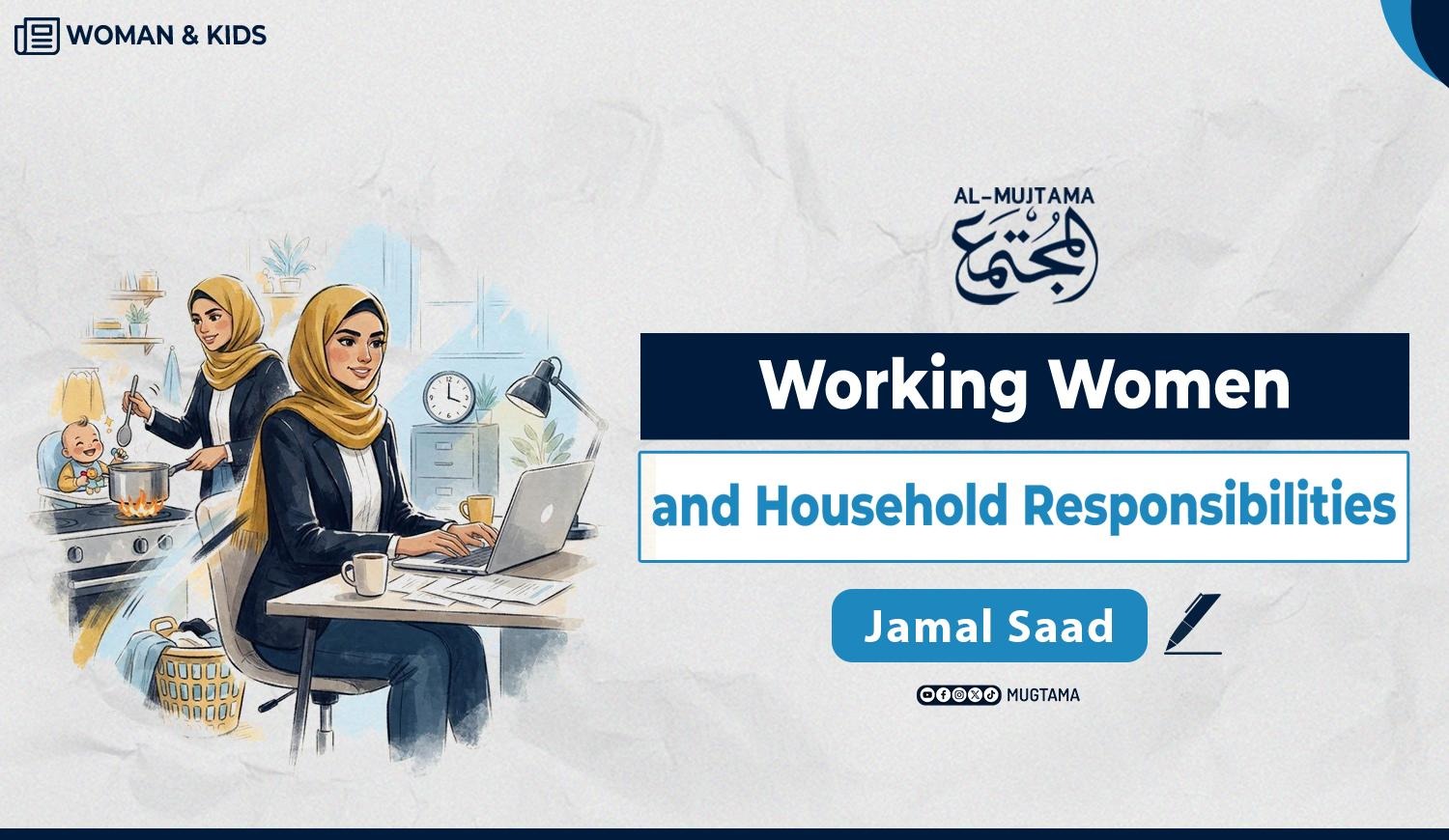
A working woman’s
responsibilities do not end when she leaves the workplace. In many homes,
another working day begins as soon as she returns, with tasks ranging from
caring for children and attending to their needs to managing household affairs,
alongside other responsibilities that extend well beyond official working
hours.
As women’s
participation in the labor market continues to expand and grow, a question
emerges that goes beyond employment opportunities and career advancement to the
nature of partnership within the family: Are household responsibilities changing at the same pace as the realities of working
life?
This
question takes on particular significance in light of figures announced by Fahd
Bin Abdullah Al-Faraj, Chairman of the Board of Directors of the Asharqia
Chamber in Saudi Arabia, during the Women’s Economic Forum on November 4, 2026.
According to a statement by the Chamber, he noted that approximately 1.7
million Saudi women are registered in the labor market, including more than 1.1
million working in the private sector.
These
figures reveal the growing presence of women in the labor market and economic
activity. However, they do not, on their own, provide a complete picture of how
this transformation affects family life. The announcement does not specify how
many of these working women are married or mothers, and their circumstances
vary in terms of the nature of their jobs, working hours, income, and the
support networks available to them.
Al-Faraj
also noted that women’s representation in senior and middle management
positions had reached 43.9%. While these indicators reflect progress in
professional participation, they also raise questions about what is happening
inside homes. Is partnership in caregiving and the distribution of
responsibilities evolving alongside women’s professional roles, or do household
burdens remain governed by traditional expectations?
Marriage and Shared Family Responsibilities
Partnership
within the family is not simply about the number of tasks each spouse performs.
It also extends to taking responsibility for thinking about those tasks,
planning them, and following through on them. For example, taking a child to
the doctor does not begin when the family leaves home. It involves noticing the
symptoms, booking an appointment, arranging time away from work, preparing the
child’s medical records, and then following up on the doctor’s instructions
after returning home.
One
spouse may take the child to the appointment and carry out the task, while the
other has already taken sole responsibility for remembering it, planning it,
and arranging all its details. This is not necessarily a matter of dividing the
execution of tasks, but of sharing responsibility for them.
This
aspect of family responsibilities was examined in a study led by researchers
from the University of Southern California, published online on July 1, 2024,
in the journal Archives of Women’s Mental Health. The study included 322
mothers of young children and asked them about the planning and execution
involved in 30 household tasks.
Participants
estimated that they were responsible for approximately 73% of the mental work
associated with managing these tasks, compared with around 64% of their
practical execution. A higher share of planning responsibilities among mothers
was also associated with higher indicators of stress, exhaustion, and
depressive symptoms, as well as lower marital relationship quality. These are
statistical associations and do not establish a causal relationship.
Although
the study relied solely on mothers’ self-reports and included a sample in which
participants generally had higher levels of education and income, its findings
should not be generalized to Saudi families. Nevertheless, the distinction it
draws between managing a task and carrying it out adds an important dimension
to discussions about family partnership. Specifically, who takes responsibility
for remembering, planning, coordinating, and following up?
Family Balance and Clear Agreements Between
Spouses
Speaking
about family balance in the Gulf region in light of women’s growing
participation in the labor market, Emirati expert Dr. Khalifa Al-Muharzi, Vice
President of the Arab Family Organization and Chairman of the Family Advisory
Council, stressed that mothers need personal time to rest and recharge.
In an
interview on the programme Sabah Jadid on Al-Qahera News, on November 8,
2026, he explained that this could be achieved at home, with the father taking
responsibility for caring for the children and managing their affairs while the
mother rests.
Al-Muharzi
linked this arrangement to mutual understanding and cooperation between
spouses, as well as the mother’s need to pursue personal interests,
friendships, and hobbies. He noted that putting this idea into practice could
involve turning it into a specific agreement addressing questions such as: Who
follows up with the school? Who arranges the doctor’s appointment? And what
alternative arrangements can be made when appointments conflict with working
hours?
Assigning
full responsibility, including planning and follow-up, allows the other spouse
to enjoy genuine rest. However, if that spouse must remain available by phone
to provide instructions on every detail, their supposed time off simply becomes
an extension of household management from a distance.
According
to the Emirati expert, such an agreement does not require dividing every task
equally or disregarding differences in working hours, health, and individual
capacity. A couple may choose an unequal distribution of responsibilities and
still consider it fair, provided that the arrangement is clear and open to
review, and that one spouse’s satisfaction is not simply assumed from their silence.
Practical Support for Working Mothers
In Saudi
Arabia, some programmes offer practical support to working mothers. One example
is the Qurrah programme, provided by the Human Resources Development Fund,
which covers—according to its official service page—up to 50% of childcare
costs, with a maximum of 1,600 Saudi riyals per child up to the age of six.
The
programme targets Saudi mothers working in the private sector, subject to its
published eligibility requirements. Therefore, becoming familiar with the
eligibility criteria and approved childcare centers can help families benefit
from this support when arranging the mother’s return to work or her transition
to a new job.
However,
securing a place at a childcare center does not, by itself, resolve the
challenges of daily caregiving. Much also depends on how close the center is to
the home or workplace, whether its opening hours suit the mother’s schedule and
commuting time, and whether an alternative arrangement is available if the
child becomes ill or the center closes.
Childcare
is not limited to the cost of a place at a center. It also involves
transportation, follow-up, and dealing with emergencies—all responsibilities
that require a clear distribution among family members.
Eng.
Manal Al-Bawardi, Chairwoman of the Businesswomen’s Council at the Asharqia
Chamber, points out that the next phase calls for maximizing the economic
impact of women’s participation, supporting women-owned businesses, and
improving their access to markets and sources of financing, according to a
statement by the Chamber.
This
ambition raises a question no less important than employment and financing
opportunities: How can the necessary conditions be created to ensure women’s
advancement in the labor market and the continuity of their careers without
turning caregiving responsibilities into an obstacle? The success of economic
empowerment should not be measured solely by women’s opportunities to enter the
labor market, but also by their ability to remain in it and advance, supported
by family and social arrangements.
Genuine
partnership begins at home, when spouses agree on how to distribute caregiving
responsibilities and manage family affairs. This includes planning appointments
and meeting daily needs, rather than simply carrying out the visible tasks.
Such
agreements also need to be reviewed whenever working conditions or children’s
needs change, while making use of available childcare services and flexible
working arrangements whenever possible.
The
challenge is no longer simply about women’s advancement in the labor market or
their ability to balance work and family life on their own. It is about the
ability of families, employers, and childcare services to build a supportive
system in which professional advancement becomes a shared responsibility, with
roles that complement one another, rather than an additional burden that women
must carry alone.
