









Why Gen Z No Longer Sees Motherhood as a Dream?
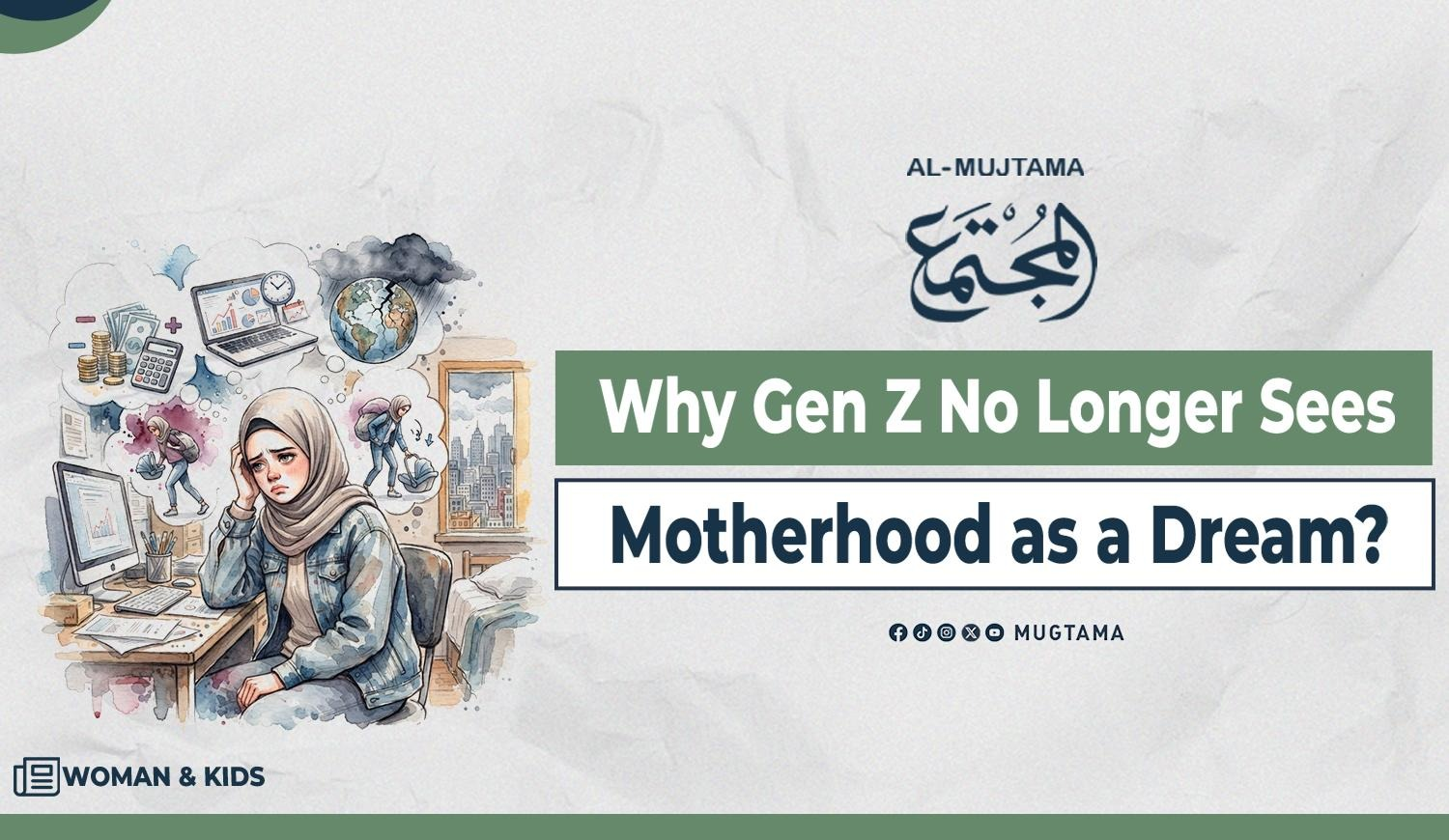
For generations, motherhood was
widely regarded as one of life’s natural aspirations. Today, that assumption no
longer holds—especially among Gen Z.
Across much of the Western world, an increasing number of
young women are postponing motherhood indefinitely or deciding not to have
children at all. This shift is often described as liberation, but it also
raises a deeper question: What changed?
The answer is more complex than a simple rejection of family
life. It reflects a generation shaped by economic uncertainty, cultural
transformation, and changing definitions of success.
A Generation Redefining Life Goals
Recent demographic data reveal a striking change in how young
adults imagine their future.
A 2025 analysis by the Pew Research Center found that Americans in their
twenties and thirties now expect to have an average of 1.8 children, down from
2.3 children in 2012. The decline is not merely in birth rates but in the
number of children young adults actually intend to have.
At the same time, fertility across much of the developed world
has fallen below replacement level. Although the United States recorded a slight increase in births during 2024, the
long-term trend remains one of historically low fertility, with births
increasingly concentrated among women having children later in life rather than
among younger adults.
These figures point to something deeper than economics alone.
They suggest that parenthood itself
is becoming a lower priority.
When Motherhood Is Seen as a Cost
For many young women, motherhood is increasingly framed in
terms of sacrifice rather than fulfillment.
Housing costs, student debt, expensive childcare, and
uncertain career prospects all contribute to the hesitation. But financial
concerns tell only part of the story.
Modern culture often presents motherhood as an
obstacle to personal freedom, professional success, and self-discovery. Social
media reinforces images of independence, travel, entrepreneurship, and
uninterrupted personal growth, while the realities—and rewards—of raising
children receive far less attention.
It is therefore unsurprising that many young women begin to
view motherhood not as a dream to pursue but as a dream to postpone.
The Loss of a Larger Purpose
Economic pressures matter, yet they cannot fully explain why
societies that enjoy unprecedented prosperity often experience the lowest birth rates.
Perhaps the deeper issue is cultural. When personal
fulfillment becomes life’s highest goal, every long-term commitment begins to
look restrictive. Marriage requires sacrifice, and parenthood demands service.
Both ask people to build something larger than themselves.
Yet the dominant message of contemporary culture encourages
individuals to ask not, “Whom can I nurture?” but, “How can I maximize my own
happiness?”
The result is not necessarily greater satisfaction. Many
surveys show rising levels of loneliness, anxiety, and uncertainty among young
adults despite unprecedented personal freedom. The pursuit of autonomy, by
itself, has not guaranteed lasting fulfillment.
Motherhood as a Sacred Trust
Islam approaches motherhood from a
fundamentally different vision. Rather than treating children as lifestyle
accessories or personal achievements, it views them as a trust entrusted by Allah.
Parenthood is therefore not merely a private choice with private consequences;
it is part of the moral responsibility of building healthy families and,
through them, healthy societies.
This is why the Quran repeatedly speaks of children as a
blessing, while the Prophet Muhammad (peace be upon him) elevated the status of
mothers in a way that was remarkable for seventh-century Arabia. When asked who
deserved the greatest companionship, he answered, “Your
mother” and repeated it three
times before mentioning the father.
It was also narrated from Mu`awiyah Bin Jahimah As-Sulami,
that Jahimah came to the Prophet (peace be upon him) and said: “O
Messenger of Allah! I want to go out and fight (in Jihad) and I have come to
ask your advice.” He said: “Do you have a mother?” He said: “Yes.” He said:
“Then stay with her, for Paradise is beneath her feet.”
Yet Islam’s appreciation of motherhood is not based simply on
sentiment. It recognizes what modern psychology increasingly confirms: mothers
shape the emotional, moral, and spiritual foundations of the next generation. The countless unseen hours spent nurturing,
teaching, comforting, and guiding a child are not viewed as interruptions to a
meaningful life—they are themselves among life’s most meaningful achievements.
Therefore, Islam does not measure a woman’s success only by
her career, income, or public recognition. Nor does it insist that every woman’s
contribution must look the same. Rather, it refuses to accept the modern
assumption that caregiving is somehow a lesser calling than professional
accomplishment. A civilization depends just as much on those who raise people
of character as on those who build economies, lead companies, or advance
scientific discovery.
In an age that often celebrates autonomy above all else, Islam reminds us that some of life’s deepest fulfillment is found not in living only for oneself, but in investing in people whose influence will outlive us.
Recovering the Value of Family
Gen Z has inherited genuine challenges that deserve compassion
rather than criticism. Financial insecurity, housing shortages, and work-life
pressures are real.
Yet solving these problems alone may not reverse the decline
in family formation.
Societies also need to recover a vision in which family is not
the end of personal freedom but one of its richest expressions. When motherhood
is viewed merely as a burden, fewer will choose it. But when it is recognized
as a source of meaning, legacy, and human flourishing, it becomes something
worth aspiring to once again.
