









A Reading on Role Models, Fame Standards, Value, and Social Responsibility
When Role Models Fall
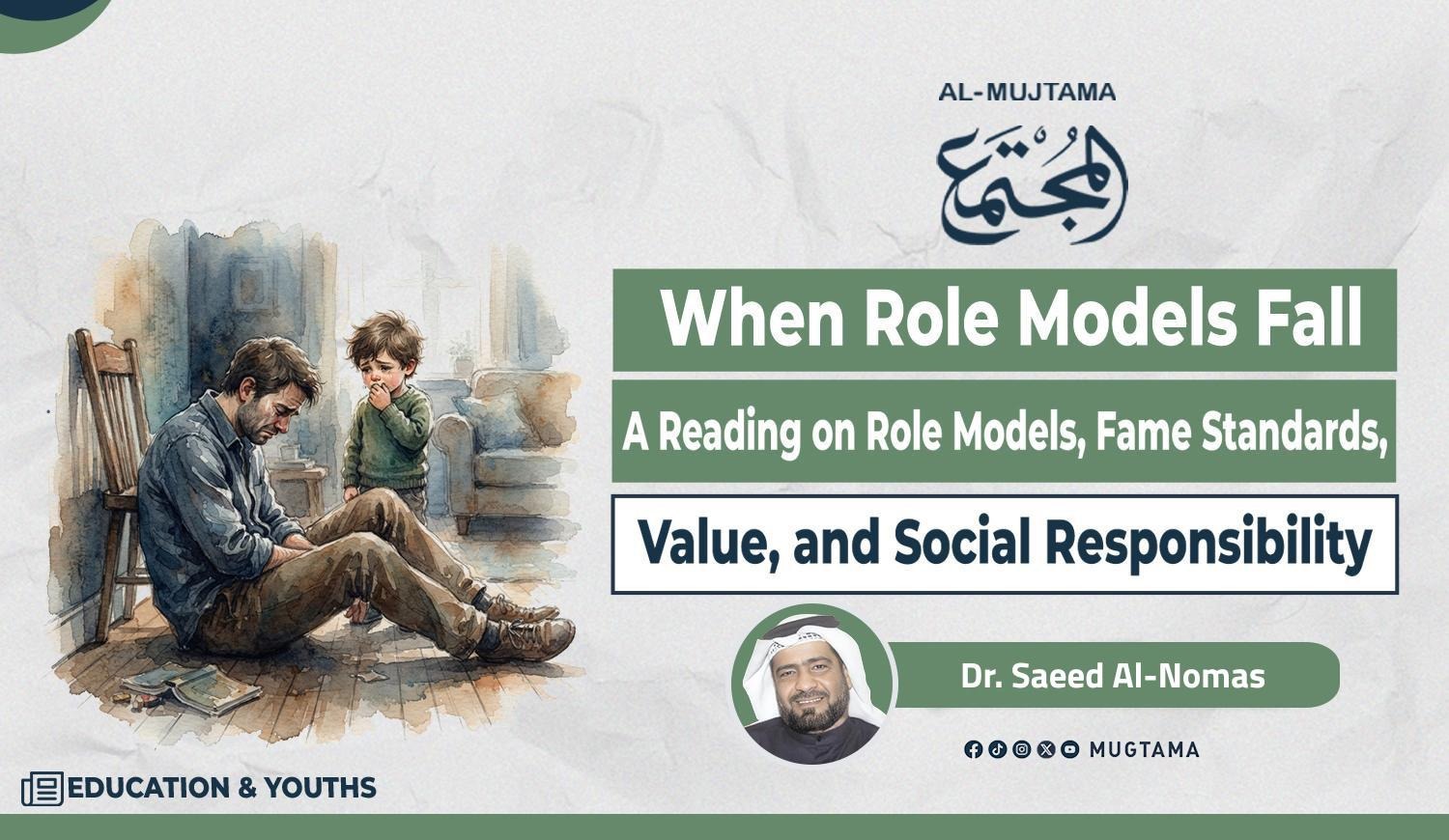
Role models do not fall suddenly, nor does their public image collapse due to a single incident or a passing campaign. Rather, the fall often begins in a silent internal moment: when a person stops engaging in self-reflection, their sense of responsibility weakens, and they become convinced that their history, status, or popularity grants them permanent immunity from error and accountability.
A role model, regardless of their
stature, remains a human being susceptible to mistakes, weakness, and the
influence of self-interest and compliments. However, the difference between a
genuine role model and others does not lie in claiming infallibility, but in
the ability to admit error, step back from it, and correct it before it turns
into a repeated approach or destructive behavior.
Fall Begins When Self-Reflection Stops
The most dangerous threat to
individuals of social, intellectual, religious, and political standing is not
external criticism, but the absence of internal criticism. When a person
surrounds themselves with those who always agree with them, distances themselves
from those who offer sincere advice, and views every observation as an insult
and every act of accountability as targeting, they gradually lose the ability
to see themselves as they truly are.
Over time, status may transform from
an ethical responsibility into a sense of entitlement, and the respect granted
by society to the role model turns into a belief that they are above the
standards they demand of others. Here, the contradiction appears between
rhetoric and practice, and between the public image and real behavior; thus, trust begins to erode even before the individual realizes the scale of what they
have lost.
The External World Does Not Always Create Weakness, but It Excels at Exploiting It
It is easy to explain the fall of public
figures through conspiracy theories or external pressures; however, this
explanation—despite its potential truth in some cases—is not alone sufficient
to understand the phenomenon.
Media campaigns, political rivalries,
and competing institutions may exaggerate mistakes, exploit slips, and reframe
them in a manner that drains reputation and sways public opinion. Yet, they
generally cannot create a complete collapse out of nothing unless they find
real weakness, an existing contradiction, or a repeated error upon which to
build.
Nevertheless, one should not go to the
opposite extreme and consider every fall a purely individual responsibility.
Upright figures may be subjected to organized defamation campaigns, deliberate
distortion of their positions, or targeting due to their steadfastness on
principles. Therefore, a fair judgment requires distinguishing between objective criticism and defamation, and between legitimate accountability and
attempts at exclusion.
When Fame Becomes a Substitute for Value
The crisis of role models grows more
complex in the digital media era, where competence, integrity, or depth of
experience are no longer the sole path to influence. The ability to provoke
controversy, create short clips, repeat appearances, and command a wide
audience has become a factor that may grant a person fame exceeding their true
value.
Here, the standard of reach becomes
confused with the standard of merit: the loudest is prioritized over the most
knowledgeable, the most sensational over the most balanced, and the most
capable of self-marketing over the most capable of serving their community.
The problem does not lie in fame
itself, but in turning it into automatic evidence of wisdom, righteousness, or
competence. Followers do not necessarily create a role model, frequent
appearances do not mean depth of impact, and the capacity for emotional
influence does not equate to the ability to present an ethical and responsible model.
Inclusive Citizenship Requires Role Models That Transcend Divides
In diverse societies, a role model
closed off within their group, sect, faction, or personal interest is not
enough. Comprehensive citizenship requires models that combine competence and
integrity, respect social and cultural diversity, and believe that difference
does not negate partnership in the homeland, rights, and responsibilities.
A role model in this context is not
merely a successful figure in their field, but a human being capable of
translating values into practice—respecting opponents, being fair to the weak,
accepting dialogue, steering clear of hate speech, and prioritizing the public
interest over narrow loyalties.
Citizenship is not built by speeches
alone, nor by slogans repeated on special occasions; rather, it is embodied in
the daily behavior of those at the forefront of the public sphere. When people
see that figures of status adhere to the law, respect society, and bear
responsibility for their mistakes, values become more transferable to future
generations. However, when they witness double standards, exploitation of
influence, or justification of errors based on the offender's identity, they
lose trust not only in individuals, but in the moral discourse itself.
Protecting Role Models Does Not Mean Shielding Them from Accountability
The call to protect role models may be
misunderstood, transforming into a demand for silence regarding their mistakes
or a justification of their infractions out of fear that their image will fall
before the public. This is a false protection; it merely postpones the crisis
rather than resolving it, and it may make the eventual collapse far more
damaging.
Protecting a true role model means
shielding them from flattery, isolation from criticism, an environment of
hollow praise, and the belief that they are unquestionable in what they do. It
also means providing fair mechanisms for review and correction that prevent
defamation without eliminating accountability.
A role model who requires concealing
the truth to remain an icon has fundamentally lost one of the most vital
prerequisites of being a role model. Conversely, the figure worthy of respect
is the one whose stature increases when they acknowledge and correct their
mistake, not the one who denies the error or attacks whoever exposes it.
The Responsibility of Society, Institutions, and the Media
The creation and protection of role
models do not fall upon individuals alone; rather, the family, school,
university, and religious, cultural, and media institutions share in this duty.
Institutions must establish clear standards for selecting those who lead the
public stage, ensuring that personal loyalty, fame, or connections do not
replace competence and integrity. They should also build systems of accountability and evaluation so that an institution's success is not tied to a single
person, nor does leadership turn into private property immune to renewal or
critique.
As for the media, it bears a dual
responsibility: to avoid creating artificial icons merely for their ability to
generate views, and to avoid destroying public figures through hasty campaigns
before verification and fairness. Professional media neither sanctifies
individuals nor characteristically assassinates them; instead, it weighs
positions with evidence and distinguishes between a passing mistake and
deep-rooted corruption, and between criticism and character defamation.
Society also bears part of the
responsibility when it rapidly elevates figures to ideal heights and then drops
them forcefully at the first mistake. A role model is not infallible, and a
mature society does not search for a human without flaws, but for a model in
which virtues prevail and which possesses the courage to correct its path.
The Fall of a Role Model Is a Loss Beyond the Person
When a role model falls, society does
not merely lose a famous name; an entire system of values may experience a
shake, especially if people had tied these values to a single individual. For
this reason, building societies should not rely on creating solitary heroes,
but on embedding values within institutions and public culture. Individuals
change, but just values and sound systems must endure.
Nations that preserve their genuine
role models do so not by covering up their mistakes, but by surrounding them
with a culture of integrity, advice, review, and accountability. They do not
settle for glorifying successful examples, but actively work to multiply them,
open doors for new talents, and prevent the monopoly of influence and
representation.
A true role model is not someone who
never falls, but someone who recognizes where they erred, possesses the courage
to rise again, and remains faithful to the values that earned them the people's
trust.
When a nation loses its moral compass,
it does not merely lose a few figures; it loses the standards by which it
distinguishes between fame and true value, between influence and merit, and
between a polished image and behavior worthy of emulation.
Protecting role models is not achieved
by granting them immunity from criticism, but by building an ethical and
institutional environment that helps them engage in self-reflection, prevents
self-aggrandizement, and balances fairness with accountability. When society's
standard becomes competence and integrity rather than noise and fame, the role
model transforms from a passing image into a genuine force in building
citizenship, societal unity, and the future.
