









War on Islamic Hijab in France

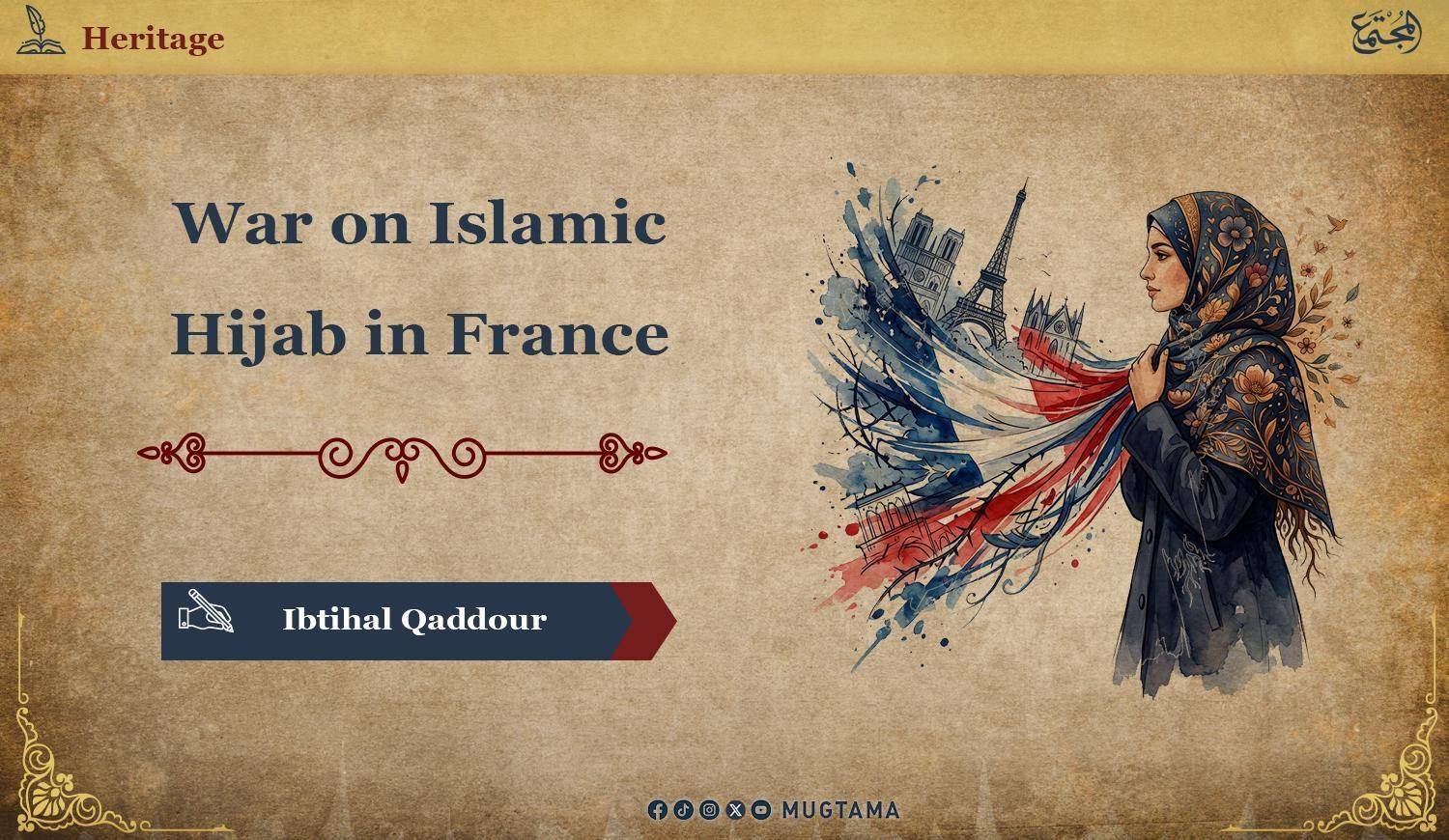
"The hijab protects me." In short, Leila expressed
her adherence to the teachings of her religion, putting before her eyes—at
seventeen springs old—all the costs resulting from a phrase that willpower
transformed into a stance. She then rejected any discussions regarding her
stance, saying: "Wearing the hijab was ordained by Allah French secularism policy and Muslim hijab in schools, and we do
not hold the authority to alter Allah's commands."
The storm erupted fierce and blatant, laden with all malice,
distortions, definitions, and hostilities—both visible and hidden—toward this
religion and those who adhere to it. Thus, it presented an opportunity in
France for anyone who likes to fish in troubled waters.
Those seeking political and economic interests rushed to link adherence to values to low economic conditions.
Even those who are superficially fair-minded do not lack
diseased motives in their fairness, such as: the fear of transferring the
problem from one place to another, the fear of spreading contagion, or treating
the matter as a passing summer cloud experienced by the girl during
adolescence, as stated by one of the headmasters: "What benefit is gained
from stopping a passing spiritual movement of a teenage student?!"
However, the most dangerous matter is the distortion of the
rulings of Islamic Sharia on the tongues of some officials who pretend
to search the Quran for the rulings governing these phenomena.
Others feel indebted to public opinion to provide a convincing
justification for expulsion measures, and after searching and probing, they
throw down their winning card: "The hijab exposes the student to sweat
during cooking class!" Yet, that card comes only to expose what was hidden
within their souls.
Muslims in France Required to Have an Islam That Dissolves into Secularism
The summary is that Muslims in France are required to have an
Islam that dissolves into secularism just as the Arabic language dissolved into
the French language, just as modest dress dissolved into revealing attire, and
just as conservative behavior dissolved into degraded behavior—a complete
dissolution that represents the desired image for an Islam whereof nothing
remains except burial rites for the dead, Eid prayers, and fasting Ramadan. The
efforts currently being made aim to emerge from doctrinal differences toward
solutions that give birth to a "French-style Islam"—those are the
goals of "modernizing Islam" in France!
The Translator
Three years have passed since a socio-political storm swept
across the Mediterranean regions, caused by the ban on three Muslim female
students from wearing the Islamic hijab in classrooms across French schools.
Have any changes occurred in the positions of officials during this period?
In a school in the suburbs of the French city of Lyon, located
in a neighborhood where Muslims constitute 78%, a student pushed open the
principal's door and surprised him by requesting the meat invoices for meals
served to students to verify whether they were slaughtered according to Islamic Sharia or not. The principal says: "I feel it is my duty to offer
pork-free meals and respect the month of Ramadan, but I will not submit to this
kind of threat."
The decisive stance of administrations against student
requests of a religious nature has become a phenomenon spreading across most
French schools. The headmaster of Voltaire High School in Paris severely
reprimanded a Muslim female student who expressed disgust at a fork used
sequentially to cut pork and beef intended for Muslim students.
What poses a major problem for school administrations is the
repeated request to designate specific places for prayer and religious
activity. It is true that the 1905 law separated church and state while
allowing religious chaplains to exist in public secondary institutions funded
by the general budget—and the presence of 3,000 Catholic chaplains in France
confirms that after a century of secularism, the Church did not yield entirely
to the law separating religion and state—yet Muslims do not benefit
sufficiently from this law, even though their requests are considered more
organized. One principal said: "A group of students asked me to vacate a
hall to perform prayers five times a day, which would cause chaos in the class
schedule; however, when I searched the Quran, I found that two prayers a day—one
in the morning and another in the evening—are sufficient for an individual to
be a good Muslim, so I rejected the request!"
Meanwhile, Jewish students pose a significant burden on
schools, as they decide their weekly day off on Saturday, prompting educational
administrations to issue recommendations against conducting any exams on
Saturdays. Strangely, this decision met with great approval among teachers, as
out of 170 teachers, only 3 rejected it, and among 500 Jewish students, only
ten were affected!
Explicit Hostility
If crosses worn around the necks of Christians and skullcaps
placed on the heads of Jews pose no problem at all, why does the Islamic hijab
trigger reactions that reflect explicit hostility? And why do schools that
accepted it yesterday hesitate today for fear of being accused of laxity?
One teacher says in this regard: "Wearing the Islamic
hijab reintroduces the rule of modesty through overt religious means, even
though there should be no religious signs in public places. The hijab is a
cultural symbol distinct from wearing a cross around the neck. All students are
equal and discrimination between them is prohibited. It is very unfortunate
that the school no longer defends values; we live in an era of cultural
conformity, and here we have nothing before us except uncertain theories."
The director of an institute justifies his expulsion of four
female students—despite their academic excellence—by stating: "Wearing the
hijab exposes female students to numerous risks in physical education classes
and in cooking classes, where the probability of the hijab catching fire is
very high, which would harm the student."
The National Institute of Education has become a refuge for
many rejected female students despite its exorbitant costs. Yet even its
administration fears the "spread of contagion," in the words of the
institute's director, which is why he is forced to expel students from time to
time!
Although constitutional legal clauses guarantee freedom of
belief, and despite the Human Rights Committee voting in favor of the female
students, all these decisions were ignored, and internal regulations for each
individual became the benchmark for their actions; thus, rulings on female
students take a moody rather than a legal form.
However, the matter is not devoid of fairness at times. In
fact, even the division within the secular front—where one of its directions
adopts the principle of granting freedom of belief—sometimes gives justice to
the Muslim female student. One official says: "If the student causes no
disruption and regularly attends all classes, there is no reason to expel her,
because the secular school is obligated to accept all students regardless of
their religions. I see no reason for Muslims to give up part of their culture
in exchange for obtaining their rights."
An academic official confirms: "As long as the student
responds to the request to remove the hijab inside the classroom, it is fine.
Since she attends all classes, we see no reason to expel her, even if co-ed
swimming classes sometimes cause some objections, because the expulsion process
is merely transferring the problem from one place to another."
Islam in France arrived with the arrival of
immigrants—especially North Africans—and was known for a great deal of
flexibility and interaction with civilizations to an extent that reaches
exaggerated limits among the youth who represent the largest segment. As for
the Islam of the more orthodox minorities, they view wearing the hijab as
compliance with a prophetic Hadith, and it also represents a type of guarantee
preventing the girl from straying from her traditions threatened with
dissolution in French society. However, the hijab phenomenon appears in areas
where the standard of living for expatriates is very low.
Political Pressures
With the decentralization of secularism in educational
institutions, the latter find themselves at the heart of local political stakes
regarding immigration, subject to pressures from political parties and Islamic
associations that protect veiled girls. Among these associations is the
"Amal" Association, affiliated with the National Federation of
Muslims of France, which refused to join the Islamic association formed by the
municipality. Resolving these disputes may result in a "French-style
Islam."
Some attribute the phenomenon to the stances of
the French government, according to the words of the president of the North
African Women's Association, Halima Boumedienne: "The French government's
appearance of rigidity leaves room for a return to fundamentals. In this case,
the economic hardships experienced by expatriate Muslim families, as well as
the difficulty of accessing political life and establishing parties, have made
these expatriates prey to Islamic currents. In any case, it is necessary to
escape political control and seek the interest of the female students."
True, these girls should not have to pay the costs of the
secular crisis; however, Islam in France does not date back two hundred years
like Judaism, nor to a century of separation between church and state, nor even
to fifty years of secular social activity. Therefore, it was inevitable to be
exposed to republican insults in which, nevertheless, modernizing religion is
not prevented.
------------------------------------
Published in Issue 1006 of Al-Mugtama Magazine —
Tuesday, July 7, 1992
