





Visit My Mosque UK: Building Bridges Through Faith
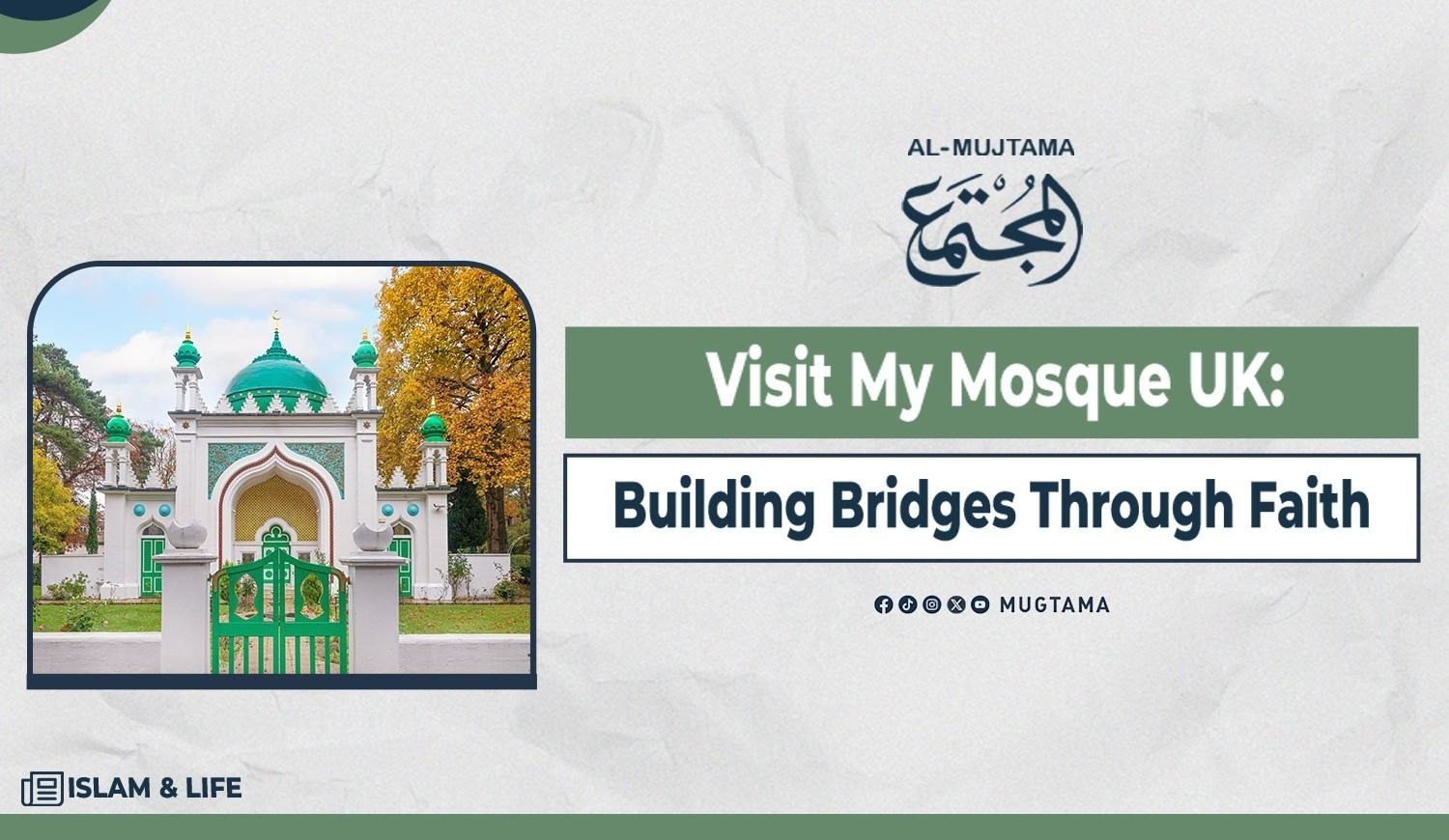
What can happen when a mosque opens its doors to its
non-Muslim neighbors and gives them the opportunity to meet the people who
worship there?
That is at the heart of Visit My Mosque UK, which returns this
year for its eleventh edition. On September 19 and 20, 2026, hundreds of
mosques across the United Kingdom will welcome Muslims and non-Muslims alike to
learn about Islam and Muslims, ask questions, share food and conversation, and
discover the role mosques play in their local communities.
According to the official Visit My Mosque website, more than 250 mosques are
participating this year. Their doors are open to people of all faiths as well
as those with no religious affiliation. Activities include mosque tours,
exhibitions, talks, cultural food, children’s activities, and opportunities to
meet members of the local community.
The initiative comes at a significant moment. As anti-Muslim hostility continues to affect communities across Britain, mosques are
offering a different way to challenge stereotypes: bringing people face to face
rather than allowing perceptions to be shaped solely by what they see on
screens.
When the Mosque Becomes a Bridge
In Islam, the mosque is not simply a place for prayer. It is
also a place of worship, learning, mutual support, and community life. Its
relationship with the people around it is therefore part of its wider purpose.
Islam places great emphasis on good relations with neighbors,
regardless of their religion, ethnicity, or background. Allah says, {Worship Allah ˹alone˺ and associate none with Him. And be kind to parents, relatives,
orphans, the poor, near and distant neighbours, close friends, ˹needy˺ travellers, and those ˹bondspeople˺ in your possession. Surely Allah does not like whoever is
arrogant, boastful.} [An-Nisa’ 4:36]
The Prophet Muhammad (peace be upon him) also said: “Gabriel kept on recommending me about treating the
neighbors in a kind and polite manner, so much so that I thought that he would
order (me) to make them (my) heirs.” (Sahih
Al-Bukhari 6015)
Opening a mosque to its neighbors, therefore, can be more than
a passing social event. It can be a practical expression of what it means for
Muslims to be a positive part of the society in which they live.
The Visit My Mosque initiative itself is built around this
principle. The Muslim Council of Britain describes it as an opportunity to
build familiarity and trust, emphasizing that mosques are living parts of the
communities in which they are located. The initiative also draws on a previous YouGov survey which found that around 70% of Britons had never visited a
place of worship belonging to another faith.
From Fear to Familiarity: Can Mosques Break Stereotypes?
It is easy for perceptions of a group to develop when people
have little direct contact with its members. Personal encounters can change
that relationship.
When a neighbor walks into a mosque, sees people praying, asks
questions and receives answers, sits down for a cup of tea, and speaks with
Muslims about ordinary life, the Muslim is no longer simply an image
encountered on a screen. He or she becomes someone the neighbor has met and
spoken to.
This matters particularly in Britain, where Muslims made up
around 6.5% of the population of England and Wales in the 2021 Census—approximately 3.9 million people, compared with 4.9% in 2011.
In London alone, 15% of residents identified as Muslim in the 2021 Census.
As the Muslim presence in Britain grows, understanding Muslim
communities becomes part of everyday social life rather than a marginal issue.
At the same time, the challenges facing Muslim communities
cannot be overlooked. Police in England and Wales recorded 3,199
religious hate crimes targeting Muslims in the year ending March 2025, an
increase of 19% from the previous year, according to the UK Home Office. The British Muslim Trust also reported more than 70 attacks targeting
mosques and Islamic places of worship across the UK during the 12 months to
July 2026. These figures are based on the organization’s monitoring and are not
comprehensive government statistics.
Against this backdrop, opening the mosque’s doors offers a
practical response in the opposite direction: if fear can grow through
distance, familiarity can reduce it.
The Mosque Is More Than a Place of Prayer
One notable aspect of Visit My Mosque is that its activities
are not limited to introducing visitors to Islamic prayer or mosque
architecture.
Participating mosques offer a range of community activities,
from youth and educational programs to social support, sports, women’s fitness
programs, activities for mothers and children, and charitable initiatives.
Some mosques provide particularly clear examples of this wider
role. Cheadle Mosque, for example, hosts scouting groups, martial arts, women’s
fitness programs, dementia support, mothers-and-toddlers groups, and activities
for children with special educational needs.
Here, the mosque becomes what the wider community can
recognize it as: a religious institution that serves its neighborhood rather
than a building isolated from it.
The initiative has also demonstrated its ability to bring
thousands of people through mosque doors in previous years. In 2023, more than
200 mosques participated, welcoming thousands of visitors from different
backgrounds.
How Can Children Learn Openness Without Losing Their Identity?
Being open to society does not require Muslims to abandon
their identity. Nor does preserving that identity require withdrawing from
society.
Children need to learn that confidence in their Islamic identity can exist alongside good character, respect for others, the
ability to engage in dialogue, and positive participation in wider society.
The mosque can therefore become a practical school for this
kind of engagement. Children can watch their parents welcome neighbors, learn
how to answer questions about Islam with courtesy and calm, and discover how to
explain their faith without apologizing for who they are or disrespecting the
beliefs of others.
Visit My Mosque also provides an important space for this. The
Muslim Council of Britain has developed resources for schools to help teachers
organize mosque visits, prepare students for what they will see, and connect
the experience with religious education lessons.
In this way, the mosque does not become a place where children
preserve their identity by standing apart from society, nor a place where they
lose themselves within it. Instead, it can become a space where they learn how
to be confident, open, and active Muslims in a religiously diverse society.
Inviting Non-Muslims to the Mosque: An Invitation with Etiquette
Opening a mosque to non-Muslims is not simply a matter of
organizing a social event. It also requires respect for the sanctity of the
mosque, thoughtful hospitality, and consideration for those engaged in worship.
A number of Islamic scholars have permitted non-Muslims to
enter mosques for a legitimate purpose or recognized benefit, citing examples
such as non-Muslim delegations entering the Prophet’s Mosque and the story of
Thumamah Ibn Uthal (may Allah be pleased with him) before his conversion. Among
them was the late Saudi scholar Sheikh Abdulaziz ibn Baz, who held that a non-Muslim may enter a mosque
when there is a genuine need or recognized benefit, while observing the
sanctity of the mosque.
Visitors should therefore be made aware in advance of basic
etiquette: removing their shoes before entering the prayer area, dressing
modestly, respecting prayer times and the privacy of worshippers, asking
permission before taking photographs, and allowing worshippers space to pray
away from the atmosphere of the event.
At the same time, visitors should be welcomed warmly and
treated with kindness. They should be free to ask questions without
embarrassment, and a visit should never become an argument or an attempt to
pressure someone into accepting Islam.
The first invitation is often not a speech about Islam, but
the opportunity to see Islam reflected in the conduct of Muslims.
When the Mosque Opens Its Doors, What Does the Neighbor See?
Perhaps the greatest value of initiatives like this is that
they restore the relationship between Muslims and their neighbors to its
simplest human form.
A neighbor enters a mosque for the first time, and a Muslim
welcomes him. A question is asked, and an answer is given. There is tea, food,
a tour of the building, and an ordinary conversation about life, work, and
children.
These details may seem too simple to be part of a serious
effort to challenge stereotypes. Yet they reach the heart of the problem:
people often fear what they do not know.
That is why Visit My Mosque UK is more than a campaign to
introduce non-Muslims to Islam. It can serve as a model for transforming the
mosque from a place some may perceive as unfamiliar or distant into a place
known by its neighbors—a place where people can meet, talk, and understand one
another.
It reminds us that religious commitment does not have to stand
in opposition to being an active member of society, and that preserving a
strong identity does not require isolation.
Sometimes, building a bridge begins with something as simple
as opening a door.