









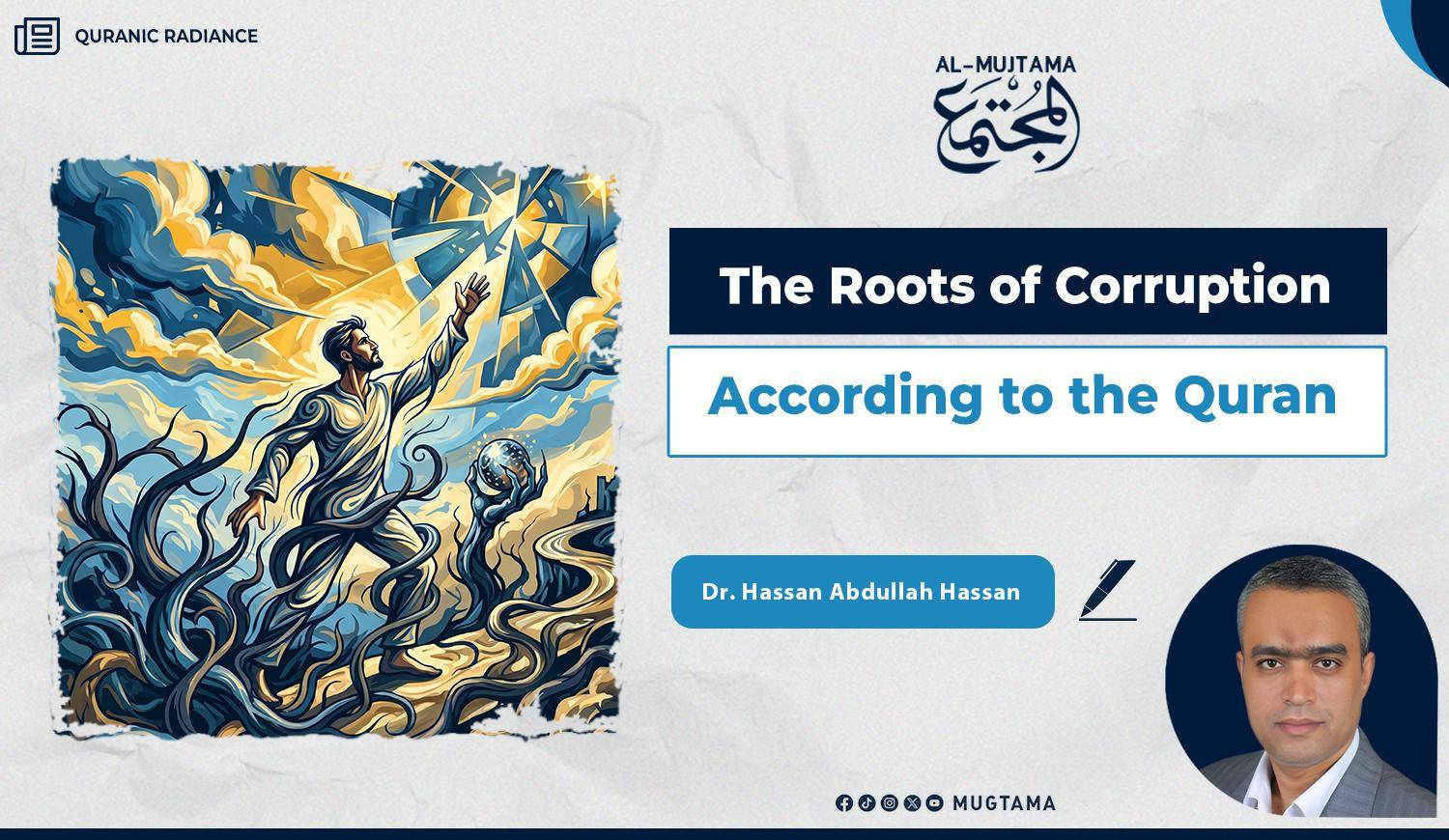
The Roots of Corruption According to the Quran
Susceptibility
to corruption refers to a person’s readiness and predisposition to accept
everything that is reprehensible and contrary to soundness and righteousness,
according to Islamic law and reason. From the Quranic perspective,
susceptibility to corruption means nurturing the self that is wicked and
constantly urges evil, while corrupting the tranquil self and the self that
reproaches itself. Allah the Almighty says, {Then with
˹the knowledge of˺ right and wrong inspired it!}
[Ash-Shams 91:8]
Corruption
means the departure of something from a state of moderation, whether that
departure is slight or considerable. Its opposite is righteousness. The term is
used in reference to the self, the body, and things that deviate from what is
sound and upright.
From the
Quranic perspective, the greatest form of corruption is associating partners
with Allah or denying His existence altogether. This is the gravest violation,
which leads to denying the unseen and rejecting the messengers and revealed
books, followed by committing injustice, oppression, aggression, and tyranny
against people on earth. These are interconnected manifestations of corruption in the Quran.
Corruption,
from the Quranic perspective, also encompasses every action that violates the
laws governing the universe as it was created to enable human beings to fulfill
their role in the world and carry out the responsibilities of stewardship
entrusted to them. This includes contributing positively to the development of
the self and the world.
Thus, any
act of destruction that harms the human self, crops, plants, intellect, or
emotions falls under the category of corruption prohibited by the Quran. Allah
says, {Do not spread corruption in the land after
it has been set in order.} [Al-A`raf 7:56]
The verse
specifically mentions the earth because it is the domain in which human beings
act, fulfill their role as stewards,
and carry out the task of developing and cultivating the world entrusted to
them from the time they first came to inhabit it.
Three Factors That Make People Susceptible
to Corruption in the Quran
A general
examination of the Quran reveals three fundamental factors that predispose the
self to accept corruption and drive people to practice it on earth: blind
imitation, luxury, and arrogance. We will briefly examine each of them below.
1- Blind Imitation:
The first
factor in developing a self susceptible to corruption is imitation. Here, this
refers to following the views, perceptions, and judgments of previous
generations concerning the universe and life, and rigidly adhering to beliefs
inherited from one’s parents without reflecting on them, examining them, or
reconsidering them.
The type
of imitation intended
here is the blameworthy kind, which is not based on evidence, clear proof, or
reflection. Rather, it is blind imitation driven by the desire to obtain the
privileges enjoyed by those who were imitated in previous generations. The
Quran gives this factor considerable attention because it prevents people from
accepting the truth and reflecting upon it. Indeed, it can lead them to reject
the truth and exert every effort to oppose it in order to preserve the material
gains inherited particularly from their parents and grandparents.
Allah the
Almighty says, {Indeed, they found their
forefathers astray.} [As-Saffat 37:69]
That is,
their forefathers were deeply rooted in misguidance, in a way that was evident
to everyone. The Quran then condemns those who blindly imitate others out of
ignorance and without insight, saying: {When it is
said to them, “Come to Allah’s revelations and to the Messenger,” they reply,
“What we found our forefathers practicing is good enough for us.” ˹Would they still do so,˺ even if their forefathers had
absolutely no knowledge or guidance?} [Al-Ma’idah 5:104]
The Quran
thus denies that the people being imitated possessed knowledge of the conduct,
judgments, and beliefs they followed, or that these could lead them to guidance
and the truth. Even worse, such people commit immoral acts while relying on
this imitation as their justification. The Quran records their claim: {Whenever they commit a shameful deed, they say, “We
found our forefathers doing it and Allah has commanded us to do it.”} [Al-A`raf
7:28]
The
statements made by those who blindly imitate others are not founded on
arguments or evidence. Consequently, their engagement in indecent acts and
other forms of vice stems from the desires and impulses of the self, rather
than rational thought that leads to guidance and knowledge.
Likewise,
nations that adopt imitation as the guiding approach throughout their
civilizational development inevitably fall into corruption. By stagnation, we
mean that successive generations content themselves with the sciences and
knowledge inherited from their predecessors, assuming that these are
sufficient, even though such intellectual output was merely a reflection of a
particular historical stage in the development of the civilization of the
earlier nation, intended to improve its circumstances and advance its
condition.
This type
of imitation causes nations to fall into intellectual stagnation or corruption.
It also leaves its mark on people’s circumstances, lives, cultures, and ways of
living, resulting in what may be described as civilizational decline or
backwardness.
2- Luxury:
The
second factor that prepares the self for corruption, both in thought and
practice, is excessive luxury. Verses in Surah Al-Waqi`ah link a life of luxury
with extreme defiance in associating partners with Allah and denying the
unseen—in other words, opposing the messengers and their messages. Allah says, {Indeed, before this ˹torment˺ they were spoiled by luxury, and
persisted in the worst of sin. They used to ask ˹mockingly˺, “When we are dead and reduced to dust and
bones, will we really be resurrected?} [Al-Waqi`ah 56:45–47]
The luxury intended
here is that which is built upon falsehood. This may occur through the
acquisition of wealth from illegitimate sources, whether by seizing or stealing
riches that a person has no rightful claim to, or through practicing tyranny
and violating the limits and rights established by Allah and the rights of
other people in order to obtain whatever satisfies these desires and pleasures.
In such circumstances, the self drives its owner to engage in even more
corruption to satisfy these desires through illegitimate means.
3- Arrogance:
The third
factor that spreads corruption within the self is arrogance or pride. It refers
to an intense sense of self-importance. Among the subtleties of the Arabic
language, as Ibn Ashur points out, is that the linguistic forms expressing the
quality of arrogance appear only in forms that indicate seeking or adopting a
quality. This suggests that an arrogant person is either seeking to appear
superior or deliberately putting on an air of superiority, when in reality they
are not truly great.
It has
also been said that arrogance means a person considers themselves greater than
others, while acting arrogantly means seeking to establish that superiority
through pretension.
In The
Revival of the Religious Sciences, Al-Ghazali explains that arrogance is a
quality rooted in the self, characterized by a sense of comfort and
satisfaction with the belief that one is superior to others. Arrogance
necessarily involves someone who is looked down upon and someone who considers
themselves superior. It is a conviction that settles in the self, producing
self-admiration, pride, joy, and attachment to that belief. The resulting sense
of superiority, elation, and satisfaction with this conviction constitutes the
trait of arrogance.
The
Prophet (peace and blessings be upon him) said: “He
who has, in his heart, an ant’s weight of arrogance will not enter Jannah.”
Someone said: “A man likes to wear beautiful clothes and shoes?” Messenger of
Allah (peace and blessings be upon him) said, “Allah is Beautiful, He loves
beauty. Arrogance means ridiculing and rejecting the Truth and despising
people.” (Narrated by Muslim, Hadith No. 91.)
The Quran
records that arrogance is a motive behind the persistence of corrupt beliefs,
as though it were a barrier between a person and the truth. Allah says, {For whenever it was said to them ˹in the world˺, “There is no god ˹worthy of worship˺ except Allah,” they
acted arrogantly.} [As-Saffat 37:35]
As the
verse indicates, arrogance is a psychological state that arises from a person’s
feeling of superiority over others. Such a person refuses to respond to them,
regardless of the truth of what they are calling them to. Instead, they respond
to their own ego, which seeks to boast and exalt itself above other people.
Satan was
the first to display arrogance toward a human being and the first whose pride
prevented him from accepting the call to the truth. He was also the first being
whose self became steeped in the corruption that arises from arrogance. Allah
says, {And ˹remember˺ when We said to the angels, “Prostrate before Adam,” so
they all did—but not Iblîs, who refused and acted arrogantly,
becoming unfaithful.} [Al-Baqarah 2:34]
He
believed that he was superior to Adam (peace be upon him). It has been explained
that Iblis became a disbeliever by refusing to prostrate because his refusal
stemmed from his arrogance toward Allah and his belief that the command he had
been given was not in accordance with wisdom.
After him
came groups of people who arrogantly rejected the calls of the prophets,
foremost among them the Children of Israel. Allah says, {Why is it that every time a messenger comes to you ˹Israelites˺ with something you do not like, you
become arrogant, rejecting some and killing others?} [Al-Baqarah 2:87]
How Blind Imitation, Luxury, and Arrogance
Fuel Corruption
Following
the Quran’s account of those characterized by these three traits—blind
imitation, luxury, and arrogance—reveals how they corrupt the self and the
world, including crops and cultivated land. It also shows how these groups
practiced tyranny, oppression, and transgression in all their forms and
manifestations, violating both the rights of Allah and the rights of people.
As we
have previously explained, these are interconnected manifestations of
corruption associated with a corrupt self that has become predisposed to
practicing every form of injustice and wrongdoing.
-------------------------------------------------------------
