



Why Raising Children Is More Than Giving Birth
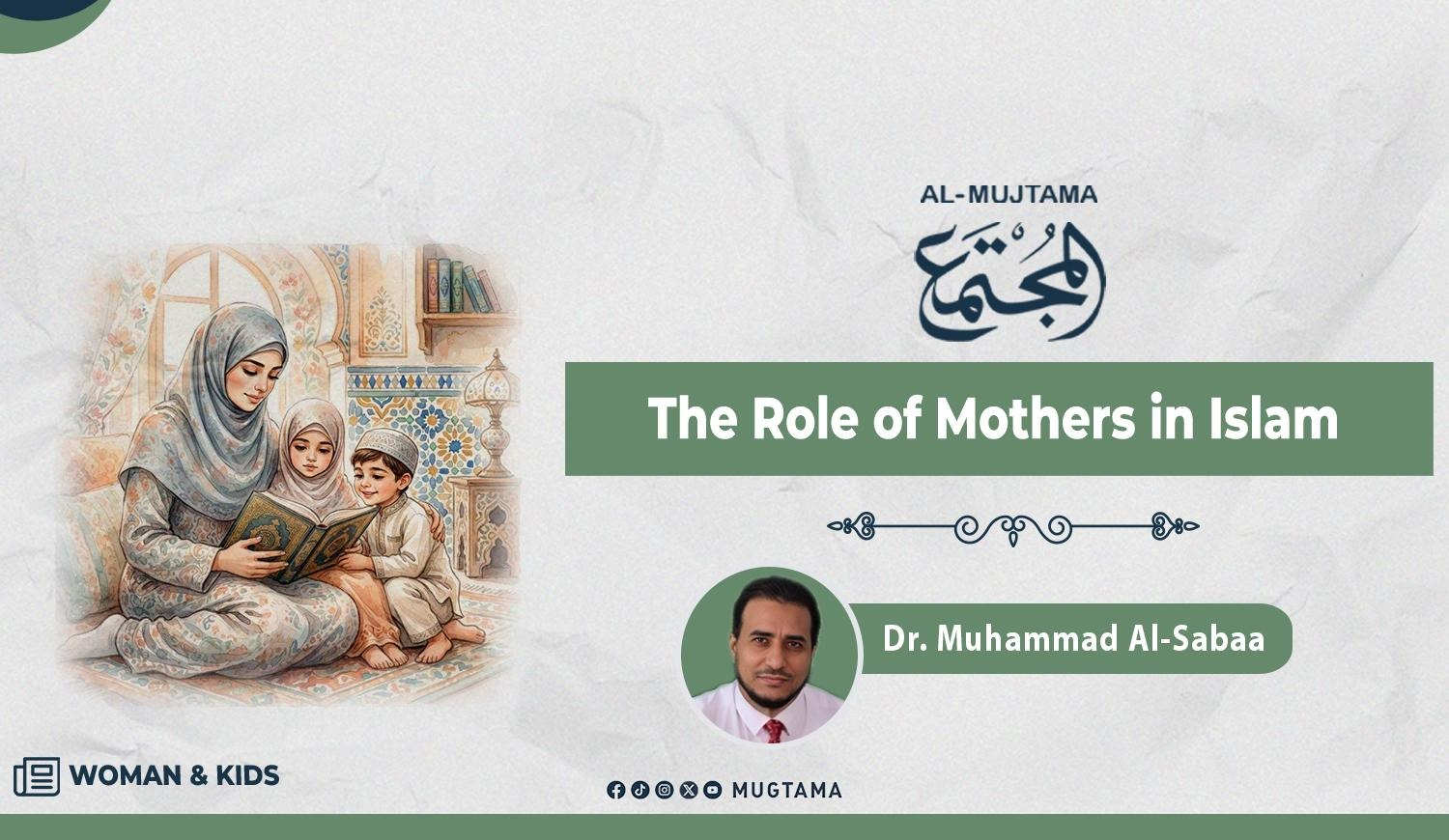
The Role of Mothers in Islam
It is part of Allah’s way in His
creation that marriage should be a means of cultivating the earth, and that
reproduction should extend life and fulfill humanity’s role as Allah’s stewards
on earth: {And Allah has made for you spouses of
your own kind, and given you through your spouses children and grandchildren.}
[An-Nahl 16:72]
Allah did not make parenthood merely a
relationship of lineage and childbirth. Rather, He entrusted parents with the responsibility of raising, caring for, and guiding their children so
that they may become a source of goodness for themselves and a beneficial
building block in society, all within the framework of their responsibility
before Allah: {O believers! Protect yourselves and your
families from a Fire whose fuel is people and stones.} [At-Tahrim 66:6]
The righteousness of children and the
soundness of their behavior are the fruits of conscious care and the
cultivation of values and faith from the earliest years of life.
Islam has made this task a shared
responsibility between the father and mother. However, the mother’s share in
this mission is greater: she is closer to her children, interacts with them
more frequently, and spends more time in their company. This makes her influence
on their development deeper and more lasting. Thus, the Prophet (peace and
blessings be upon him) said: “And the woman is a
guardian and is responsible for her husbands house and his offspring.” (1)
From here, the mother’s role does not
stop at meeting ordinary daily needs. Rather, her higher mission is to be the
educator who instills virtues, builds character, and raises a generation that
carries values, possesses knowledge, and embodies good character, so that it
may become a righteous building block in the development of its society and
Muslim community.
Motherhood in Islam: Between Instinct
and Responsibility
Motherhood is not merely a biological
event through which a woman fulfills the function of reproduction. Rather, it
is an educational, human, and civilizational mission that goes beyond instinct
to shaping human beings and building generations.
There is a significant difference between
a mother who is content with fulfilling the natural function of giving birth
and a mother who understands that her true mission begins after childbirth. She
turns her home into a school of upbringing, her embrace into a source of
values, and her own behavior into an example through which she raises men and
women who carry a message, embody good character, and understand their
responsibilities.
A mother who has
a mission cares for her child’s soul just as she cares for the child’s body.
She nourishes the child’s mind just as she nourishes the body, plants faith in
the heart, instills values in the soul, and cultivates discipline in behavior.
Therefore, not every woman who gives
birth has necessarily become an educator. Childbirth is a natural practice
shared by women, whereas conscious parenting is a choice and a responsibility.
It requires knowledge, patience, insight, and sincerity. It is this conscious parenting
that produces role models, prepares leaders, and builds righteous people who
reform themselves and contribute to the reform of others.
Such a person becomes a strong
building block in society. When these building blocks multiply, a cohesive
society emerges, and a Muslim community capable of creating renewal and
building civilization can arise.
The Mother’s Primary Responsibility in
Raising Children
One of the most important matters that
must be emphasized is that the mother has the primary role in raising her
children. She should not relinquish this responsibility or place it upon
someone else, regardless of her responsibilities or circumstances.
A mother may need a break from some
tasks, but she cannot take a leave of absence from her educational mission.
Parenting is a responsibility that extends through every moment of a child’s
life. It is an example that is seen, a word that is spoken, a look that carries
meaning, an attitude that establishes a value, and a way of life through which
a child’s awareness and personality are shaped.
Children acquire many values more from
what they experience than from what they hear. They learn from their mother’s behavior
before her instructions and from her actions before her words.
One common mistake is for some mothers
to believe that they have fulfilled their responsibility simply by sending
their child to school. The reality is that school is not a substitute for the
home; rather, it supports what has already been instilled there.
Therefore, the mother remains
responsible for following up with her children before they go to school,
throughout their educational journey, and after they return home. She observes
what they are learning, corrects any flaws that may emerge in their ideas or
behavior, and remains the first line of defense against negative influences
that may reach her children from their surrounding environment.
Another form of neglecting this
responsibility is for some mothers to delegate the task of raising their
children to a domestic worker, a relative, or another person simply because
that person is close to the children or spends a great deal of time with them.
There is no doubt that seeking help
from others with certain aspects of childcare may be necessary. But raising children
is something else. It cannot simply be assigned or delegated, because it is a
process of building identity, instilling values, and shaping character. This is
a responsibility that, in its fullest form, can only be carried out by the
parents, foremost among them the mother, because of the emotional closeness and
natural influence Allah has given her over her children.
The deeper and closer her educational
presence is, the more firmly established her children’s psychological and moral
development will be, and the more capable they will be of facing life’s challenges
and intellectual and behavioral deviations.
If a mother falls short, the
responsibility lies fully with both mother and father, and the danger is serious: “Whoever neglects
teaching his child what benefits him and leaves him without guidance has
treated him with the utmost harm. Most children become corrupt because of their
parents, their neglect of them, and their failure to teach them the obligations
and practices of the religion. They neglected them when they were young, so
they did not benefit themselves and did not benefit their parents when they
grew up.” (2)
Motherhood in the Digital Age: Raising
Children Amid New Challenges
If raising children
is a tremendous responsibility in every age, then in our time it has become
more complex and challenging.
The digital revolution has opened the
doors to a world without boundaries. From their earliest years, children are
now exposed to an enormous volume of intellectual, cultural, and behavioral
influences, to the point that screens have become constant companions for many
children and young people.
Amid this unprecedented openness, the
family is no longer the only influence shaping a child’s personality. The
mother is therefore required to be more aware, closer to her children, and more
attentive to what they are exposed to. She must guide them wisely so that they
can distinguish between what is beneficial and harmful, and between what is
consistent with their identity and what threatens it.
This is at the heart of parental
responsibility. The Prophet (peace and blessings be upon him) said: “There is no gift that a father gives his son more
virtuous than good manners.” (3)
Despite the magnitude of these
challenges, the mother’s status and the importance of her role become even
greater. She remains the first school and the strongest influence on her
children’s emotional and inner lives when she fulfills her mission well.
Children are shaped deep within by
what they experience inside their homes and by the love, guidance, dialogue,
and example they find there. But if a mother abandons her educational mission,
becomes too occupied to follow up with her children, or leaves the void to be
filled by the digital world with everything it contains, that void will not
remain empty.
Other influences will fill it, and
they may shape children’s minds and values far from the principles the family
hopes to instill in them.
Through a mother’s dedication and good
parenting, how many children—and even orphans—have become leaders! And through
the neglect of a mother, how many children have become more lost than an
orphan!
Thus, the poet Ahmed Shawqi aptly
captured both situations: the mother who is a school and the mother who is lost
and causes others to be lost:
An orphan is not one whose
parents
Have been taken by the burdens of life, leaving him weak and helpless.
The true orphan is the one
who finds
A mother who has abandoned him, or a father too occupied to care. (4)
Footnotes
- 1 Sahih al-Bukhari (2409) and Sahih Muslim (1829).
- 2 Tuhfat Al-Mawdud Bi Ahkam Al-Mawlud by Ibn Al-Qayyim, p. 229.
- 3 Narrated by At-Tirmidhi (1952), with this wording, and Ahmad (15403).
- 4 Adapted from Ahmed Shawqi’s collection of poetry, in his poem titled “Knowledge, Education, and the Teacher’s Duty.”