







Colonialism’s impact on Islamic identity and resistance
The Peaceful and Military Solutions to the Question of Palestine (4–4)
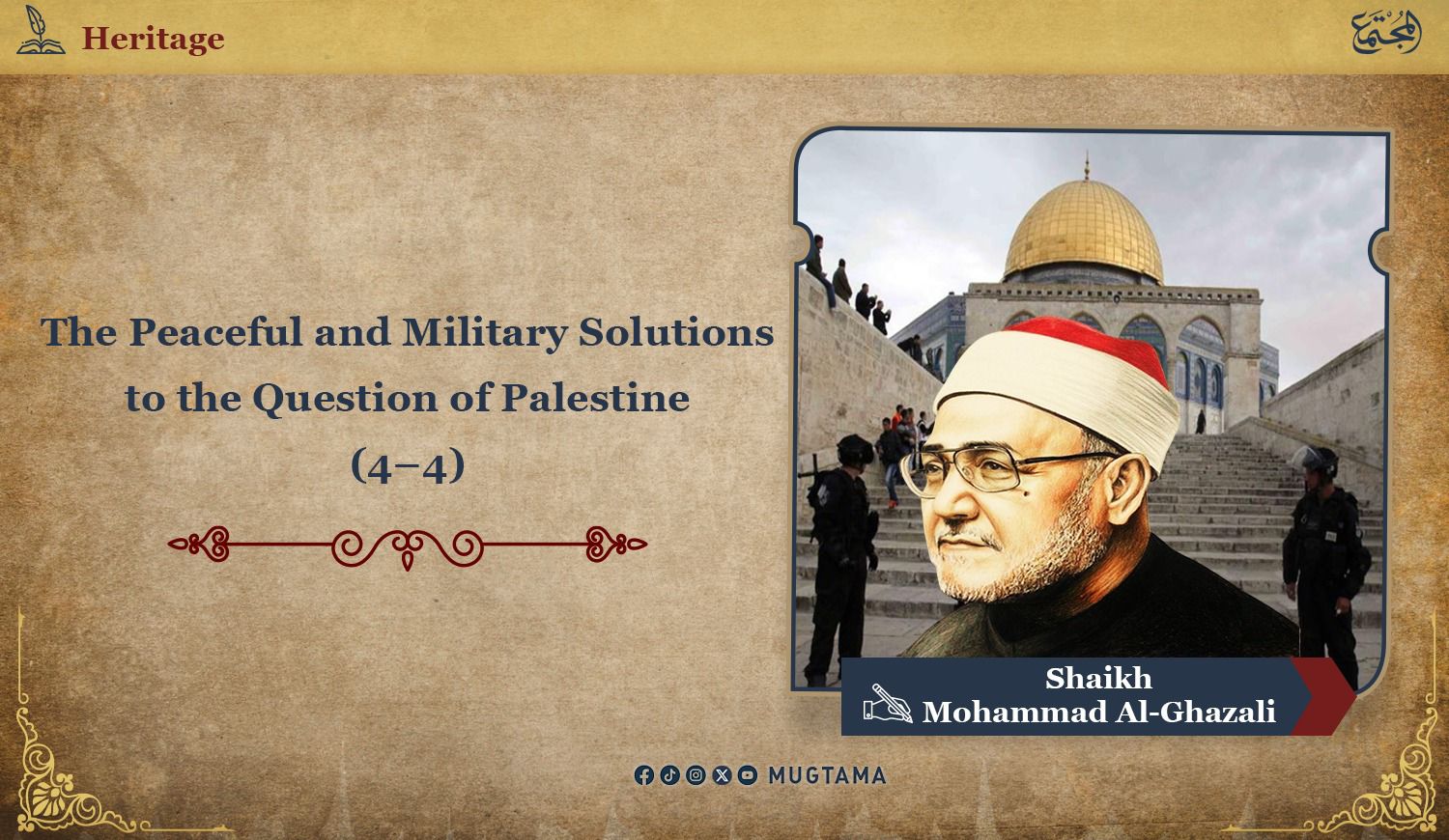
Al‑Mujtama Magazine posed several questions to leading writers and scholars concerning our contemporary problems. Sheikh Muhammad al‑Ghazali graciously responded to these questions. The magazine is pleased to present the questions and answers in a series. In the past three episodes, he answered three questions.
In this episode, we present Sheikh al‑Ghazali’s answer to the fourth question:
The Question
There are rising
tendencies toward unity or federation in our region under the slogans of Arab
nationalism or progressive forces, or calls for regional groupings such as a
“Greater Maghreb.” What is your view of this kind of thinking? Do you have an
alternative or another formula to present to the Muslim community?
Regional Groupings and Islamic Unity
Regional groupings within the
framework of economic and developmental integration are not objectionable.
Indeed, it may be in the public interest to study the vast lands of the Islamic
world to establish many organized groupings east and west, ensuring material
and social progress.
The Greater Maghreb,
the Nile Valley, the Arabian Peninsula, the Indonesian archipelago, or other
coherent economic units can be born and grow within the unified Islamic entity
that must return once more to international life. The difficulties imagined
before any Islamic grouping are less than those that have already arisen before
any Arab grouping.
Yet Muslim strugglers face long stages
before they can establish a great Islamic union that gathers Muslims together,
heals their wounds, liberates their enslaved, and repels aggression against
them. I do not understand why the existence of China is considered a normal
reality—800 million people forming a unified state—while the existence of Islam
is dismissed as an impossible fantasy, even if only as a federation of states
or a confederation of fraternal nations.
Colonialism’s Assault on Islamic Unity
Unfortunately, Muslim affairs are not
treated with ordinary reason. Colonial influence and humiliating subservience
to cultural invasion are the basis of the strange frown toward any talk of
Islam, its great nation, and its longed‑for unity.
The colonial raid launched by Europe
against Islam and its followers nearly two centuries ago targeted two terrible
objectives:
1. To reject any meeting upon Islam among
its peoples, tearing apart inherited loyalty to
the Islamic union,
and reviving genuine or fabricated nationalist tendencies that made members of
the same family estranged, disregarding one another, and failing to respect the
bond of shared religion. Thus Muslims became scattered into 60 or 70
nationalities in the international arena.
2. To kill faith in the consciences of
individuals, separating behavior from belief, so
that conduct deviated and faith shrank. Society became a theater for entrenched
vices, obeyed desires, and reckless currents. What remained of religion turned
into empty forms and petty innovations that availed their owners nothing.
By both means, colonialism succeeded
in reaching its goals. Establishing Israel became easy after this double
preparation: removing loyalty to Islam in public life, and weakening the bond
of creed in worship, morals, and other dealings.
Every Tendency Weakening Islam Serves Colonialism
We can say without hesitation or
flattery that every tendency aiming to weaken Islam—whether as a union or as an individual conscience—is
nothing but an extension of colonial encroachment and a vile encirclement of
the remnants of faith in our hearts.
Israel will find no better aid to its
survival and victories over us than these tendencies. I do not know how such
religious betrayals spread throughout the Arab nation.
There is an equation every Arab must
memorize by heart: “Arabs – Islam = Zero.” Yes, Arabs without their
religion are worth nothing.
Arabism and Islam: Indivisible
We Muslims of Africa never
distinguished between Arabism and Islam. Likewise, European historians did not
know such a distinction when Gustave Le Bon said: “The world has never
known a conqueror more merciful than the Arabs.”
Until the humiliating innovation
invented by Michel Aflaq appeared, proposing that distancing from Islam was the
path to Arab renaissance.
In reality, with that cry the man was
digging the Arab grave, to bury in it both a nation and a message.
It is not strange for someone like him
to do what he did. What is strange is that some people were seduced by his
slogan, hastening to apostatize from Islam and disbelieve in God and His
messengers. What did they gain? No call has ever appeared more ominous upon its
people, more manifest in failure, and worse in consequence than this apostate
call.
Perhaps Arabs will come to reason
after the flames of events have scorched their skin, realizing where these
deceptions have led them, and how they have smeared their faces with dust.
Islam and Religious Tolerance
One final falsehood must be refuted:
Islam does not know fanaticism
against other religions, nor does it
make religious difference a pretext for fighting and strife.
Had the few million Jews of the world
lived among Muslims, they would not have felt injustice nor complained of
persecution, as befell them in Europe.
Europe cast its disease upon us and
slipped away. It has always made religious and sectarian differences the cause
of wars and hostilities. With this mentality, it seeks to tear apart the Arab
entity in which Christians lived for long ages as citizens equal to Muslims in
rights and duties.
Its aim is either to kill Islam or to
create sectarian strife everywhere. The plan is known, and Muslims must despise
it, despise its promoters, and expose those behind them.
Arabs Cannot Abandon Islam
The demand that Arabs abandon Islam is
a baseness without foundation. I say to my people: you have no choice in the
face of clear global conspiracies. You are required to apostatize from your
religion and surrender your homelands.
Published in Al‑Mujtama Magazine, Issue 22, Tuesday, August 11, 1970