







Ottomans Defend East Africa
The Ottomans and Abyssinia: Lasting Imprints and Extended Presence
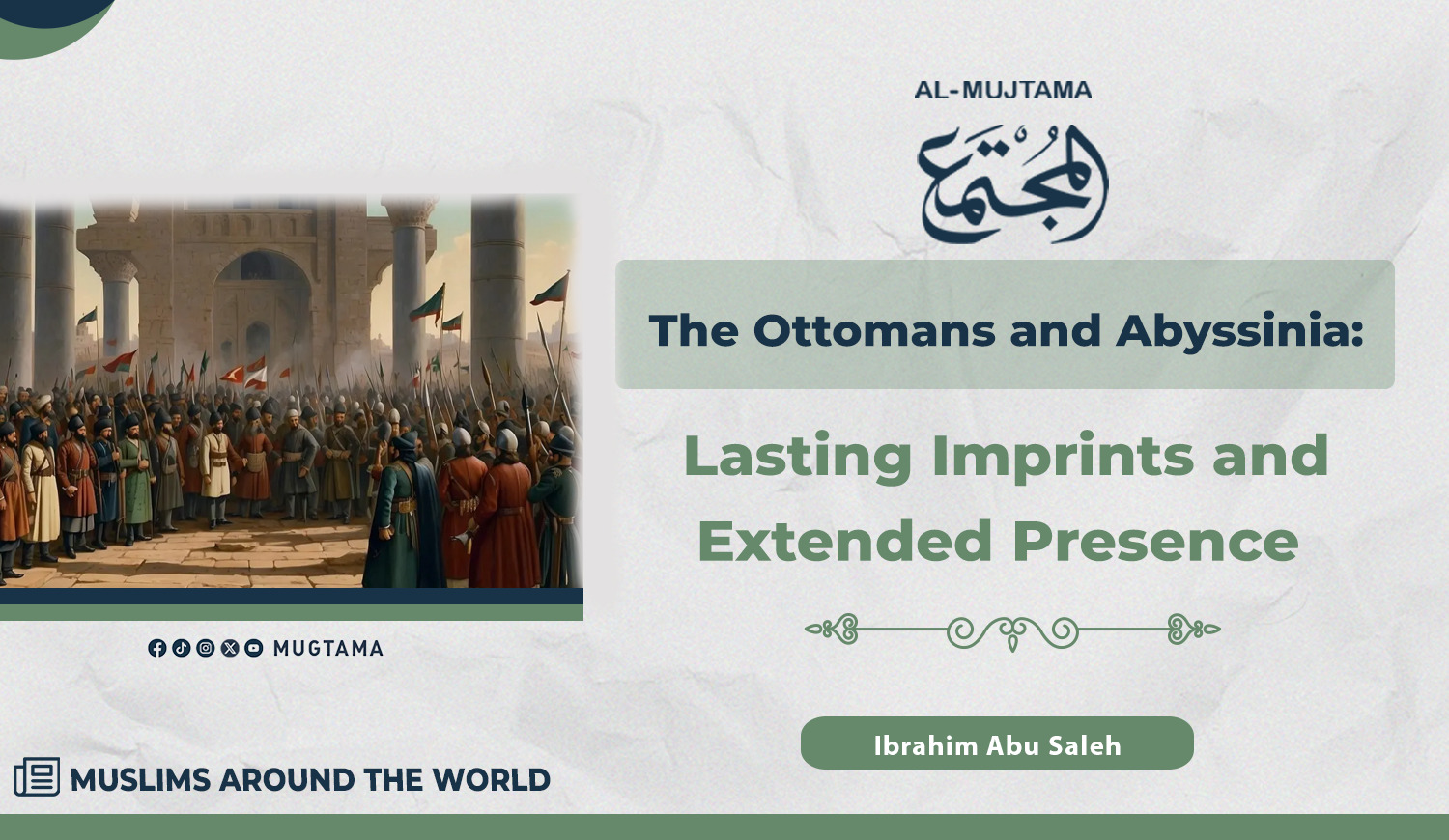
A century has passed since the abolition of the Ottoman Caliphate, which inscribed the most magnificent glories and shaped the contours of Islamic civilization in every land it encompassed. This included vast areas in the east of the African continent, where a number of countries in the Horn of Africa benefited from the arrival of Ottoman civilization, among them the ancient land of Abyssinia (modern-day Ethiopia and Eritrea).
How Did the Relationship Begin?
According to Ethiopian researcher and academic Fatih Al-Bari
Muhammad Nour, the arrival of the Ottomans in the east of the African continent
was for the purpose of protection and support. This Ottoman expansion
aimed to shield the region from European threats and ambitions, especially from
Portugal, to reach the Indian Ocean.
Researcher Nour, who spoke to "Al-Mujtama" magazine,
proudly recalled this deep history in the memory of Ethiopian Muslims. He
believes that the Ottomans spared no effort or expense in defending Islam and
Muslims after the Portuguese threat became imminent, extending from the Indian
Ocean to the coasts of East Africa.
He stated that Europe at the time harbored the idea of
controlling and reaching India, the source of spices and incense, via Vasco da
Gama. He explained that the European project became a reality after they seized
the coasts of East Africa and the Red Sea, followed by their repeated attacks
on sailing ships and pilgrimage caravans.
He added, "But the Ottoman response was much faster than
they expected. The Ottoman Empire extended its influence to protect the Islamic
world, incorporating the Levant, Hijaz, and then Yemen, bringing them within a
stone's throw of Abyssinia."
This is how the story of the arrival of Ottoman civilization
to Abyssinia began. At that time, Abyssinia was divided into Christian kingdoms
in the north and Islamic ones in the east and south. This gave Portugal
influence when the Christians sought their help to eliminate Islam and Muslims,
especially those Islamic city-states that were flourishing day by day,
according to Nour.
He added that this Portuguese expansion, which supported
Christianity in the region, also prompted the Ottomans to extend a helping hand
to the Muslims of Abyssinia to defend themselves. This relationship solidified
under the name of Habesha Eyalet, or the Province of Abyssinia, which
was the fourth in the Red Sea region after Massawa in Eritrea, Zeila in
Somalia, and Suakin in Sudan.
Nour continued that the first indirect aspect of this
relationship was when the Ottoman-affiliated governor of Zabid provided
military aid to Imam Ahmed ibn Ibrahim. This was followed two decades later by
Sultan Suleiman, his son Osman, then Sultan Selim II, and then Sultan Murad
III.
He emphasized that the Ottoman Empire did not view the east of
the African continent with exploitation or greed for its resources, but rather
focused its attention on assisting the countries located in that geographical
area.
Impact of the Caliphate's Fall on
Abyssinian Muslims
Undoubtedly, the fall of a state the size of the Ottoman
Caliphate had an impact on the regions under its control, including Abyssinia,
which is modern Ethiopia. The Ethiopian researcher touched upon the effect of
the abolition of the Ottoman Caliphate on Ethiopian Muslims. He stated that the
presence of the Ottoman Empire in Abyssinia had a positive impact on Ethiopian
Muslims, especially since the Ottoman expansion aimed to protect and support
them. He affirmed that Ethiopian Muslims were affected by the fall of the
Ottoman Caliphate, losing much of the protection and support they had enjoyed.
Conversely, and as a result of the Caliphate's abolition, the activities of
missionary organizations among Muslims in Ethiopia increased.
Nour considered the role currently played by the Turkish
government to be an extension of what the Ottoman Caliphate previously
undertook.
Prominent Landmarks and Milestones
Among the most prominent ancient Turkish landmarks is the Ottoman
Consulate, which still carries much historical depth between Turks and
parts of eastern Ethiopia. He stated that Turkey pays special attention to
eastern Ethiopia to highlight its old relationship with Ethiopia through the
restoration of its antiquities, such as the Ottoman Consulate in the city of
Harar in eastern Ethiopia.
He added that Turkey and Ethiopia enjoy deep historical
relations, explaining that the first Turkish consulate in Ethiopian territory
was established in 1912 during the Ottoman era, and the establishment date of
the Turkish Embassy in Addis Ababa dates back to 1926, while the Ethiopian
Embassy in Ankara was established in 1933.
The history of the Ottoman Consulate building, which consists
of a library, museum, meeting room, cafeteria, and reception and lounge areas,
dates back to the period between 1875 and 1885. Turkey opened its first
consulate general, during the Ottoman era, in Harar in 1912.
Modern Turkey
He discussed the extension and renewal of Turkish relations
with modern Ethiopia, stating that modern Turkish-Ethiopian diplomatic
relations were renewed in 1896 between Emperor Menelik II and Sultan Abdul
Hamid II. The latter opened the Ottoman Consulate in Harar in 1912, which still
stands tall, narrating that deep-rooted relationship, before bilateral
relations were elevated to embassy level in 1926. Ethiopia, meanwhile, opened
its first embassy in Turkey in 1933.
He pointed out that during the reign of Lij Iyasu, who ruled
between 1913-1916, Ethiopia had a close relationship with the Caliphate, as the
King attended a Turkish mission dinner in Addis Ababa in 1915 to congratulate
on the birth of the then Turkish Sultan. The King also allied with the Turks in
World War I, and in 1931, Turkey participated in the coronation of Haile
Selassie as Emperor of Ethiopia.
He reviewed the Turkish presence in Ethiopia in the field of
education through Turkish schools. He fully funded government scholarships for
Ethiopians in Turkish universities, alongside the role of the Turkish
Cooperation and Coordination Agency (TIKA), IHH Humanitarian Relief
Foundation, and the Directorate of Religious Affairs in Turkey,
which provides urgent aid to those affected and hosts scholars.