


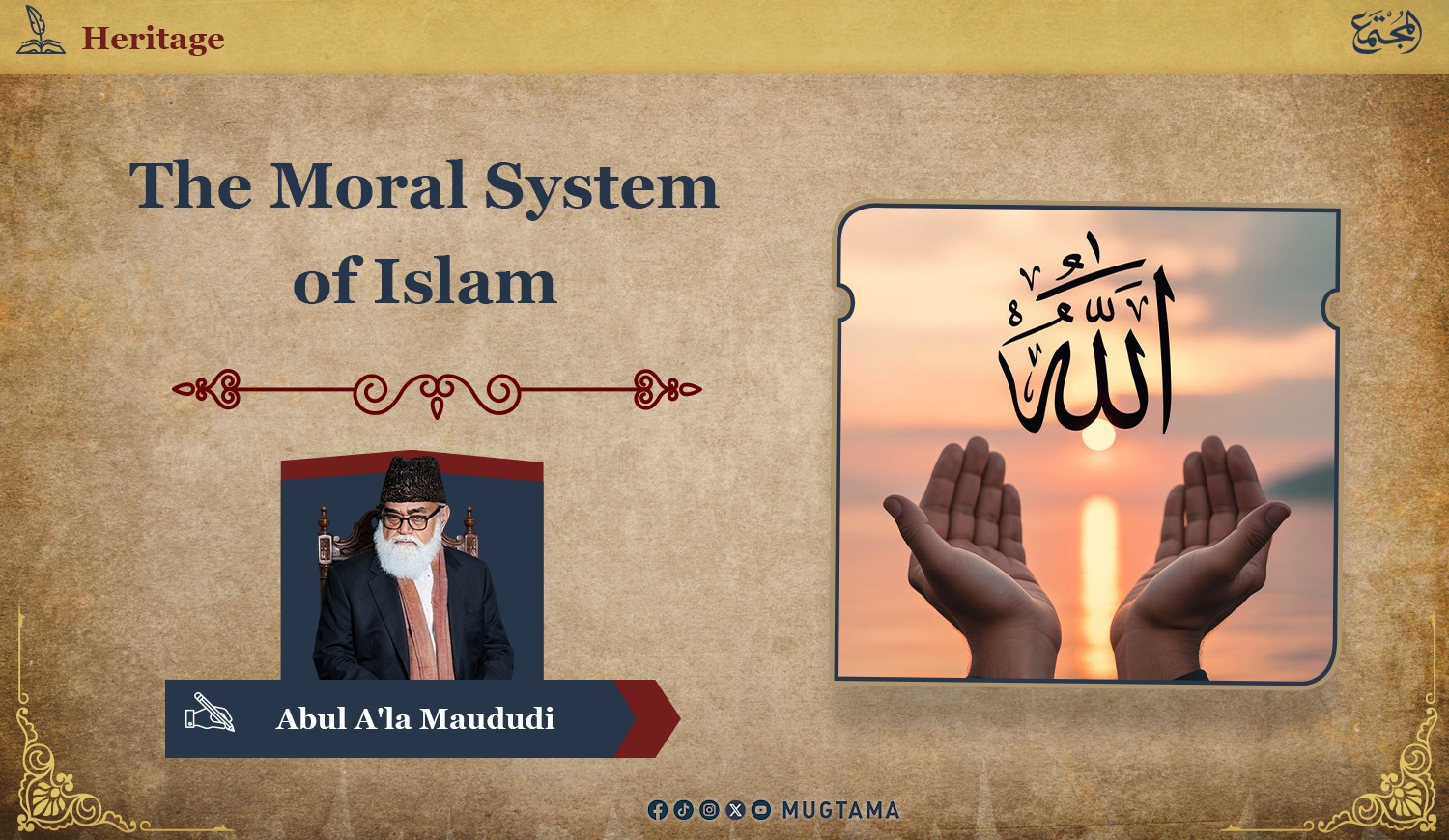
The Moral System of Islam
Moral sense is inborn in man and through the ages it has served as the
common man's standard of moral behavior, approving certain qualities and
disapproving others. While this instinctive faculty may vary from person to
person, human conscience has given a more or less uniform verdict in favour of
certain moral qualities as being good and declared certain others as bad.
On the side of moral virtues, justice, courage, bravery and truthfulness have always
elicited praise and history does not record any period worth the name in which
falsehood, injustice, dishonesty, and breach of trust may have been upheld;
fellow-feeling, compassion, fidelity, and magnanimity have always been valued
while selfishness, cruelty, miserliness and bigotry have never received the
approval of the human society; men have always appreciated perseverance,
determination and courage and have never approved of impatience, fickle mindedness,
cowardice and imbecility.
Dignity, restraint, politeness,
and amiability have throughout the ages been counted among virtues, whereas
snobbery, misbehavior and rudeness have never found recognition as good moral
qualities. Persons having a sense of responsibility and devotion to duty have
always won the highest regard of men; never have people who are incompetent,
slothful and lacking in sense of duty been looked upon with approval.
Moral Standards in Human Societies
Similarly, in respect of the
standard of good and bad in the collective behavior of society as a whole, the
verdict has always been almost unanimous. Only that society has been looked
upon as worthy or honour and respect which possesses the virtues of organization,
discipline, mutual affection and fellow-feeling and has established a social
order based on justice, freedom and equality of men. As opposed to this,
disorganization, indiscipline, anarchy, disunity, injustice and social
imbalance have always been considered as manifestations of decay and disintegration in a society.
Robbery, murder, larceny,
adultery, fraud and graft have always been condemned. Slandering, scandal
mongering and blackmailing have never been considered as wholesome social
activities. Contrary to this, service and care of the aged, help of one's kith
and kin, regard for neighbors, loyalty to friends, assistance of the weak, the
destitute, and the orphans, and nursing the sick are qualities which have
always been highly valued ever since the dawn of civilization.
The Quranic Concept of Good (Ma`roof) and Evil (Munkar)
Virtuous, polite, mild and
sincere persons have always been welcomed. Individuals who are upright, honest,
sincere, outspoken and dependable, whose needs conform to their words, who are
content with their own rightful possession, who are prompt in the discharge of
their obligations to others, who live in peace and let others live in peace and
from whom nothing but good can be expected, have always formed the core of any
healthy human society.
This shows that human moral standards are in fact universal and have been well-known to mankind
throughout the ages. Good and evil are not myths to be hunted out. They are
well-known realities and are equally well-understood by all. The sense of good
and evil is inherent in the very nature of man.
Hence, in the terminology of the
Quran virtue is called “Ma`roof” (something to be announced) and evil is
designated as “Munkar” (something to be denounced); that is to say virtue is
known to be desirable for every one and evil is not known to commend itself in
any way. This fact is mentioned by the Quran when it says: {And (Allah gave to the Soul) its enlightenment as to its
wrong and its right;.....} (Quran, 9l :8)
Why Do Moral Systems Differ Despite Shared Values?
The questions that arises are: if
the basic values of good and evil have been so well-known and there has
virtually been a universal agreement thereon, then why do varying patterns of
moral behavior exist in this world? Why are there so many and do conflicting
moral philosophies? Why do certain moral standards contradict each other? What
lies at the root of their difference? What is the unique position of Islam in
the context of the prevailing ethical systems? On what grounds can we claim
that Islam has a perfect moral system? And what exactly is the distinctive
contribution of Islam in the realm of ethics?
These questions are important and
must be squarely faced; but justice cannot be done to them on the brief span of
this talk. To cut a long story short, I shall briefly sum up some of those
important points which strike us at the very outset when we undertake a
critical examination of the contemporary ethical systems and the conflicting
patterns of moral behavior.
The Limitations of Contemporary Ethical Systems
(a) The present moral system fail to integrate various moral virtues and norms by
prescribing their specific limits and utility and assigning to them their
proper place. That is why they fail to provide a balanced and coherent plan of
social conduct.
(b) The real cause of their
differences seems to lie in the moral systems offering different standards for
good and bad actions and enunciating different means of distinguishing good from
evil. Differences also exist in respect of the sanction behind the moral law
and in regard to the motives which impel a person to follow it.
(c) On deeper reflection, we find
that the grounds for these differences emerge from different peoples
conflicting views and concepts about the universe, the place of man in the
universe, and the purpose of man on the earth. Various theories of ethics,
philosophy and religion are but a record of the vast divergence of views of
mankind on these most vital questions, viz.
Ultimate Questions of Existence and Their Moral Consequences
Is there a God and a Sovereign of
the universe and if there is, is He One or are there many gods? What are Divine Attributes? What is the nature of the relationship between God and the human beings? Has God made any arrangements for guiding
humanity through the rough and tumble of life or not? Is man answerable to God
or not? If he is, then what are the matters for which he is to be answerable?
What is the ultimate aim of man's creation which he should keep in view
throughout his life?
Answers to these questions will
determine the way of life, the ethical philosophy and the pattern of moral behavior of the
individual and the society.
Also Read:
- Value Centrality: Between Islamic Scruples and Man-Made Law Coercion
- How Islam Shapes Civilized Humans ?
- Islamic Value System and Civilizational Intersection Allure
-------------------------------------------------------------
Taken from: “Islamic Way of Life” book by Abul A'la Maududi