









Political Analysis:
The Israeli Assault Against Iran… Playing with Fire

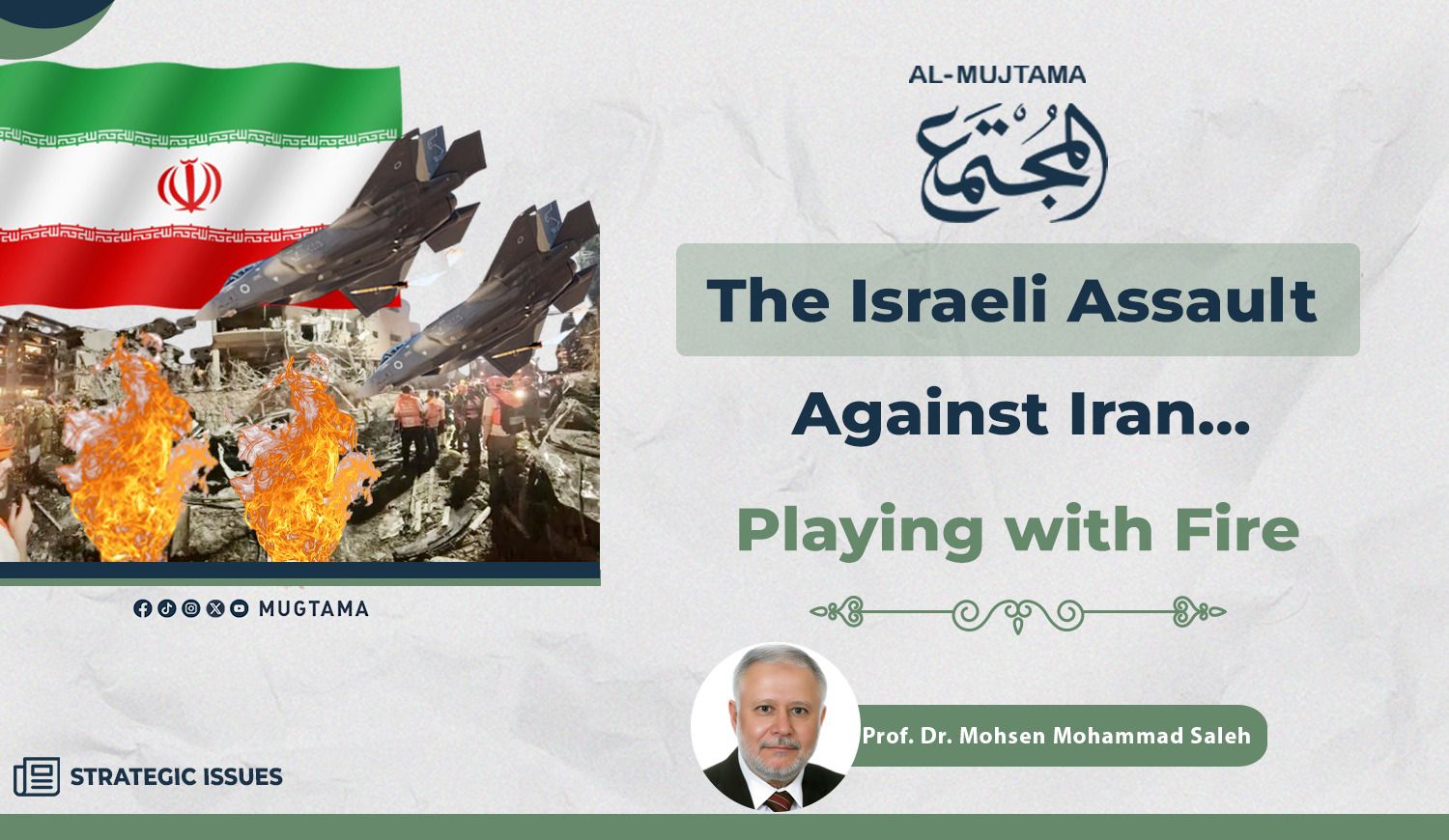
The Israeli assault launched against Iran shortly before dawn on Friday, 13/6/2025, targeted three levels:
First: The military command-and-control
system, including senior army and Revolutionary Guard leadership.
Second: The core infrastructure of
Iran’s nuclear program—particularly nuclear stations and reactors, as well as
missile and drone launch bases.
Third: The qualitative level,
represented by senior nuclear scientists involved in Iran’s nuclear project.
This multi-phase assault—carried out in five waves at the time of
writing—sought to deliver a severe preemptive strike against the nuclear
program, disrupt command and control systems, and disable key elements of
Iran’s deterrent capability. With the confirmed assassination of Iran’s Chief
of Staff, the head of the Revolutionary Guard, several top-tier military and
Guard commanders, along with a number of nuclear scientists, and with direct
damage inflicted on the targeted nuclear reactors, Israel began celebrating its
achievement, even as anticipation mounted over Iran’s potential response. This
article, written just hours after the attack, offers only a preliminary reading
of the assault.
Netanyahu, who named this assault Operation Rising Lion,
described it as a pivotal moment in Israel’s conflict history and a necessary
measure to confront the “existential” threat posed by Iran’s nuclear program
and to secure Israel’s safety. He obtained unanimous approval from the security
cabinet for the attack. Israeli sources justified the offensive by stating that
intelligence had recently detected an acceleration in Iran’s pursuit of nuclear
weapons capabilities, claiming Iran was nearing the “point of no return.”
Reports by international inspectors also indicated that Iran possesses enough
material to produce 9 nuclear bombs, an assertion Netanyahu emphasized in his
speech.
The Israeli aggression aligns with Netanyahu’s long-term
security vision, which extends beyond merely restoring Israel’s deterrence
image lost on 7/10/2023. It aims to expand Israel’s security dominance across
the surrounding strategic environment in a blatant, violent and unapologetic
manner. Netanyahu outlined this vision publicly on the first anniversary of
Operation al-Aqsa Flood (7/10/2024), under the pretext of safeguarding Israel’s
security and the future of Israeli generations. This same policy is now being
pursued in Lebanon and Syria.
The US… Deception and Role-Playing:
It is clear that the US played a significant role in executing
and ensuring the success of the Israeli attack. The Israeli airstrikes could
not have penetrated deep into Iranian territory without US logistical support,
especially regarding the use of Iraqi airspace and aerial refueling operations.
Prior to the attack, US media outlets leaked information about
the possibility of an Israeli strike. The Wall Street Journal cited
a senior Israeli official as saying a strike could come as soon as Sunday, June
15, if it did not accept the US proposals. The New York Times also
reported that “Israel appears to be preparing to launch an attack soon on
Iran.” The situation became clearer when the US took precautionary measures,
including evacuating some of its nationals from the region.
Israeli media revealed that the US was informed of the attack
well in advance and that Israel coordinated fully with the US. However, it
appears the US deliberately misled by confirming the sixth negotiation session
on Sunday, 15 June, while hints and leaks from President Trump expressed a
desire to continue and successfully conclude the talks.
The Iranian Response:
There are two possible scenarios for the Iranian response. The first is a
“calculated response,” similar to previous reactions, involving the launch of
hundreds of rockets and drones targeting specific locations within Israel. This
is a response for which Israel has prepared extensively; it has anticipated and
taken precautions against it, making it manageable, absorbable and its impact
weakened. Moreover, it lacks the element of surprise, which means Israel can
appear as the “victor” in the confrontation. This perception would embolden
Israel to continue violating Iran’s national security, as it does in Syria and
Lebanon, thereby weakening Iran’s regional standing.
The second scenario is an “equivalent response,” where Iran
delivers severe and precise strikes against Israeli leadership and its military
and nuclear infrastructure. Such a response could halt Israeli arrogance and
impose limits, forcing Israel into a defensive posture while establishing Iran
as a significant regional power that cannot be bypassed.
Certainly, neither option is easy for Iran. The “calculated”
response risks perpetuating an environment dominated by Israeli hegemony and
aggression. The strong, equivalent response is difficult to execute and fraught
with risks, including the possible entry of the US into the war, especially
since President Trump pledged to defend Israel, if necessary, in addition to
the danger of escalating the conflict into a wider regional war. Therefore, it
is expected that Iran will seek a balanced response that preserves its status
and prestige without being drawn into a regional war. It may continue
negotiations with the US on its nuclear file regardless of the nature of its
response, and it may decide to join the nuclear club if it perceives itself or
its political regime to be engaged in an “existential battle.”
***
Netanyahu may have sought, through attacking Iran, to escape
forward by boosting his popular support, maintaining his grip on power and
preserving his ruling coalition. He may also have aimed to present an image of
achievement in light of the failure to crush the resistance in Gaza Strip (GS)
and to free the Israeli prisoners, especially given his sinking deeper into a
quagmire of massacres, bloodshed, brutality and starvation, and the ugly image
of Israel in GS that has drawn global condemnation.
However, Netanyahu is, in reality, “playing with fire.’ What he is doing does not necessarily expand deterrence; rather, it broadens the circle of resentment, hostility, and conflict within the strategic environment, disrupting the peace process and normalization tracks, exposing the ugly face of Israeli occupation, and accelerating the arrival of a “new Arab Spring,” which increases existential risks to Israel. What Netanyahu fails to realize is that the mindset he operates under “what can’t be done by force can be done with even greater force,” might succeed elsewhere, but it will never succeed with the people of this Arab and Muslim region, deeply rooted in its civilization, history and heritage. Challenges only strengthen their faith and determination, fueling projects of reform, change and revolution against the bleak reality.
