






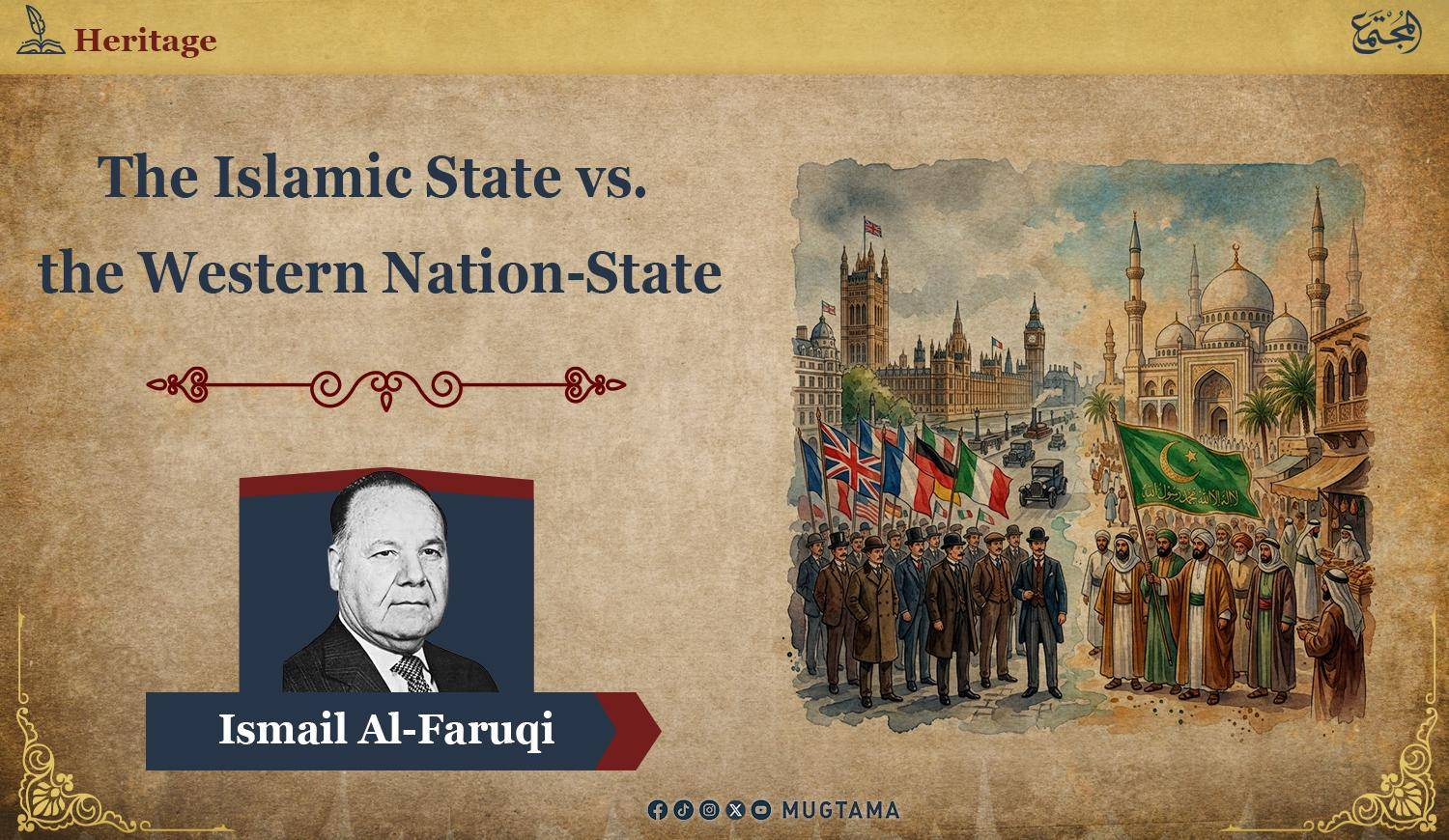
The Islamic State vs. the Western Nation-State

Western
political theory defines the state as consisting of four elements: territory,
people with common features, government, and sovereignty. It cannot exist
without territory, and that territory must have boundaries.
Its
citizens must share certain common features, such as racial characteristics,
language, customs, and history. Finally, the state must have corporate
institutions and a government that together exercise sovereignty, that is,
enforce in all aspects of life a will assumed to be the single will of the
whole. This is a definition of the Western national state, which is a creation
of the last three or four centuries of Western history.
The Islamic State and the Universal
Concept of the Ummah
Such a
Western state is radically different from the Islamic state. The latter does
have a territory, but this is not essential. It can exist without a territory,
as well as with one devoid of definite boundaries. Indeed, Islam asserts that
the territory of the Islamic state is the whole earth or, better, the whole
cosmos, since the possibility of space travel is not too remote. Part of the
earth may be under the direct rule of the Islamic state and the rest may yet
have to be included; the Islamic state exists and functions regardless. Indeed,
its territory is ever-expansive. So is its citizenry, for its aim is to include
all humankind.
If the
Islamic state is at any time restricted to a few of the world’s population, it
does not matter as long as it wills to comprehend humanity. Its citizenry need
not be all Muslim and, in fact, has hardly ever been all Muslim. What is
important is that its citizenry includes all those humans who agree to live
under the auspices of the Islamic state because they approve of its order and
policies. The Islamic state never binds people to its citizenship against their
will. They are always free to move out, together with all their people, relatives,
dependents, and everything they possess.
The Covenant of Madinah: Religious
Freedom and Community Rights
The
Islamic state derives its constitution from the Covenant of Madinah, which the
Prophet (peace be upon him) granted to the city upon his emigration there in
622.
The
spirit of that covenant has determined every Islamic state in history. The
covenant stated that the Muslims, regardless of their origins (they belonged to
different tribes and nations), are one Ummah, or community. That is to say,
they constitute one corporate entity regulated by Islamic law.
The Ummah
has its own institutions, courts of law, and schools for the education of its
children. The Ummah’s governance, with a view to self-realization—to achieving
the full measure of its religion, its genius, its laws, its ethics, and
culture—is guaranteed. So is its perpetuity. For an Ummah has the freedom to
pass on to its offspring its legacy of religion and culture. The Ummah, then,
is a community living up to its own ideals, or at least seeking to do so in
perfect freedom.
Besides
recognizing and establishing the Muslims as an Ummah, and
hence wiping out their racial and tribal differences with the universalism of
Islam, the Covenant of Madinah recognized and established the Jews as another
Ummah, on a par with the Muslim Ummah. They too constitute a community that
ought to be given full freedom to
realize itself according to its own legacy and genius. It should have its own
religion, its social institutions, its own laws and courts to administer them,
its own language and culture, its own ambiance, and schools in which to bring
up its children according to its own genius. It should enjoy all that is
necessary to perpetuate itself.
-------------------------------------------------------------
Taken from “Islam” by Ismail Al-Faruqi