









The Islamic Concept of Scientific and Technological Progress

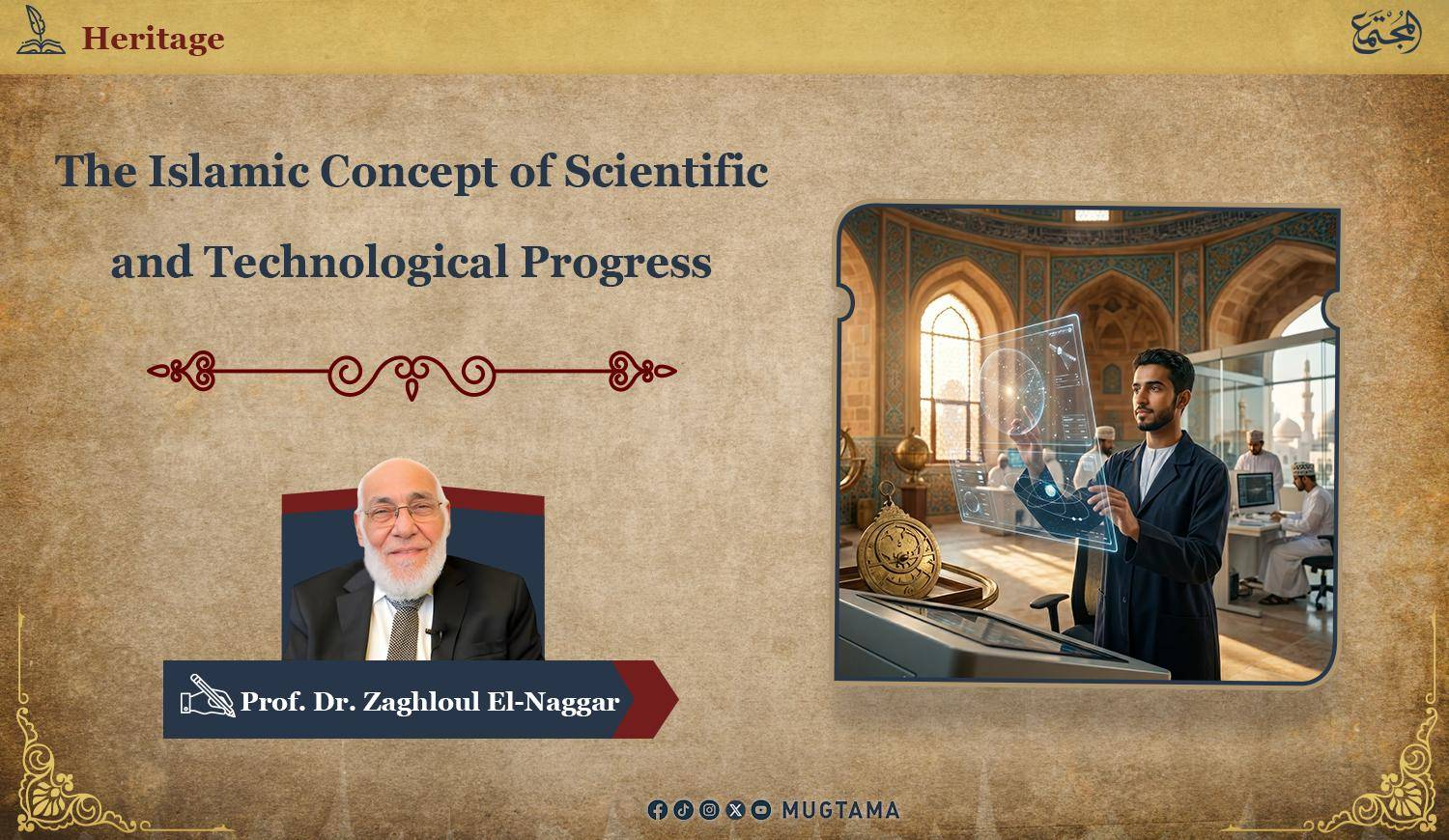
If the concept of scientific and
technological progress in any society is determined by the stock of knowledge
available to that society at a particular time, and by its ability to employ
its scientific resources and technological capabilities in a comprehensive
developmental process that achieves the material cultivation of life at the
level of its age—while maintaining the ability to improve and develop that
level continuously through the advancement of scientific knowledge and
available technologies—then, in Islam, this concept expands to encompass human
growth in all its dimensions until it reaches the honor described by Allah, the
Exalted, in His saying: {Indeed, We have dignified
the children of Adam, carried them on land and sea, granted them good and
lawful provisions, and privileged them far above many of Our creatures.}
[Al-Isra’ 17:70]
While the modern concept of scientific
and technological progress has been confined within narrow boundaries that
encompass only a number of purely material concepts—whose outcomes are
restricted to economic, urban, political, and military advancement, together
with industrial activity, agriculture, increased production, control over land
and its resources, and attempts to dominate its environments—in Islam it
includes all of this while simultaneously emphasizing the growth of the human
being in all dimensions, whether as an individual, a family member, or part of
a society.
This comprehensive development begins
with the ability to secure material necessities—which enable human beings to
fulfill their responsibility of stewardship on earth
and contribute to its cultivation—and extends to their spiritual, intellectual,
moral, behavioral, and doctrinal aspirations, which connect them to their
Creator and help them realize their true identity as servants of Allah and
understand the reality of humanity’s mission in this life.
Scientific Research as a Path to Knowing
Allah
The Muslim does not view scientific
research merely as a pursuit of discovering the secrets of the universe and the
laws established by Allah within it in order to exploit the earth’s resources
and exercise control over them—although these are among the responsibilities of
stewardship, as previously mentioned.
Rather, the Muslim sees scientific
inquiry as, above all, a path leading the seeker to Allah.
It is a means of recognizing some of
the attributes of the Magnificent Creator through contemplating His marvelous
creation within oneself and throughout the horizons. This knowledge of the
Creator and His attributes is itself one of the duties of servitude to Allah.
Such servitude represents the only
true guarantee against the misuse of scientific and technological achievements
in ways that displease Allah, let alone their employment in the many forms of
oppression, tyranny, exploitation, and corruption that have become widespread
throughout the world today.
The Muslim View of Nature and the
Universe
By way of example, not limitation, the
Muslim does not regard the universe as an enemy that must be conquered,
challenged, or subdued, as many modern Western philosophies
have proposed.
Rather, he sees it as a creation that
Allah has subjected for his benefit. He lives in harmony with it through
obedience to Allah, just as he lives in harmony with it through understanding
the divine laws that govern it.
He adapts to life’s circumstances
through adherence to truth, just as he adapts by understanding the laws
governing those circumstances.
After exhausting his abilities and
making his utmost effort, he accepts whatever outcomes occur—not the acceptance
of one who is defeated and compelled, but the acceptance of one who submits to
Allah, is content with His decree, and possesses complete certainty
that all affairs of the universe are in the hands of the Magnificent Creator,
who describes Himself by saying, {With Him are the
keys of the unseen—no one knows them except Him. And He knows what is in the
land and sea. Not even a leaf falls without His knowledge, nor a grain in the
darkness of the earth or anything—green or dry—but is ˹written˺ in a perfect Record.} [Al-An`am 6:59]
Thus, it is not appropriate for a
Muslim to use expressions such as “conquering nature,” “conquering space,” or “sky-scrapers”
when such expressions imply hostility between human beings and their environment.
The fundamental relationship is one of
harmony and compatibility, not hostility and challenge.
Islam, Resources, and Trust in Divine
Provision
Likewise, the Muslim does not view the
depletion—or anticipated depletion—of a natural resource as a crisis that
justifies intrigue, deception, conspiracies, or wars.
The Muslim does not view events such
as the invasions carried out by the United States of America and its allies against Iraq and Afghanistan, or the implantation of
the usurping Zionist entity in Palestine at the heart of the Arab and Muslim
worlds for the purpose of controlling, exploiting, and exhausting oil
resources, through the lens of material desperation.
Rather, the Muslim who understands his
religion believes that provision always comes from Allah. He is the One who
determines it, apportions it, and bestows it generously.
He is fully capable of sending
provision from the heavens in due measure and of bringing forth from the earth
treasures and blessings known and unknown to humanity.
This understanding does not imply
laziness or blameworthy dependence, which would contradict the obligations of
stewardship on earth or diminish the honor with which Allah has ennobled
humanity.
Regarding this, Allah says, {In heaven is your sustenance and whatever you are
promised. Then by the Lord of heaven and earth! ˹All˺ this is certainly as true as ˹the fact that˺ you can speak!} [Adh-Dhariyat 51:22–23]
And He says, {There
is no moving creature on earth whose provision is not guaranteed by Allah. And
He knows where it lives and where it is laid to rest. All is ˹written˺ in a perfect Record.} [Hud 11:6]
The Purpose of Scientific Advancement in
Islam
Accordingly, scientific research in Islam is not merely a means of earning a livelihood,
achieving personal glory, or gaining fame.
Nor is it simply a tool for
domination, superiority, or oppression over weaker peoples.
Rather, it is one of the paths leading
to Allah, the Exalted, and one of the means through which human beings fulfill
their mission in life as servants of Allah and vicegerents upon the earth.
They are required to worship Allah as
He has commanded and to fulfill the responsibilities of stewardship in the best
possible manner.
This includes cultivating the earth, establishing Allah’s justice and law, and assisting
the weak and vulnerable in achieving a dignified life according to one’s
ability—without arrogance, favoritism, harm, or oppression.
When scientific research is conducted
within this framework, it becomes an act of worship through which a servant
comes to know his Creator by contemplating the wonders of Allah’s creation.
It also becomes a communal obligation
(fard kifayah), such that the entire Muslim Ummah bears responsibility if it
neglects or abandons it.
If this is the Islamic vision of
knowledge, science, and technology, then why has the Muslim Ummah today fallen behind
in virtually every sphere of life in general, and in science and technology in
particular, despite having carried the banner of true civilization—both
religious and worldly—in a remarkable and integrated manner for more than ten
consecutive centuries without rival?
For Further Reading:
-------------------------------------------------------------
Taken from “The Issue of Scientific and Technical Backwardness in the Contemporary Islamic World” by Dr. Zaghloul El-Naggar
