






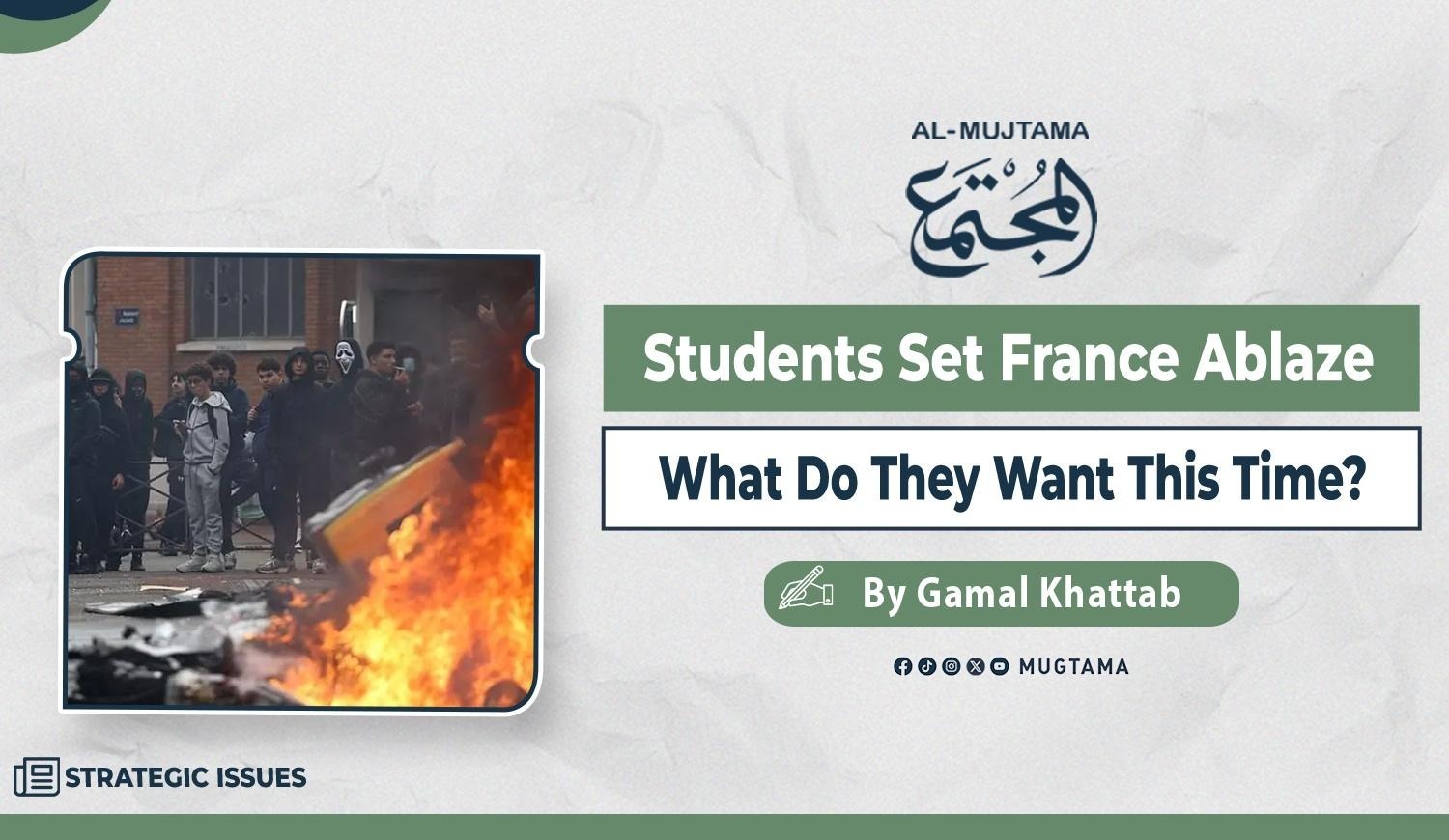
Students Set France Ablaze.. What Do They Want This Time?
On a morning in May 1968, thousands of students poured out of
Paris universities into the streets, believing they were protesting
campus-related issues and student freedoms. However, what began as sit-ins
inside lecture halls transformed within weeks into the largest political and
social crisis France had witnessed since World War II. Factories came to a
standstill, nearly ten million workers went on strike, and General Charles de
Gaulle's authority was shaken. It was then that the French realized a small spark
could ignite a massive political fire.
Six decades later, history seems to be repeating itself. The
streets of Paris, Lyon, Marseille, and Lille are witnessing a new wave of
protests today, led this time by high school students, but the tools have
changed.
A Republic of Permanent Protest
It is difficult to understand what is happening in France
today in isolation from history. Since the French Revolution in 1789, the idea
that popular pressure can force change when institutions fail to respond to
demands has been deeply rooted in the collective consciousness. Since then,
successive waves of uprisings, strikes, and popular movements have managed each
time to reshape the political landscape.
In May 1968, a student rebellion turned into a pivotal event
that transformed French society culturally and politically. This was followed
by the 1986 protests against higher education reforms, and a widespread wave in
1995 against pension and social security reforms.
In 2005, the suburbs of Paris and other French cities exploded
in one of the worst modern riots, after two teenagers died during a police
chase. The unrest lasted for weeks, leaving behind massive economic losses and
exposing the deep social divide between the suburbs and the central authority.
In 2006, students again led widespread protests against the
"First Employment Contract" law, forcing the government to back down.
Then came the "Yellow Vests" movement in 2018 to confirm that the
street remains a primary player in French political life, before riots returned
to the fore in 2023 following the killing of the young man Nahel Merzouk during
a traffic check.
Overcrowded Classrooms and Teacher Shortages
The current protests officially erupted due to problems
that the French education sector has known for years.
Students and teachers complain about overcrowded classrooms
(with classes sometimes reaching 35 students), a shortage of teachers, an
absence of substitutes for absent educators, deteriorating infrastructure in
many schools, and long school days that sometimes extend until 6:00 PM.
However, what started as educational demands quickly escalated
into widespread field confrontations. Classes were disrupted in more than 1,200
high schools during the peak of the protests, while hundreds of schools
remained closed in the following days.
The greatest paradox lies in the fact that a movement claiming
to defend education found itself accused of shutting down schools and depriving
thousands of students of their education.
TikTok: Gen Z's Weapon
While the students of 1968 relied on posters and paper
pamphlets, the students of 2026 rely on social media for mobilization and
organization.
The French government accuses the leftist La France
Insoumise (France Unbowed) movement, led by Jean-Luc Mélenchon, of exploiting
the anger within schools and turning it into political leverage. In this
context, the young MP Louis Boyard stood out, appearing in videos addressing
protesting students outside closed schools, while videos related to the
protests amassed millions of views on the TikTok platform.
Conversely, La France Insoumise denies these accusations,
asserting that its actions come in support of legitimate student demands.
Why Do They Resort to Violence?
The most pressing question in France today is not why students
are protesting, but why part of the protests always turns to violence.
One participant in the protests told a French radio station:
"We just want to show our dissatisfaction, and the only way, as history
has proven, is violence." In his remarks, he invoked the French Revolution as the most prominent example that radical change came through
confrontation, not dialogue.
Le Pen as the Biggest Winner... and Trump Steps In
As usual, the protests do not remain a local affair confined
within national borders.
President Trump stepped into the line, accusing immigration
and Islam of being behind what France is experiencing! He wrote on Truth Social
that what is happening "is not about schools, but about Islam's desire to
control a country that was once great"—an arbitrary and strange reading
that bypasses the educational and social demands raised by the protesters.
Inside France, the biggest beneficiary of these violent protests appears to be far-right leader Marine Le Pen. The more images of
fires, school closures, and clashes with the police escalate, the more the
right gains the ability to present itself as the force capable of imposing
order and restoring state authority.
Thus, the radical left finds itself in a striking paradox:
while trying to leverage youth anger against the government, the outcomes of
this rage may ultimately end up strengthening its most dangerous political
opponent.
France Between Yesterday and Today
Anyone reviewing French newspaper archives over the past six
decades will notice almost the same scene repeating: angry youth,
institutions accused of negligence, political parties seeking to exploit the
crisis, police confronting the street, and then a new political wave reshaping
the balance of power.
The difference this time, however, is that Generation Z does
not write its slogans on the walls of the Sorbonne; instead, it broadcasts them
live to millions of followers via smartphones.
Despite the changing tools, the question that has accompanied
France from the French Revolution until today remains without a decisive
answer: Can the Republic resolve its crises through dialogue and institutions,
or will the street remain the preferred tool for the French to force the state
to listen?
While waiting for an answer, schools continue to burn, students continue to demonstrate, and political forces watch the scene, searching for the votes that will be born from the womb of this anger.