








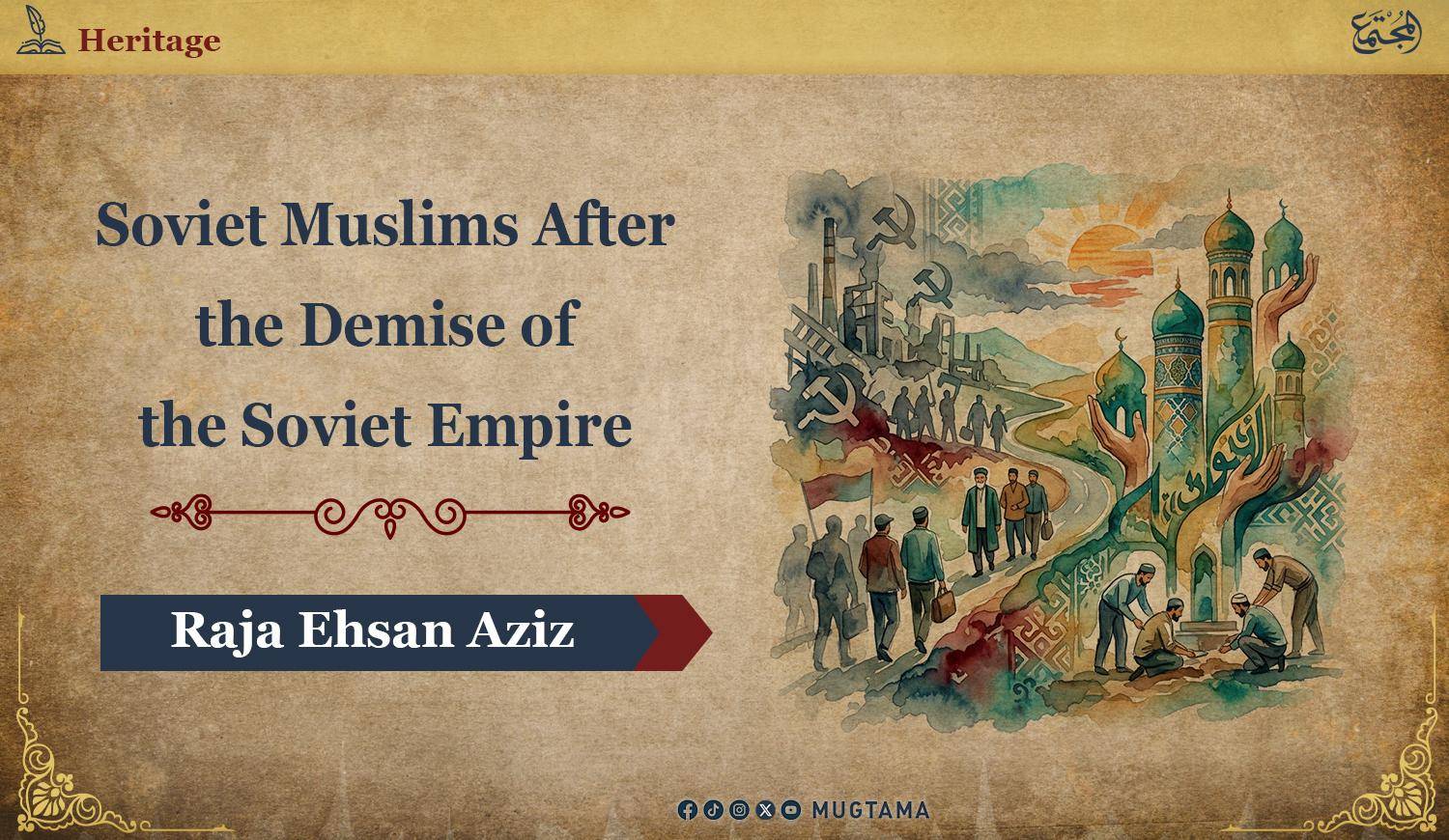
Soviet Muslims After the Demise of the Soviet Empire
The number of Muslims in the former Soviet Union ranges between 70 to 75 million out of a total population of 300 million. This means they represent the second-largest group after the Russian populations (inside and outside the Russian Federation). Between 50 to 55 million Muslims inhabit the independent republics of East Asia—where one is Caucasian and seven others enjoy autonomous status within the Russian Federation.
Muslims do not constitute a homogeneous group; they are divided along
ethnic, linguistic, and even tribal differences. Such an assessment was not
permitted under the communist regime. However, they share a cultural identity,
the Islamic faith, the Russian language, the Soviet lifestyle, and the
common suffering of living under the yoke of white European colonialism during
Tsarist rule in the Russian Empire.
The collapse of the Soviet state followed historic transformations in
Eastern Europe and the independent Baltic states, coinciding with the
establishment of the Commonwealth of Independent States (CIS). This
disintegration marked a pivotal point in the history of Soviet Muslims.
The stances of both the Tsarist and Russian Empires were rife with
deception, betrayal, and broken promises. Will these changes cause Muslims to
distance themselves from the rest of the former Union? Will the Muslim
republics accelerate their steps toward complete and comprehensive
independence, following the model of other independent countries in Africa and
Asia? What are the expected scenarios for the future of Soviet Muslims? And how
will they handle various trends? Such questions dominate the concerns of Soviet
Muslims today.
Remote from Slavic Conflicts and the Shift of Power
The Islamic republics remained removed from the arena of Slavic conflicts
in the former Union, ranging from ethnic disputes among Slavic groups to Boris
Yeltsin’s succession of Mikhail Gorbachev as the last strongman in Moscow.
Although the foundations of this Commonwealth link are not yet clear—as it does
not represent a central power, and choosing Minsk (Belarus) as its capital aims
to strip it of the specters of both empire and communism—Yeltsin’s unilateral
and defiant control over the former Union's nuclear and conventional weapons
makes him effectively in control of what was known as the Red Army.
The new Commonwealth reflects Gorbachev's proposed Union Treaty, yet it
lacks the status of statehood and homeland; it is merely a grouping that does
not constitute a state or a federation at all. However, as long as economic
pressure and control (the shared ruble currency) remain in Yeltsin's hands,
remote and impoverished republics will have to turn to the Russian Federation to
ensure their security and economic survival. In this regard, the fate of the
so-called autonomous republics does not differ much from that of certain Black
African republics when they gained fragile independence in the
1960s—independence that was sufficient to divert them from true resistance to
achieve full independence. At the very least, if no detailed, fair, and
enforceable charter exists for the new Commonwealth, Russian assurances that it
does not seek dominance over its smaller partners in the association will
convince no one.
The Quietest Empire Collapse in History
In reality, the new Commonwealth is merely an innovative, hastily devised
vehicle to ensure a peaceful transition toward the post-Soviet era, which may
prove full of surprises. Yeltsin's moves and the new Commonwealth association
appear aimed at imposing Russian control over the old empire. Furthermore, the
peace and prosperity of nearly 25 million Russians scattered across the former
Union are also threatened with collapse.
Within the next two years, a quiet dissolution of the empire is expected
to take place.
Of course, it would be the quietest demise of an empire in history.
However, looking back at the French, British, and other empires, all of them
generated problems and turmoil following their demise. In this respect, the
Russian case is far more dangerous due to its past filled with massacres and
bloodshed. There is no need to elaborate on the gravity of the ethnic,
economic, border, and countless other issues that remain unresolved across what
was the Soviet Union. To say the least, these very problems are bound to haunt
Yeltsin.
Economic decline and the loss of international status could drive
nationalists—who sided with communists against democrats during the failed
August 1991 coup attempt—to challenge Russian nationalism, which glorifies the
motherland, expansionism, and dominance. In fact, this would turn all balances
upside down. Will Yeltsin become a hostage or be forced to ally with the
nationalists in his efforts to support the Commonwealth and achieve stability
within it? However, this possibility remains unlikely.
A Return to the Islamic Republics
Let us return to the Islamic republics, which last year's referendum
showed to fall mostly into the category of conservative republics. However,
Tajikistan could potentially transform into an Islamic power due to its
proximity to Afghanistan and the strong influence it drew from the Afghan
Jihad.
On another front, Uzbekistan is home to the highest proportion of
Muslims among the Islamic republics (21 million Muslims). There are concerns
regarding Uzbek aspirations for dominance, as they form a significant minority
within Tajikistan (23%). Furthermore, fears regarding a larger European
presence relate to their high birth rate—the highest in the former Soviet
Union—driven by pride in having large and handsome families.
As for Kazakhstan, it is considered an Islamic republic where Russians
account for 28% of the population, Ukrainians 6%, Kazakhs 42%, and other
Islamic nationalities 11%.
Kazakhstan is also the second-largest nation after the Russian
Federation, followed by Kyrgyzstan, where the Russian population stands at 25%.
Both Kazakhstan and Kyrgyzstan share a long border with China, while the
proportion of Muslim minorities in the remaining Islamic republics ranges
between 7% and 12%. Meanwhile, neighboring Azerbaijan, whose population is
predominantly Shia, has been under Iranian influence since the 1979 Iranian
Revolution.
Thus, the Islamic republics located in East Asia are treading a
rough and complex path in their Islamic journey. The situation of the
autonomous Islamic republics is even more complex and warrants detailed future
study.
An Islamic revival is expected in Central Asia, though the
existence of ethnic and nationalistic tendencies could act as a divisive
factor, as seen in Uzbekistan.
It appears that these republics' neighbors among Muslim nations—such as
Turkey, Iran, Afghanistan, Pakistan, and further away, the Arab states—do not
serve as a political reference model for progress. Therefore, their opening
toward Central Asia may drive them into constructive competition with the
Central Asian countries.
With the collapse of communism, an ideological vacuum prevailed across
what was known as the Soviet Union. It is unlikely that Christianity will fill
this spiritual void. Consequently, this region has become fertile ground for
the spread of Islam throughout the Central Asian republics and into the
broader former Soviet Union. Therefore, a shared language and the presence of a
Russian minority could help spread the light of Islam to the far north of our
world. This task requires further continuous studies as well as substantial
linguistic and analytical capabilities—a responsibility that rests upon Islamic
organizations.
Population Estimates (1990–1991)
|
Entity / Country |
Population & Demographics |
|
Former Soviet Union |
300 Million |
|
Russian Federation |
150 Million (82.6% Russian, 15% Muslim) |
|
Ukraine |
53 Million (21% Russian) |
|
Uzbekistan |
21 Million (10.8% Russian, 16.5 Million [Muslims]) |
|
Azerbaijan |
7 Million (8% Russian, 8% Armenian) |
|
Kyrgyzstan |
4.5 Million (48% Kyrgyz, 26% Russian) |
|
Tajikistan |
5 Million (22.9% Uzbek, 10.4% Russian & Ukrainian) |
|
Turkmenistan |
4 Million (12.2% Russian, 8.5% Uzbek) |
|
Belarus |
10.5 Million (12% Russian) |
----------------
Published in Al-Mujtama Issue No. 986 — Sunday, January 26, 1992 - Written by: Raja Ehsan Aziz
