









Netzah Yehuda: A Zionist Battalion Overseen by Rabbis
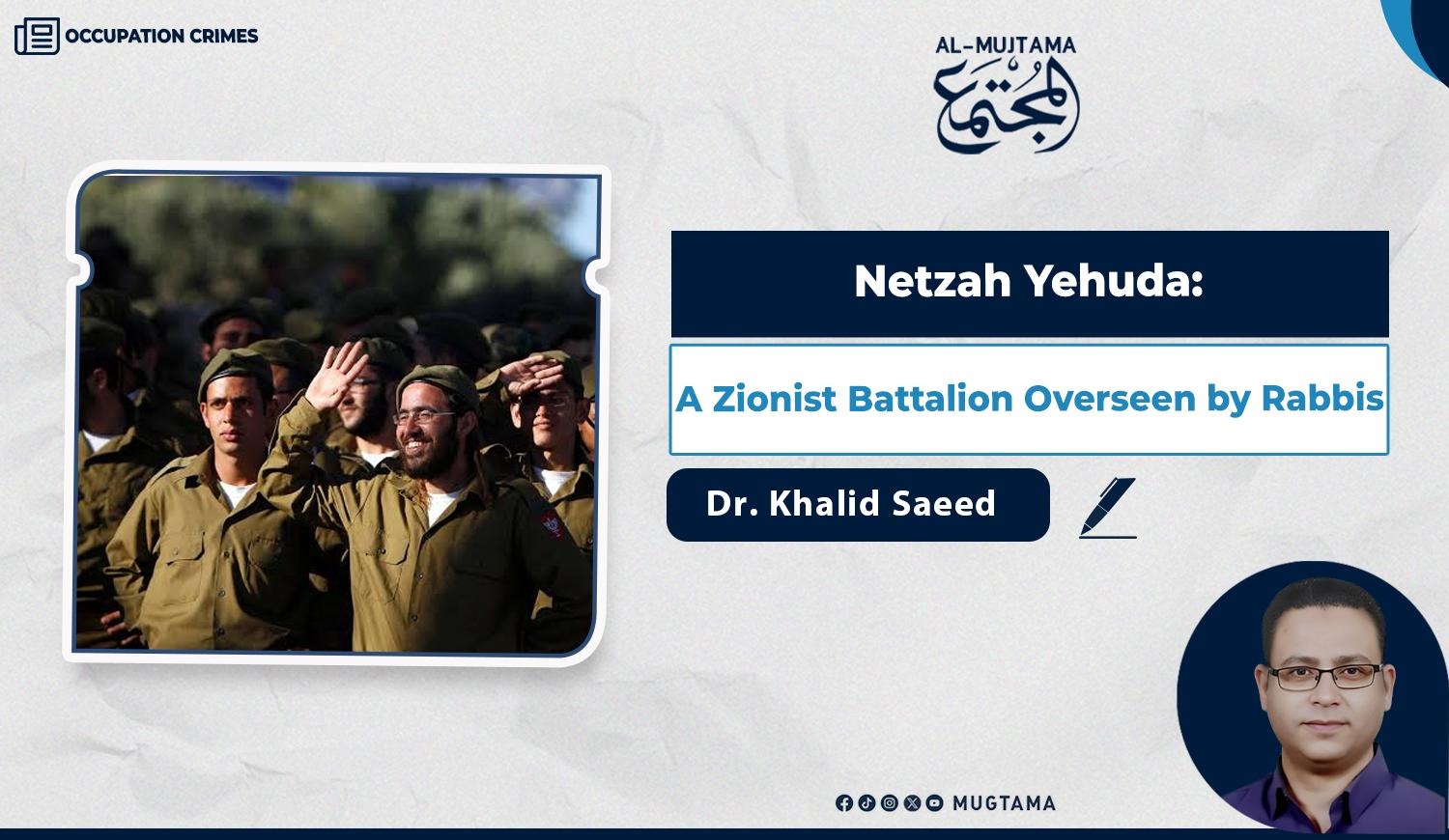
On September 7, 2026, a
soldier was found dead near a military base in northern occupied Palestine. It
later emerged that he belonged to the Netzah Yehuda Battalion, which operates
under the Kfir Brigade, marking the fourth Israeli fatality within just 48 hours
at the time. Although the military did not officially announce the incident,
the Hebrew-language news site 0404 attributed the death to a state of
internal and security disarray within the Israeli army. The circumstances
surrounding the incident remain undisclosed, with no determination made as to
whether it resulted from a targeted attack on the ground or falls within the
growing number of suicide cases.
News of the soldier's death
has paved the way for shedding light on the extremist Netzah Yehuda Battalion,
which is widely regarded and described as a special Zionist military unit and
the first ultra-Orthodox (Haredi) combat battalion serving in the Israeli army.
Netzah Yehuda: Origins and Establishment
According to the battalion's official website, Netzah Yehuda
was established in 1999, despite earlier failed attempts to form an
ultra-Orthodox (Haredi) unit. It is a special Haredi military unit composed
exclusively of extremist Jewish soldiers. The battalion was formed by Brigadier
General Yehuda Duvdevani, founder of the Givati Brigade, as part of a project
overseen by the extremist religious organization Netzah Yehuda in coordination
with the Israeli army's Social Services Unit. Initially operating under the
Nahal Brigade, it became an independent battalion in 2002.
A group of Haredi rabbis participated in launching the
battalion to integrate young men from the ultra-Orthodox community into the
Zionist army and society without compromising their religious traditions.
According to the Hebrew-language website Hamichlol, these soldiers are
frequently photographed wearing religious symbols and are permitted to grow
their beards and hair in accordance with Jewish law (Halakha). They are also
allowed to carry Torah scrolls inside their military bases across various
locations.
Religious Privileges for Netzah Yehuda Soldiers
The battalion's website noted that its soldiers enjoy special
privileges designed to preserve their extremist Jewish beliefs. Foremost among
these are full adherence to an ultra-Orthodox lifestyle, continuous Torah study
sessions, performing daily prayers in a minyan (a quorum of ten adult
men required for communal prayer), and being provided with strictly kosher
food.
The primary reason behind forming the battalion was to address
the issue of ultra-Orthodox (Haredi) youths aged 18 to 20 who were unable to
enroll in the strict religious educational system (yeshiva), enabling
them to perform military service and integrate into the army while preserving
their religious traditions. However, their numbers surged following the
genocidal war on Gaza, as they saw an opportunity to fulfill their extremist
agendas against the Palestinian people in the Strip.
From 30 Soldiers to a Haredi Battalion
Upon its establishment, the battalion operated under the
Jordan Valley Brigade and consisted of just 30 Haredi soldiers. Known at the
time as Nahal Haredi—an acronym for 'Haredi Fighting Youth'—it was later
renamed Netzah Yehuda. The Hebrew word Netzah translates to
'eternal' or 'forever,' while Yehuda was named after its founder, Yehuda
Duvdevani, giving the name the dual meaning of 'Eternal Yehuda.
Throughout its military deployments, Netzah Yehuda has
rotated between the occupied West Bank and the northern front in the occupied
Syrian Golan Heights. According to the Hebrew-language website Hamichlol,
these redeployments stem from the unit's operational nature, which is
characterized by killing, violence, and intimidation. Since early 2024, the
battalion has also been participating in the genocidal war on the Gaza Strip.
On September 17, 2025, the battalion was awarded a Medal of
Merit—or Distinction—by the Israeli army for its role in the genocidal war on
Gaza. According to the Hebrew-language daily Yedioth Ahronoth, the honor
came after the unit spent the preceding two years fighting in the Strip,
particularly in northern Gaza.
The newspaper quoted Captain 'Y,' commander of the extremist
religious battalion, as saying: 'Before the war, some families opposed the
enlistment of their sons, whereas today, parents fully understand why they are
here in Gaza.' This underscores that it was the bloodiest and most violent
battalion in its treatment of Palestinian civilians—a reality reinforced after
it received this military decoration from Central Command chief Major General
Avi Bluth, further proving its involvement in war crimes and human rights
violations. Moreover, the Hebrew daily noted that Netzah Yehuda was
among the battalions that participated in the killing of Yahya Sinwar,
head of Hamas's political bureau, on August 6, 2024.
Meanwhile, Lieutenant Colonel Avigdor Dickstein, commander of
the Haredi battalions, stated that the battalion's fighters serve as a role
model and an example of how to uphold the Haredi lifestyle as a combatant both
inside and outside the unit. According to Yedioth Ahronoth, he added
that they perform 'sacred work' during their operations, making a significant
contribution to the security of the people of Israel while fully preserving
their way of life.
The Battalion's Religious Ideology
The hardline battalion's ideology is rooted in extremism and
racist thinking driven by violence, sabotage, terror, and the killing of
Palestinians, under the pretext that these are deeply entrenched ideological
and political principles. Its members embrace the concept of 'Greater Israel,'
while the battalion operates as a special unit with a military doctrine
distinct from that of other secular units within the Zionist army.
Despite losing five soldiers and having 14 others wounded in
its ranks on July 7, 2025, in Gaza—during an ambush carried out by the Martyr Izzad-Din al-Qassam Brigades, the military wing of Hamas—the battalion
continued its killing of Palestinians in the Strip. As reported by Israel's Channel
14, the unit resumed its operations under the pretext of returning to its
combat mission for the sake of the State of Israel's existence.
U.S. Sanctions Against Netzah Yehuda
On April 26, 2024, the U.S. administration postponed the
implementation of a decision to impose sanctions on Israeli army units that
committed human rights violations in the occupied West Bank—foremost among them
the Netzah Yehuda Battalion. According to a report by the
Hebrew-language daily Haaretz on the same day, a special panel at the
U.S. State Department had launched an investigation in late 2022 into
allegations against the battalion following reports of human rights abuses and
acts of violence against Palestinian civilians. The most prominent of these
incidents was the death of elderly Palestinian-American Omar Assad during a
raid carried out by battalion members in the West Bank prior to the 'Al-Aqsa Flood' operation on October 7, 2023.
The Israeli army did not wait for formal sanctions to be
imposed on the Netzah Yehuda Battalion before issuing a statement on April
21, 2024, in its defense. As reported by Israel's Channel 12, the
statement declared that Netzah Yehuda fighters 'are a vital pillar in
operational activities.' Ultimately, Washington appears to have backed down
from imposing those sanctions.
Calls to Disband the Battalion
However, Hebrew-language media have documented internal calls
to disband the extremist battalion, including from former Israeli Labor Party
leader Merav Michaeli, over its years-long violent and corrupt conduct.
According to a report published on the same day by the Hebrew-language news
site Walla, Israeli officials had previously urged the unit's
dissolution for the exact same reasons.
Nevertheless, Netzah Yehuda continues to hold a
privileged status within the Zionist army. In fact, National Security Minister Itamar Ben-Gvir has expressed his readiness to absorb its members into the police
force and the Ministry of National Security, as well as the possibility of
integrating the unit into the Border Police—also known as 'Ben-Gvir's militias.
