









Political Analysis:
Netanyahu’s Strategy Toward Gaza

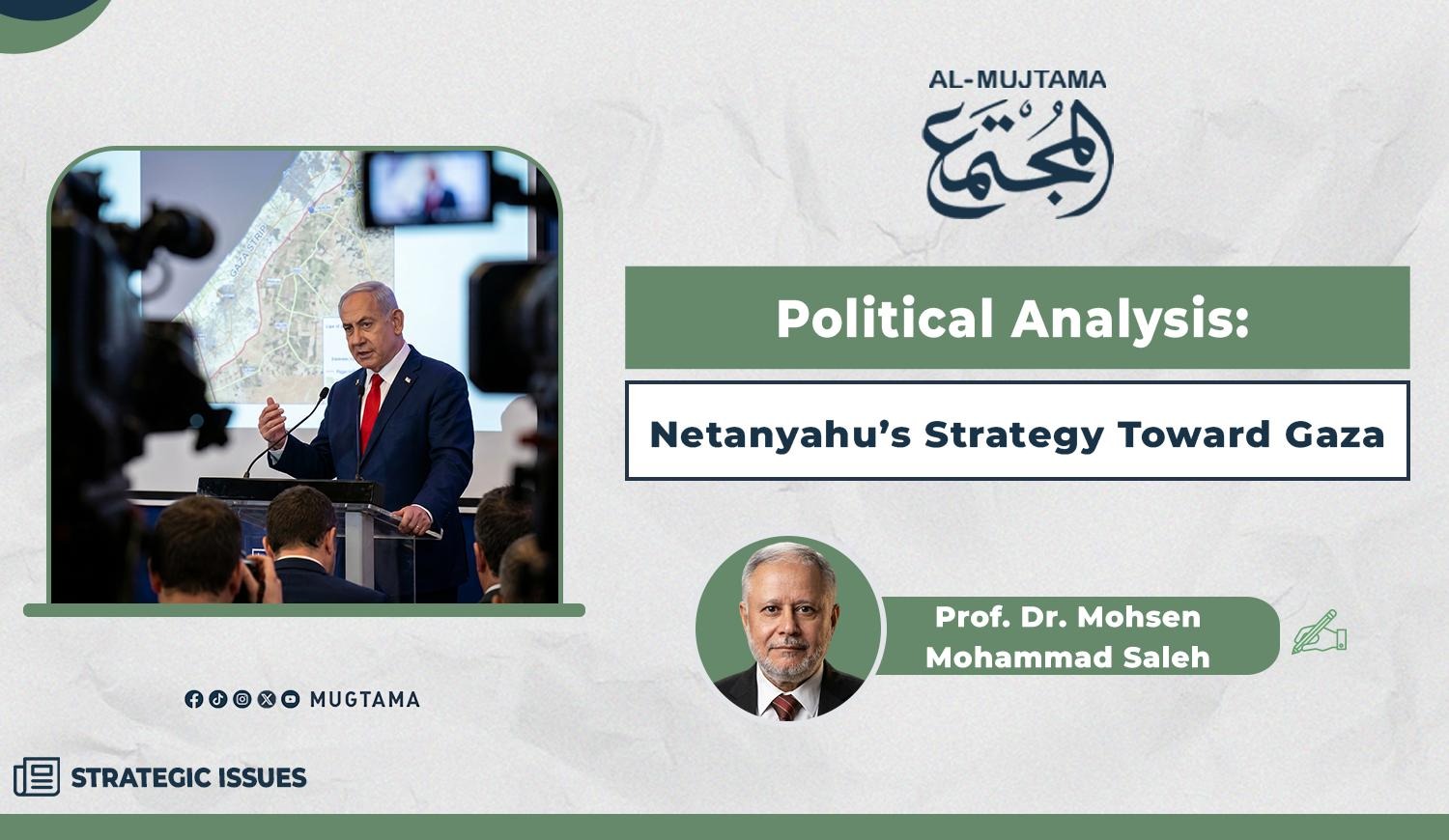
Recent days have witnessed a significant Israeli escalation in Gaza Strip (GS), resulting in a rising death toll, thousands of injuries, and an expanded scale of destruction. This escalation coincided with Netanyahu’s announcement that the Israeli army had increased the area designated as a “Yellow zone” from 52% to 60% of GS, while instructing military forces to expand its control further to 70%.
Netanyahu’s Strategy in GS:
Netanyahu’s strategy toward GS can be summarized as follows:
1. Continuing Israeli military operations in GS despite the
ceasefire announced on 10/10/2025, while effectively expecting only the
Palestinian side to adhere to its terms. Israel has treated this arrangement as
a de facto entitlement, enabled by sustained US political support.
Consequently, Israeli ceasefire violations have exceeded 2,200 incidents. Since
the ceasefire came into effect, Israeli actions have resulted in more than 945
Palestinians killed and about three thousand wounded.
2. Establishing new facts on the ground by expanding Israel’s
occupation of GS to 70%, while not excluding the possibility of extending
control over the entire territory. This represents a blatant violation of the
ceasefire agreement.
3. Sustaining political, economic, humanitarian and military
pressure on the population of GS to force the territory into submission and
compel the resistance to relinquish its weapons. This strategy includes
maintaining the blockade, permitting the entry of less than half of the
agreed-upon aid and supplies, preventing the deployment of the technocratic
committee tasked with administering GS, obstructing reconstruction efforts, and
continuing targeted killings and large-scale destruction.
4. Keeping GS in a state of chronic instability and
tension to facilitate a rapid return to war whenever deemed necessary, while
ensuring that the Strip remains in a condition of continuous attrition and
exhaustion.
5. Imposing severe living and humanitarian conditions in GS,
with the aim of pressuring the population toward forced displacement.
6. Providing support to collaborationist groups, including
arms and logistical assistance, so that they function as an auxiliary arm of
Israel in confronting Palestinian resistance and weakening the cohesion of the
social fabric in GS.
Worsening Humanitarian Conditions in Gaza Strip
Undoubtedly, these strategies have had a profound impact on
worsening humanitarian conditions in GS, where exhaustion has reached extreme
levels amid continued US political cover for Israel’s actions. This is
further compounded by the lack of serious US engagement in enforcing the first
phase of the ceasefire, as well as the limited effectiveness of the guarantor
states and the paralysis of UN bodies and international institutions.
Netanyahu’s Inability to Subdue the Resistance
At the same time, Netanyahu appears intent on securing a
tangible “achievement” that can be presented to the Israeli electorate ahead of
elections expected in October 2026. Current polling trends indicate a likely
victory for the opposition and a potential defeat for the governing coalition
led by Netanyahu. However, his central constraint does not lie in his capacity
for killing, committing massacres, destruction and starvation; rather, it lies
in his inability to subdue the resistance and achieve its disarmament. This
constraint is compounded by parallel strategic failures, including the
inability to disarm the resistance in Lebanon as well as the broader failure to
coerce Iran into strategic compliance or submission.
Netanyahu Prefers War to Peace
At the same time, Netanyahu appears wary of the prospect of a
US–Iran agreement being concluded before his government achieves its stated
objectives. In this context, escalation and the sustained destabilization of
the regional environment function as policy tools aimed at maintaining a
continuous cycle of conflict. This approach also serves to defer an eventual
political reckoning in which the outcome would likely be assessed as a failure
to realize those objectives.
More Blood, Fewer Achievements.
On the other hand, Netanyahu appears to be achieving no
meaningful “gains” in GS, having largely exhausted his available tools and
methods. In addition, the coercive approach and large-scale massacres have
deepened Israel’s domestic and regional challenges, while further increasing
its international isolation and reinforcing perceptions of it as a pariah
state. At the same time, Israel now finds itself, after successive rounds of
escalation in GS, Lebanon, Iran and Syria, in an increasingly fragile security
environment and a more hostile regional order, shaped by open-ended conflicts
that remain beyond Israel’s capacity to decisively resolve, thereby amplifying
risks and strategic uncertainty.
Accordingly, Netanyahu is likely to continue pursuing the
strategies outlined above in relation to GS at least until the next Knesset
elections, in the hope of securing a tangible “achievement” for domestic
consumption. However, mounting countervailing pressures are expected to
intensify, including a gradual erosion of US political cover, growing Western
pressure, stagnation in normalization tracks, and increasing signs of strain
within the Israeli military establishment. In this context, these strategies are
not necessarily stable or long-term. Rather, they remain contingent and subject
to adjustment as Israel recalibrates its approach in response to shifting
regional and international dynamics.
Source: Al-Zaytouna Centre for Studies & Consultations
Read also:
A
Reading of Potential Trajectories in the US–Israeli War on Iran
Gaza
Strip…The Forthcoming Clash of Wills
