






A Political Earthquake
Muslims in India’s West Bengal at Risk
Gamal Khattab
West Bengal awoke to an extremist political earthquake not
seen in decades. The victory of the far-right Bharatiya Janata Party (BJP) with
207 seats was not merely a shift in political roles with the Trinamool Congress
(TMC), but a declaration of a new “era” of Hindu extremism backed by the brute
force of the central government. For the first time since 1972, the state is
ruled by the same extremist party that governs New Delhi, granting right-wing
forces a sense of absolute impunity and unleashing a wave of systematic
violence targeting Muslims, who make up nearly one-third of the state’s
population.
Geography of Fear: Targeting Sacred Symbols
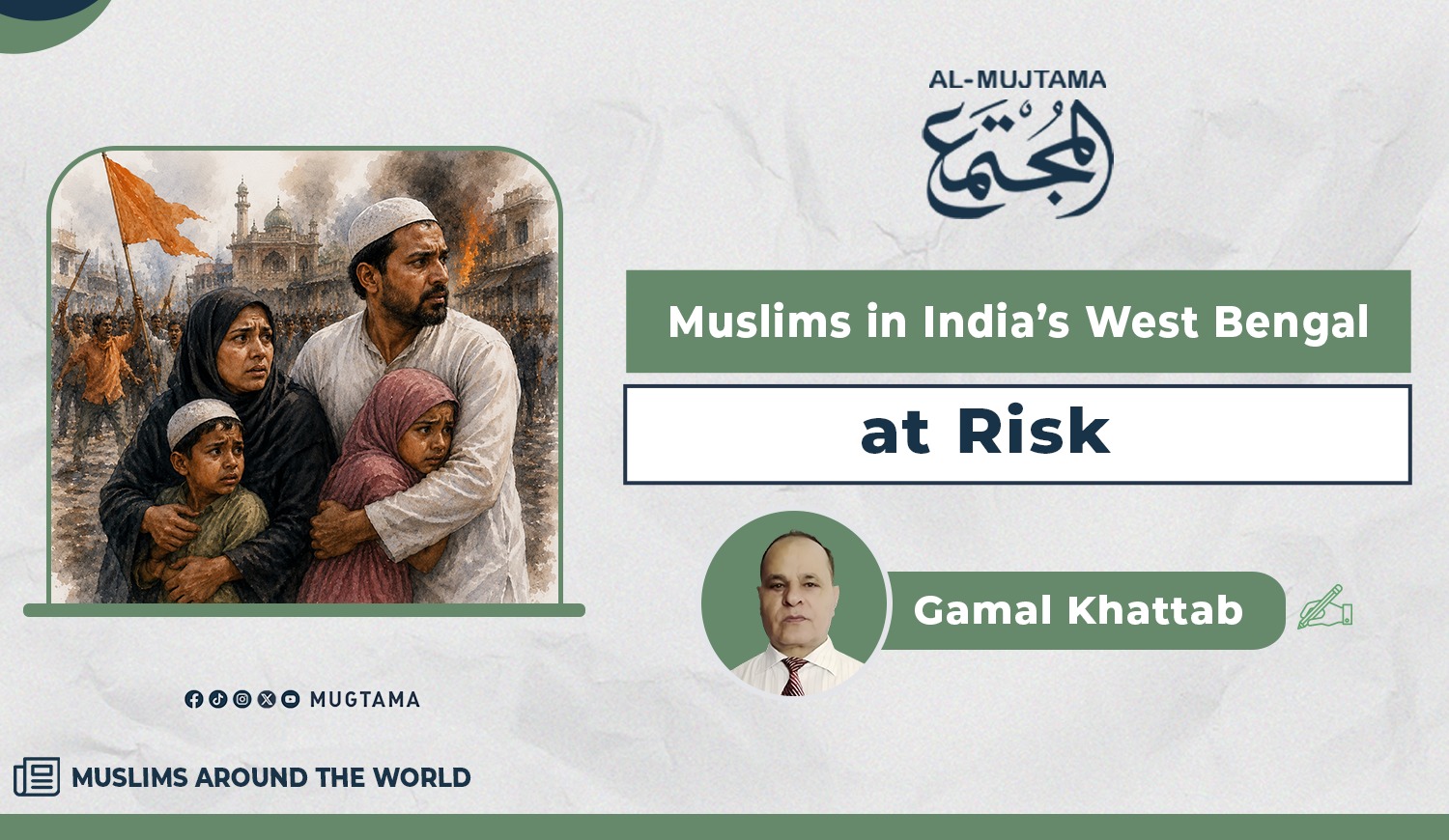
The violence spread from rural villages to urban centers. In
Chandrakuthi, Cooch Behar district, victory celebrations turned into brutal
attacks as Hindu extremist groups, backed by BJP authorities, stormed Muslim
homes and destroyed property amid suspicious silence from security forces.
Religious symbols were also targeted to break Muslim morale. In Darjeeling,
extremists climbed the minaret of Jor Bukhari Mosque and planted the saffron
flag — a symbol of Hindu nationalism — chanting “Jai Shri Ram” (“Glory to Lord
Ram”), evoking memories of sectarian crimes of the 1990s. In Murshidabad, the
historic Eidgah was stormed and its barriers smashed, sending a clear message
that public spaces were no longer safe for Islamic worship.
From Taj Mahal to Biryani Shops
The violence extended into cultural cleansing. In Dinata,
Hindu nationalist Hindutva activists set fire to a decorative replica of the
Taj Mahal, symbolically attacking India’s Islamic heritage while chanting
against Emperor Babur. Economic life was also targeted. In Dalkhola and
Bongaon, Muslim-owned biryani shops were threatened with closure or forced
relocation, especially near Hindu temples, striking at livelihoods and
undermining the region’s famed culinary diversity.
Bulldozer Politics
In Kolkata’s New Market, the most chilling symbol of modern
Indian politics appeared: the bulldozer. During a pro-BJP rally, a bulldozer
demolished a local TMC office in full view of police, who did not intervene.
This “bulldozer policy” has become a political weapon of intimidation against
Muslims nationwide. Parallel to physical destruction, symbolic erasure began.
In Islampur, BJP cadres sought to rename “Bara Mosque Road” to “Netaji Bali
Road,” replacing Islamic references with Hindu figures, deepening Muslim
alienation in their own neighborhoods.
Incendiary Hindu Rhetoric
These events escalated under the influence of inflammatory
rhetoric from extremist Hindu leaders. Suvendu Adhikari, who led BJP to victory
and is tipped as the next Chief Minister, openly declared he would work “only
for those who voted for him” — meaning Hindus — and that the “era of
favoritism” toward Muslims was over. This exclusionary rhetoric threatens to
transform West Bengal from a space of coexistence into a zero-sum battlefield.
The Future of Bengal at Stake
BJP’s 45% vote share reflects a tragic shift in the Bengali
electorate. Yet using this mandate to suppress Muslims endangers the state’s
future. Attacks on mosques, burning of historical symbols, and targeting
livelihoods do not build the promised “Golden Bengal,” but lay the foundation
for a sectarian state tearing apart the social fabric. If this path continues,
West Bengal risks becoming a permanent hotspot of communal tension that will
harm all communities.
Sources
- West
Bengal Human Rights Commission Report (2026): “Documenting Minority Rights
Violations After Assembly Elections.”
- Centre
for the Study of Developing Societies (CSDS): “Analysis of Voting Shifts
and Rising Communal Polarization in Eastern India.”
- The
Telegraph (Kolkata): Field coverage of vandalism in
Cooch Behar and Dinata (May 2026).
- Amnesty
International India: “Statement on Disproportionate Force and Bulldozer
Policy Against Opposition and Minorities in Bengal.”
- West
Bengal Police Records: “Reports on Street Renaming and Attacks on
Religious Sites in North Bengal.”
- Election Commission of India (2026): “Final Statistics of Assembly Seats and Voting Percentages by Constituency.”
Read also: