



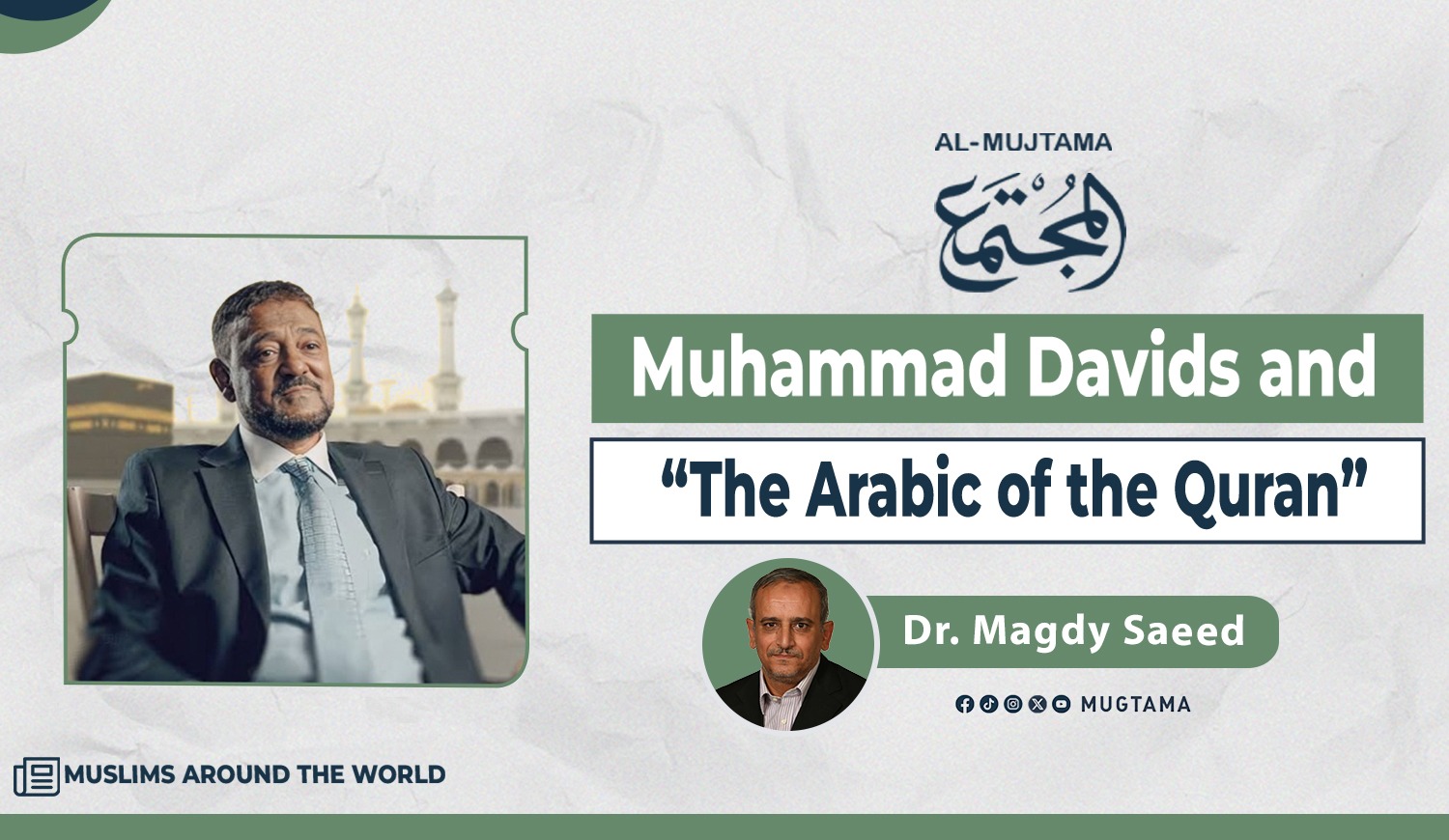
Mohammed Davids and “Quranic Arabic”

From the far
southern edge of our Islamic Ummah—specifically South Africa—came a unique
response to one of the most pressing, recurring, and enduring needs of nearly
90% of Muslims who are not native Arabic speakers: the ability to understand
the Quran through grasping its original language.
A simple need,
yet one that stretches across history and geography. It is a need that captured
the mind and heart of one member of this Ummah, stirring him into action. What
began as a concern transformed into determination, and from determination into
a project that took an entire decade to develop—ten years of study, planning,
and constructing a methodological solution that addresses two needs at once:
teaching Arabic to non-native speakers and enabling Muslims to understand the
Book of their Lord without reliance on translation.
In a lecture
delivered on March 9, 2025 (Ramadan 1447 AH), Mohammed Morshed Davids described
his personal journey with this need:
“I was born in South Africa, far from the Arab world yet close to Islam. I grew
up hearing the Quran recited in our home. I would repeat its verses before
understanding them, memorizing surahs without grasping their deeper meanings.
The Quran was present in our lives, but there was a barrier between it and us—a
barrier of language. I lived a painful paradox: reciting the words of Allah
without understanding them except through translation. That is where the
question arose that changed the course of my life: how can the Quran be a guide
if I do not possess the key to its expression?”
Driven by this
question, Morshed traveled to Riyadh, where he earned a degree in Islamic
Studies from Imam Muhammad ibn Saud Islamic University, along with diplomas in
Arabic from King Saud University and later from the Institute of Linguistics in
London. Prior to this, he had completed his undergraduate studies in Sociology
at a university in South Africa. He then pursued a Master’s degree in Arabic
Translation and Second Language Acquisition at the University of Salford in the
United Kingdom, followed by doctoral studies in Britain, during which he
designed a bilingual lexicon focusing on verb frequency in the Quranic text.
Morshed
described four stages in his relationship with the Quran:
The first began at the age of three, when he started memorizing it.
The second came when he resolved to study Arabic and Quranic exegesis.
The third unfolded as he began teaching the Quran in English to professional
teachers, imams, and preachers across ten countries in Southern Africa.
The fourth and final stage came when he realized that the priority was to
empower young people to understand the Quran directly in its original language.
This realization led him to dedicate ten years to developing his project, “Quranic Arabic.”
The
Linguistic Architecture of the Quran
Morshed
explains that the paradox which drove him to undertake this project lies in the
fact that approximately 1.5 billion Muslims read the Quran without
understanding it, and—by his estimation—150 million of them have memorized it
without comprehending what they recite. This, he argues, is the real challenge.
The Quran was not revealed merely to be memorized, especially since Allah has
already guaranteed its preservation—and, by extension, the preservation of its
language. Nor was it revealed solely for recitation, even though Allah praises
those who recite it as it ought to be recited. As Morshed explains, true
recitation entails understanding and acting upon it.
From this
perspective, he began his project by studying the linguistic architecture of
the Quran. As he notes, the Quran contains approximately 77,400 words, of which
only 5,155 are unique and non-repeating. There are 3,680 nouns and 1,495 verbs,
while 1,700 words appear only once. Remarkably, just 400 words account for 80%
of the entire Quranic vocabulary.
He also points
out that Surah Al-Fatiha, which Muslims recite at least 17 times a day,
consists of 29 words. Yet when analyzing the roots of these words, they appear
7,430 times throughout the Quran.
To complete
their work, the research team examined the themes of the Quran, its common
expressions, frequently occurring supplications, semantic opposites and
parallels, synonyms (where applicable), closely related meanings, recurring
word pairings, and semantic fields across the Quranic text. They also conducted
surveys to identify Quranic vocabulary familiar even to non-Arab Muslims.
All of these
analytical and linguistic studies—carried out by a large team of scholars and
funded by Morshed Davids’ family in South Africa—ultimately aimed to develop a
structured educational program. The result was a 700-hour curriculum designed
to achieve two goals: teaching Arabic to non-native speakers and enabling
direct understanding of the Quran. This curriculum was compiled into six books
and tested in 37 countries.
Digitization
and an Interactive Platform
The project’s
team has begun digitizing the curriculum through an interactive platform that
teaches Quranic Arabic in seven languages, with plans to expand to eleven. The
curriculum is also set to be transformed into a mobile application, with future
integration of artificial intelligence into its learning process.
Several key
insights emerge from this initiative:
1.
The “Quranic
Arabic” methodology may well be one of the most intelligent and necessary
innovations for Muslims worldwide today, across all languages. It has the
potential to become the most effective global method for achieving these dual
objectives.
2.
The
advancement of Arabic linguistic sciences—through innovative approaches—is not
limited to native speakers. Historically, figures like Sibawayh contributed
profoundly to Arabic grammar, and today, non-native scholars like Mohammed
Morshed Davids continue this legacy through modern initiatives such as “Quranic
Arabic.”
Ultimately,
this project, along with its motivations and justifications, reinforces the
vital importance of teaching Arabic to non-native speakers as a fundamental
need for Muslims worldwide. At the same time, it highlights a critical reality:
if the heart of the Islamic world—the Arab world—does not fulfill its
responsibility in this regard, then the peripheries will claim their rightful
share in the language of the Quran, led by dedicated, diligent, and exceptional
individuals like Morshed Davids.
Read Also:
-
The Arabic Language: From Revelation to Civilization
-
Exporting the Arabic Language
-------------------------------------------------------------