







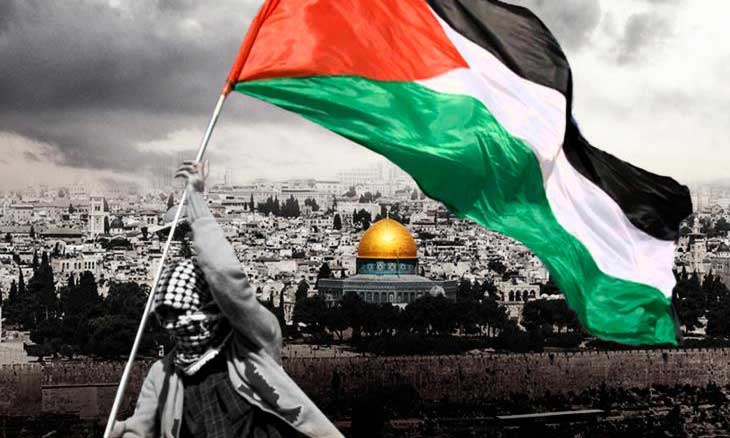

On ‘Nakba’ Anniversary
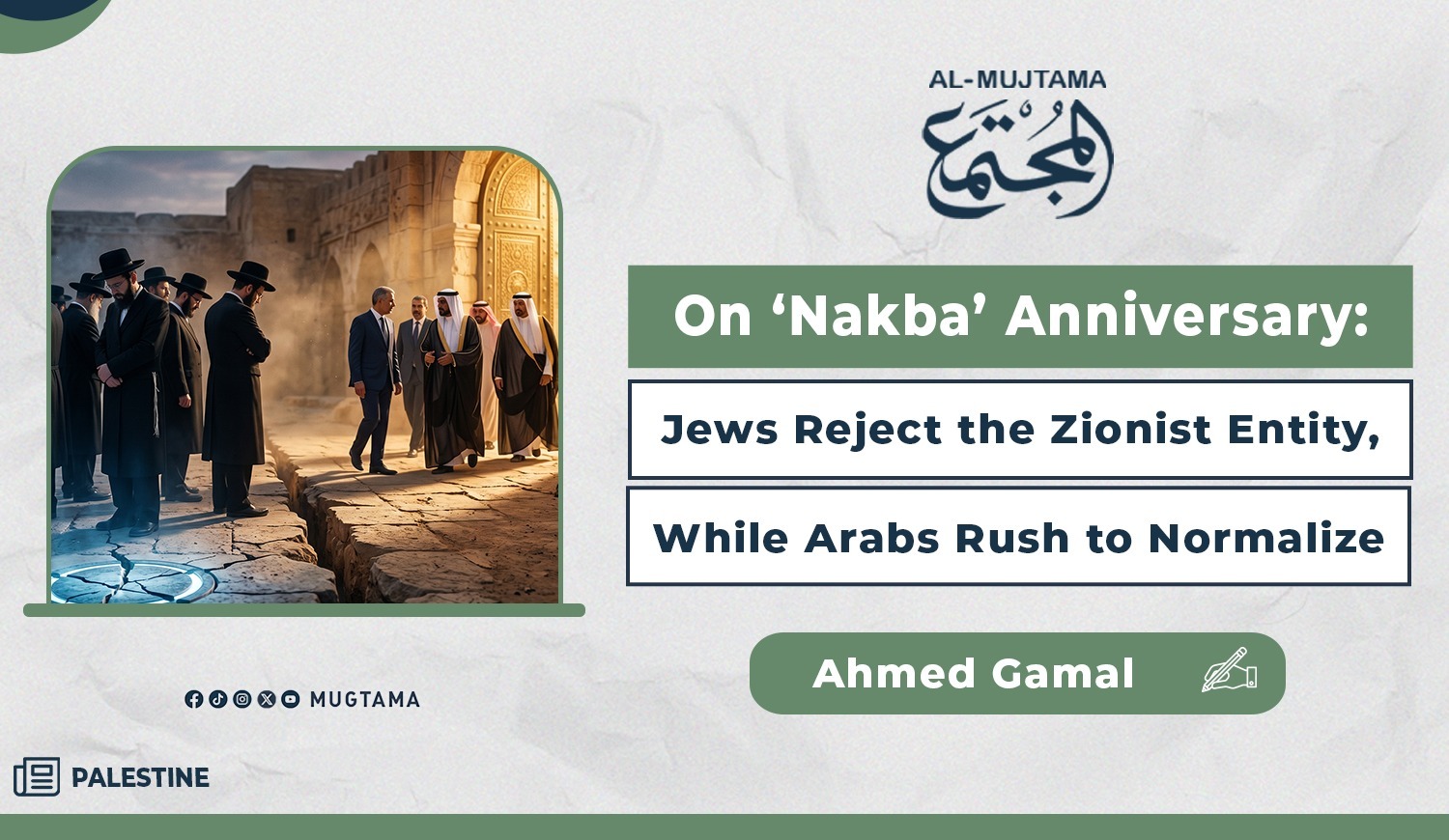
Jews Reject the Zionist Entity, While Arabs Rush to Normalize
On May 14, 1948, the establishment of
the so-called state of 'Israel' was announced on a stolen land and a displaced
people.
Seventy-seven years have passed, and
the wound has not healed. However, a stark paradox imposes itself on this
anniversary: while some Arabs race to normalize relations with this entity,
Jews from both within and outside it reject it—religiously, morally, and
politically.
Who, then, are these Jews who reject
the existence of the Zionist entity? Why do they reject what some Arabs are
rushing toward? Is it permissible for those struggling for Palestine to benefit
from their voices? And what does their existence say about an entity that
claims to represent all Jews?
Religious rejection
The Neturei Karta movement, whose name
in Aramaic means 'Guardians of the City,' was founded in 1935 by Orthodox Jews
who lived in Palestine before the establishment of the entity. Its membership
numbers around 5,000, distributed among Jerusalem, London, and New York.
Their stance is decisive: the
establishment of 'Israel' before the coming of the awaited Messiah violates the
Torah itself. On the walls of their synagogues is a phrase that leaves no room
for interpretation: 'Judaism and Zionism are diametric opposites that can never
meet.'
One of its leaders, Moshe Hirsch, went
so far as to participate in Yasser Arafat's government as Minister for Jewish
Affairs. Its leader, Rabbi Meir Hirsch, says: 'The creation of
"Israel" violates the Jewish faith itself; "Israel" is not
a state, but rather a criminal regime that took control of the Jewish people
through terror and force.
Heritage-based rejection
The 'Edah HaChareidit' community,
founded in 1921, represents a faction of ultra-Orthodox Jews opposed to Zionism
out of adherence to authentic Jewish heritage. Its members do not speak Hebrew
because, in their view, it represents the language of the Zionists, not the
language of the Torah. They abstain from participating in Knesset elections,
believing that such participation is forbidden. Their core stance is: 'Our
ancestors did not struggle for a Jewish state at the expense of another people,
and we have no right to change this heritage.'
Popular rejection
The 'Jewish Voice for Peace'
organization is an American Jewish movement active in American universities,
working to sever the relationship between American Jews and 'Israel.' It has
called for divesting from companies that support the occupation, participated
in the Freedom Flotilla to break the blockade on Gaza, and adopts a strategy of
complete international isolation for 'Israel.'
In 2024, its activists organized a
protest inside the U.S. Congress building, wearing red shirts that read, 'Not
in Our Name... Jews Say: Stop Arming Israel.'
Similarly, the International Jewish
Anti-Zionist Network commits in its founding charter to dismantling the
'Israeli' apartheid system, seeking the return of Palestinian refugees, and
ending the 'Israeli' colonization of Palestine.
The network has organized protests in
dozens of American and European cities and has explicitly stood with the
Palestinian resistance throughout all stages of its conflicts with the entity.
Intellectual rejection
Jewish rejection is not limited to
religious movements; it extends to Jewish thinkers and academics who have left
a deep imprint on the global discourse.
Historian Ilan Pappé argues in his
book Ten Myths About Israel that the entity is built on systematic lies,
from the myth of 'a land without a people' to the claim of being the only
democracy in the Middle East. He describes 'Israel' as a settler-colonial
project dedicated to two missions: the dehumanization of Palestinians, and
cleansing Palestine of them. His conclusion is that the entity is living its
final chapter, because genocide itself is the fundamental rift in its
structure.
As for Professor Les Levidow, he
exposes the fundamental contradiction in the Zionist project, saying: 'The
founders of the Zionist movement were atheists, then they needed a biblical
text to justify the expulsion of the Palestinians, so they used a religion they
did not believe in to serve a political project. Orthodox Jewish branches
opposed this exploitation from the very beginning, considering it an explicit
desecration of sanctity.'
And David Cannon, chair of the 'Jews
for Palestine' organization, turns the equation on its head when he says: 'The
West's support for the Zionist movement was antisemitism at its finest, because
the West did not want to welcome Jews into its countries, so it pushed them
into the land of others.'
Jewish writer Israel Shahak puts
forward evidence from the Talmud itself of the invalidity of the Zionist
project, citing a text that obligates Jews to three principles: not to rebel
against those among whom they live, not to migrate collectively to Palestine
before the coming of the Messiah, and not to pray insistently to hasten his
arrival."
Alternative vision
Udi Raz, a board member of Jewish
Voice for a Just Peace, holds a vision that he expresses by saying: 'I dream of
a single state from the Jordan River to the Mediterranean Sea that includes
Jews, Muslims, and Christians, ensuring equal rights and duties for them. Jews
used to live in Palestine and throughout all Arab countries, and no one stopped
them. As for "Israel," its doctrine is that it is a state for Jews
only, and this is the fundamental difference.'
A telling paradox
Thus, within the scene on May 14 of
every year, something difficult to explain comes together: Jews in London, New
York, and Jerusalem carrying signs that read 'Stop Israel'; Jewish historians
writing books that prove the falsity of the Zionist narrative; and religious
Jewish movements asserting that the establishment of 'Israel' is a biblical
sin. In contrast, Arabs and Muslims rush to normalize with the very same
entity, taking its side and defending its narrative!
This contradiction is revealing, not a
coincidence; it reveals that the matter is neither religious, between Islam and
Judaism, nor cultural, between East and West. Rather, it is a matter of right,
justice, and stolen land—a reality that many Jews themselves recognize and
declare, while some who claim to struggle in the name of Arabism and Islam
ignore it.
Those who reject this entity with
their voices in the streets of the world are not only Arabs; some are Jews who
say clearly, 'Not in our name.' Will those who rush toward normalization and
adopt the Zionist narrative listen?!
You may also like:
Is there a difference between a Jew, a Zionist, and an 'Israeli'?
Book Review: The Palestinian Diaspora in Latin America
==============================