





Islamic Model for Industrial Development
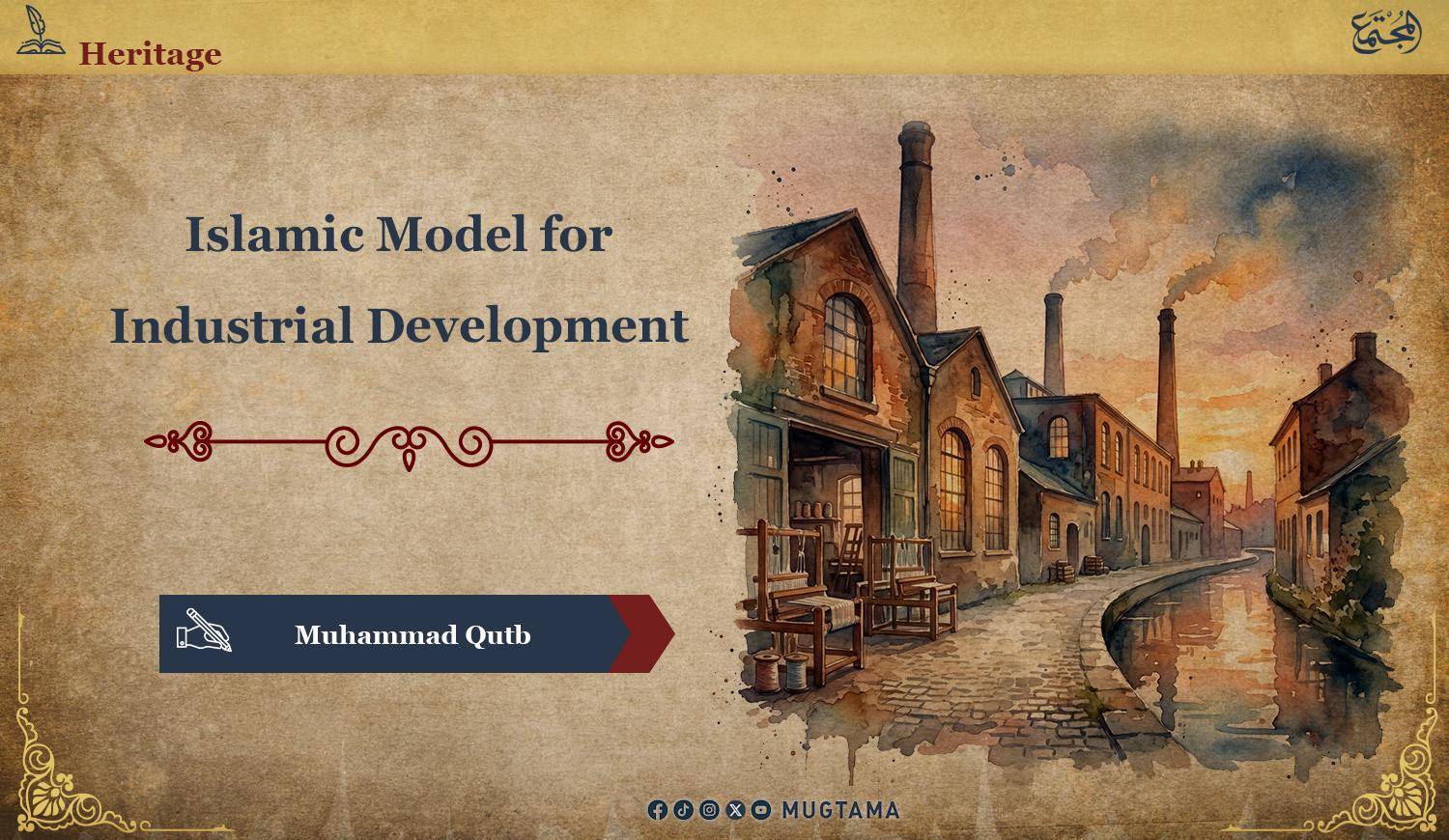
What would have
been the fate of industry if it had originated under Islamic rule?
Surely Islam
would not have restricted industry to minor workshops whose profit is shared by
the employer and the workman. Production would have rather grown but the
relationship between the employer and workmen would have developed on different
lines from those outlining the development of the employer-employee relations
in Europe in the nineteenth and twentieth centuries. It would have developed in
accordance with the basic principles of Islam such as the above-mentioned
principle which provides for an equal division of profit between the workmen
and their employer.
By so doing,
Islam would have avoided resorting to usury or monopoly and would have
precluded the injustice to which workmen are subjected under capitalism where
they are exploited and left to suffer poverty and humiliation.
It would be
foolish to suggest that Islam could not have established such justice without
first passing through hard ordeals, class conflicts, and economic pressures all
of which would ultimately lead to the amendment of its legislations. It is
proved beyond all doubt that Islam had been ahead of all nations in dealing
with the questions of slavery, feudalism, and early capitalism. In so doing
Islam was not acting under any outside pressure whatsoever. It was rather
acting voluntarily and in accordance with its own conception of eternal equity
and justice scoffed at by communist writers. On the other hand, it is a fact
that Russia, a model communist state, itself passed directly from feudalism to
communism without passing through the intermediary stage of capitalism. Thus
Russia-which adopted the doctrine of Karl Marx-practically gives the lie to
Marx's theory regarding the phases of development which, he says, every state
has to experience.
Islam's
Rejection of Colonialism and Economic Exploitation
As to
colonialism, wars and exploitation of peoples, it should be pointed out that
Islam is firmly opposed to all these as well as to all the other universal
evils engendered by capitalism. It is not one of the principles of Islam to
colonize other peoples or to wage any war against others for the purposes of
exploitation. The only war approved by Islam is that which is waged against
aggression or is meant to spread the Word of Allah (swt) where its peace and
peaceful dissemination is rendered impossible.
The communists
and their like allege that colonialism is an inevitable phase in human
development. They add that colonialism could not have been averted by any
doctrine or moral principle since it was essentially an economic phenomenon
resulting from a surplus in the production of industrialized countries and the
need for foreign outlets for marketing such surplus.
Needless to
say, Islam does not recognize such nonsense about the inevitability of
colonialism. Besides, the communists themselves say or profess that Russia will
solve the problem of surplus production by reducing both working hours and
workmen's role in production. The solution which communism professes to have
found may be used by other systems as well.
History bears
witness that colonialism has been an ancient human propensity. It did not
originate with capitalism although capitalism with its modern weapons of
destruction rendered it more ferocious. As to the exploitation of the
vanquished, Roman colonialists were more ruthless and monstrous than their
modern counterparts.
History
furnishes us with the best evidence to the effect that Islam has been the
cleanest of all systems as far as war is concerned. Islamic wars have always
been free from exploitation as well as subjection of others. Therefore, if the
industrial revolution had taken place in Islamic countries, Islam would have
solved the problem of surplus production without resorting to war or
colonization. Besides, it may be said that the problem of surplus production is
an outcome of the capitalist system in its present form only. In other words,
if the basic principles of capitalism are changed, the problem would not
exist.
Wealth
Distribution and the Responsibility of the Islamic State
As against
this, the ruler in the Islamic state shall not remain helplessly indifferent
towards the problem of the accumulation of wealth in the hands of a few people
while the majority are suffering from poverty and deprivation. Such amassing of
wealth is contrary to the principles of Islam which expressly prescribed that
wealth should be fairly distributed among all the people lest it should be
confined to the rich only. The ruler in Islam is charged with the enforcement
of Sharia (Islamic law) by all means at his command without any injustice or
harm to anyone. In this respect, the ruler is invested with full and unlimited
powers within the bounds set by Allah's law-the law that precludes the
accumulation of wealth. We might refer in this respect to the law of
inheritance which ensures that wealth left by each generation is properly
distributed. Reference should also be made to Zakah (poor-due) which prescribes
that 2.5% of the capital and profit should be annually earmarked for the poor.
In addition, Islam explicitly prohibits the hoarding of wealth. It likewise
prohibits usury which is the basic factor in the accumulation of capital.
Moreover, the relationships among the members of Islamic society are based on
reciprocal responsibility rather than exploitation.
It should also
be added that the Prophet (peace be upon him) ensured for officials of the
state certain rights including the basic necessities of life: "If a
person who is charged with work for us (i.e. the state) has no wife, he shall
have one; if he has no dwelling place, he shall have one; if he has no servant,
he shall have one: if he has no animal to ride, he shall have one."
Such guarantees
are not to be confined to officials of the state only. They are the basic
necessities required by every person. They can be obtained in return for work
done in the service of the state or through any profession or occupation from
which society may benefit. If the state ensures the basic necessities for its
officials it must also ensure the same for every working individual in the
state. This is evident from the fact that the Public Treasury is responsible
for supporting those who are unable to work owing to old age, illness, or
childhood. The Public Treasury is also responsible for providing basic
necessities to persons who cannot obtain them owing to insufficient
means.
All the
above-mentioned facts emphasize the responsibility of the state to ensure by
all means the basic necessities for workers. There is no great importance to
the means by which such necessities could be provided to the workers; what
really matters is the principle which guarantees that profit and loss shall be
equally shared by all members of the nation. By providing such necessities for
workers Islam protects them against exploitation, besides ensuring a decent
life for all. Islam would not have allowed capitalism to grow into the
monstrous forms which are presently prevalent in the "civilized"
West. The Islamic legislations-whether originally prescribed by Sharia or newly
adopted to face new developments within the frame-work of Sharia-would not have
allowed the capitalists to exploit the working people or suck their blood.
Islam would have precluded all the evils of capitalism including colonization,
war and the enslaving of people.
Moral
Foundations of the Islamic Economic System
Islam, as
usual, is not content with the mere enactment of economic rules and laws. In
addition to law, Islam also makes use of moral and spiritual incentives which
are satirized by the communists because they see that such values have no
practical significance in Europe. But in Islam moral and spiritual values are
not separated from practical considerations. Islam has a unique manner of
combining and harmonizing both the purification of the spirit and the
organization of the community. The individual is never left to wonder how to
reconcile the ideal with the practical.
Islam
formulates its legislations on a moral basis so that the moral values are
always in harmony with the legislations. In this way, each side supplements the
other without any fear of conflict or divorcement.
Islamic
morality prohibits and discourages all forms of luxury and sensuality which are
the inevitable results of the amassing of wealth in the hands of a few people.
Along with this, Islam also prohibits being unjust to employees or underpaying
them. As the amassing of wealth is an outcome of injustice to employees, it
invariably means that it must also be discouraged. Islam calls the people to
spend their money in the way of Allah (swt)even if that should lead to
disposing of all one's property. It is because the rich people spend their
money on themselves rather than in the way of Allah (swt) that the majority of
the people live in poverty and deprivation.
The spiritual
elevation of men brought about by Islam brings them closer to Allah (swt) and
makes them renounce all worldly pleasures and profits in striving to attain
Allah's (swt) pleasure and in expectation of His recompense in the other world.
There is no doubt that a man who keeps his peace with Allah (swt) and has faith
in the other world, in Heaven and Hell, will not rush madly for the amassing of
wealth or resort to exploitation or injustice for the realization of his
selfish ends.
In this way the
moral and spiritual edification will pave the way for economic legislations
which aim at curbing the evils of capitalism. Consequently, when such
legislations are made they are sure to be complied with, not because of fear of
punishment but rather because people would be acting according to the dictates
of their conscience.
In conclusion,
it should be made clear that the monstrous capitalism which is currently
prevalent in the Islamic world is not a part of Islam as it is the outcome of
colonialism and the Western "civilization," and consequently, Islam
cannot be held responsible for its evils.
-------------------------------------------------------------
Source: Book “ISLAM
THE MISUNDERSTOOD RELIGION” by Muhammad Qutb