









How Does TikTok Shape Youths’ Awareness of Major Crises?

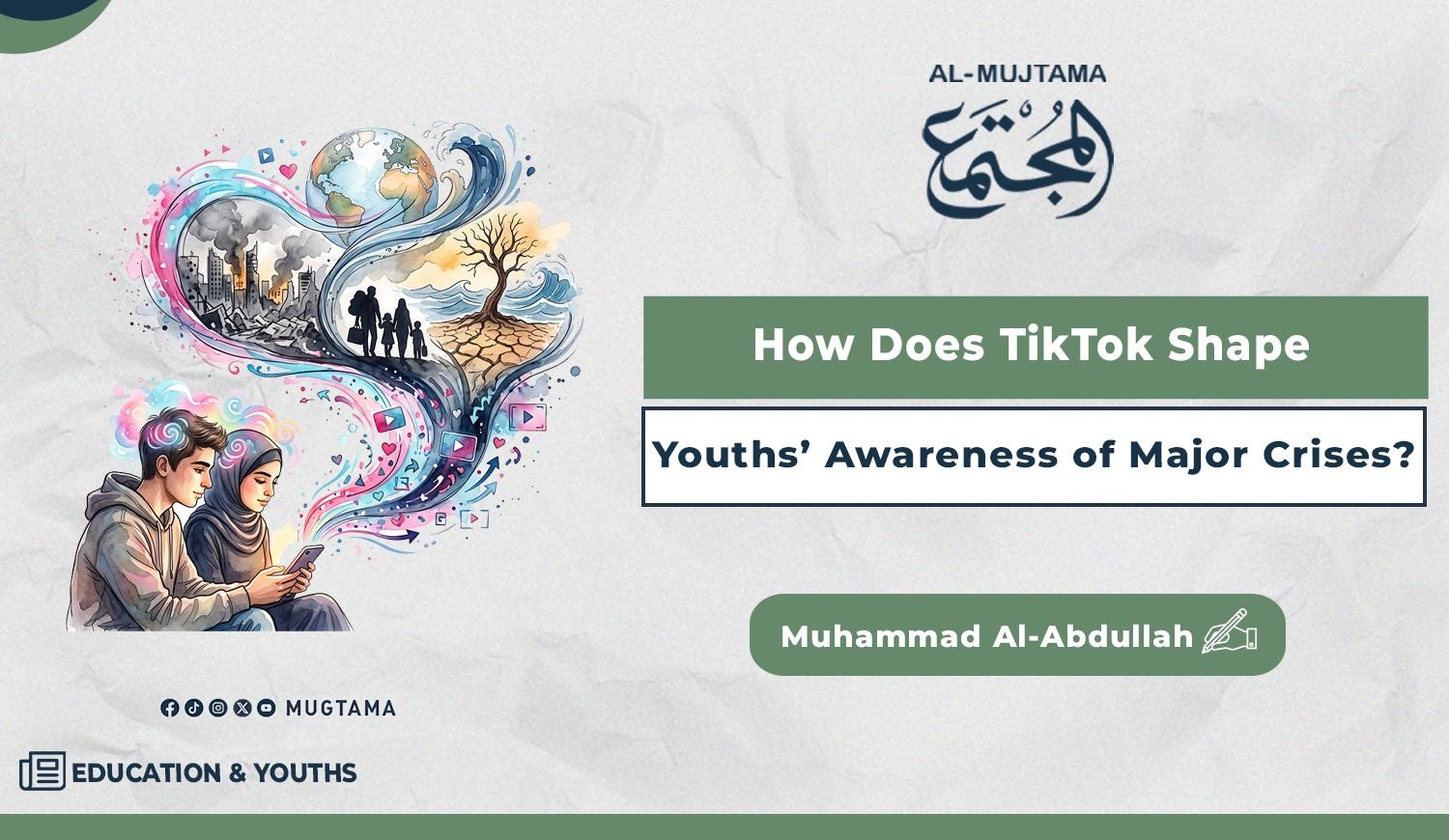
Breaking news,
rapidly unfolding events, advanced technologies, and a generation immersed in
the digital world. Today’s young people experience crises differently from
previous generations, responding to global and regional developments in ways
that reflect their digital upbringing.
Understanding
the digital landscape is key to understanding how the younger generation
develops its awareness of the crises unfolding around them.
In an age of
nonstop content, strengthening critical thinking and the ability to verify
information has become essential. Without these skills, the rapid flow of
information can become a source of confusion rather than a tool for
understanding.
Al-Mujtama spoke with technology experts and specialists in
digital media and technology management to explore how platforms such as TikTok
shape young people’s awareness of major events and influence the way they
respond to them.
TikTok’s
Short-Form Videos
Dr. Muhannad
Amin, a technology management specialist and lecturer at Lincoln University
College in Malaysia, stressed that the battle for public awareness in the age
of digital platforms has become as significant as political events themselves.
In recent
years, he explained, it has become increasingly clear that young people’s
understanding of political crises is no longer shaped solely by traditional
media or lengthy analyses in newspapers and on television. Digital platforms,
particularly TikTok, are playing an increasingly influential role in how young
people interpret major events and engage with them.
“Today’s young
people experience crises differently from previous generations,” Amin told Al-Mujtama.
“News is no longer limited to reports that people read or broadcasts they
watch. It now comes in the form of short videos, images, and comments that
spread rapidly, reaching millions of users within just a few hours.”
He added that
the recent regional tensions and the widespread debate across the Gulf
following Iran’s attack demonstrated how TikTok has become a space for
discussion and the exchange of views.
Young people
watch brief analyses, repost videos, and comment on events in their own way.
Sometimes, this serves as an entry point to a broader understanding of what is
happening. At other times, however, reducing complex issues to short clips can
oversimplify them and obscure important details.
The
Spread of Information
Dr. Abdelazim
Khadr, former professor and chair of the Journalism and Publishing Department
at Al-Azhar University’s Faculty of Mass Communication, highlighted TikTok’s
growing influence on how young people in the Gulf perceive major crises amid
escalating regional tensions.
He identified
five key ways in which the platform shapes their understanding of events.
1.
The rapid spread of information
Short-form
videos enable news, commentary, and analysis to circulate almost instantly.
This keeps young people continuously connected to developments, but it also
creates an information environment characterized by overwhelming volume and
constant updates. As a result, audiences face a growing challenge in
distinguishing verified news from emotionally charged content.
2.
Reframing events
The platform
allows content creators to present major events in condensed, visually engaging
formats that are easy to share. Through this process, complex political and
military developments can be transformed into simplified narratives that
circulate widely, shaping how young people perceive a crisis.
3.
Collective interaction and the formation of public opinion
Users are no
longer passive recipients of information. Through comments, reposts, and their
own content, they often become active participants in public discourse. In this
sense, TikTok becomes a space where collective attitudes take shape and what is
known as networked public opinion emerges.
4.
Emotional and symbolic influence
TikTok videos
rely heavily on imagery, music, and visual effects, all of which can exert a
powerful emotional influence. This may strengthen sympathy for one side in a
crisis or generate a form of symbolic mobilization around a particular cause.
5.
Competition with traditional media
TikTok has
become a serious competitor to traditional media in reporting and interpreting
events. Many young people encounter their first accounts of a crisis on digital
platforms before turning, if they do so at all, to conventional news sources.
Khadr told Al-Mujtama
that TikTok’s role in regional and international events extends far beyond
entertainment. It has become an active force in shaping political awareness and
media literacy.
Trends
and the Shaping of Awareness
Dr. Ahmed
Abdelhafiz, director of the Artificial Intelligence and Computer Engineering
Program at Egypt’s Innovation University, explained that the world is
witnessing a fundamental shift in how information security and young people’s
awareness are understood. TikTok, he noted, is no longer merely a platform for
entertainment; it has become a digital battleground and a major source of
information during crises.
Speaking to Al-Mujtama,
Abdelhafiz pointed to the public’s online response following Iran’s recent
attack as a clear example. Short-form videos dominated the conversation,
spreading faster and exerting an immediate influence that often surpassed that
of traditional news channels.
He warned that
the greatest danger lies in these platforms’ extraordinary ability to shape the
initial narrative surrounding an event. For young people in the Gulf, TikTok
delivers a concentrated stream of visual content that encourages emotional
reactions and immediate engagement.
Amid escalating
regional tensions, algorithms play a dual role. On the one hand, they give
young people opportunities to express national solidarity and raise awareness
of surrounding threats. On the other, they can expose them to misinformation
and manipulation.
Recent events,
he added, have demonstrated that young people’s political awareness is no
longer shaped by established news outlets alone. It is increasingly influenced
by trending content produced by influencers and even ordinary users with no
professional media background.
Dr. Mohamed
El-Bahrawy, a professor of journalism and publishing at Al-Azhar University’s
Faculty of Mass Communication, similarly observed that during major crises and
wars, including those affecting the Gulf region, social media platforms become
a parallel arena in which events unfold. Their influence extends beyond
reporting the news to shaping public awareness, directing emotions, and
influencing attitudes.
TikTok stands
out as one of the most influential platforms among young people because of its
rapid reach and short-form content, which can reach audiences within seconds.
These features make it a powerful tool for shaping public awareness and
perceptions during crises.
However,
El-Bahrawy told Al-Mujtama that the constant stream of content can also
have a noticeable psychological impact on young people. Repeated exposure to
footage of war and sensationalized analyses may increase anxiety and stress.
Fabricated or exaggerated videos can further intensify perceptions of danger
and even trigger widespread panic.
He offered
young people the following advice: “Under
these circumstances, do not allow the speed of a news report to become more
important than verifying its accuracy. Always remember that digital awareness
is both an individual and a collective responsibility. Every share and every
comment can either help build a more informed society or contribute to
distorting its understanding of events.”
-------------------------------------------------------------
