









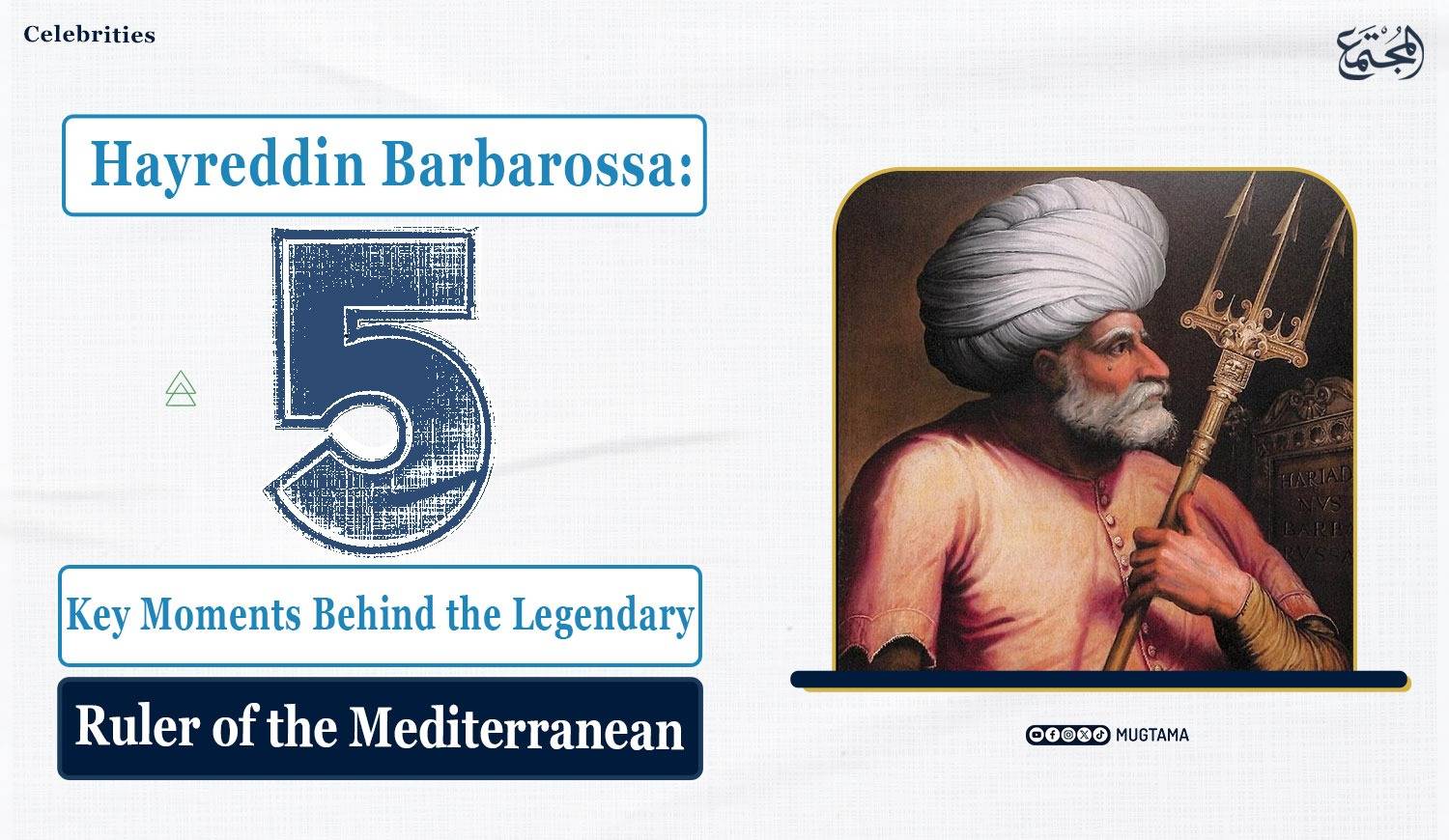
Hayreddin Barbarossa: 5 Key Moments Behind the Legendary Ruler of the Mediterranean
"A noble greeting... to
His Imperial Majesty the Sultan... Spur your steeds, that you may rescue souls
whom the Christians have humbled after a reign of glory."
Verses penned in blood and
tears, dispatched by the people of al-Andalus in 1501. They pleaded for
salvation as the Inquisition tightened its grip and even whispered prayers
inside their homes were outlawed. It was an agonizing elegy that echoed across
eastern capitals like a cry lost in a barren canyon—at the very hour European
monarchs gathered in Toledo and Rome to celebrate the "final erasure"
of Islam's footprint in the West.
Yet behind this sheer
despair, across Mediterranean waters the Spanish believed they held in an iron
grip, destiny was forging a man who did not merely read their desperate plea in
ink. He answered it in fire and steel—turning the seas of the Old World from a
slaughtering ground for the displaced into an arena of terror that shook the
thrones of Castile to their core
Milestone 1: The Fraternal Pact and the Dawn of Maritime Dominance
(Oruç and Khizr)
The legend of "Barbarossa" was neither forged within
the corridors of imperial palaces nor drafted on military drawing boards; it
was born from the ashes of a family tragedy.
On the island of Midilli (modern-day Lesbos), the two brothers
chose maritime commerce as their livelihood, hauling pottery, timber, and grain
aboard modest merchant vessels that plied the Aegean Sea between the ports of
the Levant, Alexandria, and Thessaloniki. Oruç was the embodiment of raw valor
and battlefield audacity, while Khizr, from his earliest youth, was
distinguished by calculated cunning, sharp intellect, and a mastery of
logistics.
Yet the Mediterranean was no sanctuary for peaceful
merchantmen. Its waters were an open theater of organized corsair warfare
spearheaded by the Knights of Saint John—a crusading naval vanguard that
relentlessly stalked Muslim merchant traffic.
On one of Oruç’s trading voyages bound for the Levant, the
Knights intercepted his vessel. A vicious, asymmetrical battle erupted. Though
outmatched, the lightly defended crew fought with sheer desperation; the
confrontation claimed the life of the youngest brother, Ilyas, while Oruç was
dragged into chains.
For nearly three years, Oruç endured the brutal agony of
physical torment and forced rowing at the galley oars, unbroken beneath the
lashes of the Hospitaller knights. 1
How did he manage to break free?
Prince Korkud, the
Ottoman governor of Antalya, had made it an annual custom to ransom one hundred
captives from the clutches of the Knights of Rhodes.
Yet Oruç was not one to wait for official emancipation.
The moment the galley drew near the coastline of Antalya, he
seized his chance, plunged into the open sea, and swam ashore—shattering the
Knights' hold on him once and for all.2
The ordeal left the two brothers with a stark realization:
unarmed commerce on the open seas was nothing short of suicidal. According to
the İslâm Ansiklopedisi (the Turkish Encyclopedia of Islam), Prince
Korkud backed Oruç by outfitting an 18-bench galley, unleashing him to strike
back at the Hospitallers and exact a punishing toll on their fleets.
Milestone 2: The Andalusian Lifeline and the Great Sea Evacuations
These evacuations were far more than a maritime refugee
transport; they were a high-stakes intelligence contest and naval showdown with
the Spanish Crown, ultimately serving as the sole lifeline for the Moriscos.
In the wake of the fall of Granada in 1492 and the forced
conversion edicts of 1502, the Spanish Navy imposed a suffocating blockade on
the ports of al-Andalus, seizing any vessel suspected of carrying Muslims and
summarily executing its crew.
In response, the two brothers established covert backchannels
with underground Morisco networks on the mainland, orchestrating departures
through prearranged coastal signals.
Historical records document dozens of perilous
cross-Mediterranean sorties commanded by Oruç and Khairuddin. Their most famed
endeavor rescued an estimated 70,000 Muslims and Moriscos, alongside scores of
Sephardic Jews fleeing the flames of the Inquisition.
It was during these very rescue missions that the moniker
immortalized by history was forged. Grateful Andalusian refugees took to
calling their savior Baba Oruç ("Father Oruç") in homage to
the protector who pulled them from the horrors of the Inquisition. Over time,
European chroniclers, struck by his battle-hardened demeanor and striking
auburn-red beard, Italianized the Arabic honorific into Barbarossa—"Redbeard."
Milestone 3: The Martyrdom of Barbarossa (Oruç)
Abu Hammu III, the
Zayyanid ruler of Tlemcen, reigned as a vassal to the Spanish Crown, paying
tribute to Madrid. Desperate to throw off the imperial yoke, the city’s elders
and Islamic scholars appealed to Oruç for deliverance. He answered their call,
marching his forces into Tlemcen, toppling the client ruler, and restoring the
storied inland hub to independent Muslim rule.
But the deposed sultan fled to Oran—Spain’s premier military
fortress on the North African coast—where he struck a pact with its Spanish
governor, the Marquis of Comares. Abu Hammu pledged his forces to the Spanish
throne in exchange for his crown. The imperial counterstroke was swift: a
colossal force of over 10,000 troops laid siege to Oruç and his fighters inside
the historic El Mechouar citadel. After withstanding six grueling months under
tight blockade, Oruç and his men resolved on a desperate gambit. Under the
cover of pitch-black night, they tunneled beneath the fortress ramparts and
slipped out across the rugged hills toward the sea, hoping to rendezvous with
their waiting galleys.
Riding with the vanguard, Oruç reached the Rio Salado (Wadi
el-Malah, near Ain Témouchent) and successfully crossed the riverbank toward
coastal sanctuary. But glancing back, he saw his rear guard—exhausted sailors
and fighters—encircled and being systematically cut down by the Spanish
cavalry.
Rather than press ahead to safety, Oruç wheeled his horse
around and plunged back across the river into certain death. Wielding his
scimitar with his sole remaining hand—his left having been torn away at Bougie
and replaced with a forged silver prosthetic—he charged straight into the
cavalry swarm to rejoin his doomed men.
A savage hand-to-hand melee ensued. Riddled with wounds and
surrounded on all sides, Oruç fought on even after a Spanish spear pierced clean
through his breastplate. He swung his blade until his strength finally gave
out, collapsing blood-soaked from his saddle.
A Spanish soldier named García de Tineo surged forward,
driving home the lethal thrust. There, in the spring of 1518 (924 AH), Oruç
Barbarossa drew his final breath—falling as a martyr facing the enemy, with his
eyes on the vanguard and his back never turned.
Milestone 4: Shattering the Spanish Dagger The Fall of the Peñón Fortress (1529)
Yet a venomous thorn remained lodged in the throat of Algiers,
suffocating the city and denying it the breath of true sovereignty: the
fortress rock of El Peñón. Looming a mere few hundred meters off the capital’s
shoreline, this impregnable marine redoubt had been seized by the Spanish in
1510, who crowned it with a formidable bastion bristling with heavy ordnance.
The citadel stood as an open dagger thrust into the heart of the capital. At
the slightest sign of defiance, its batteries rained cannon shot upon
residential quarters and minarets, choking off the mouth of the bay. It
rendered the harbor perilous for Muslim shipping to dock or set sail, forcing
Khairuddin to berth his fleet in distant, secondary roadsteads.
Unfazed, Khairuddin methodically laid the groundwork for his
assault, casting advanced, heavy-caliber siege guns for the confrontation
ahead. With his artillery in place, he dispatched a formal ultimatum to the
commander entrenched on the rock, the Spanish military governor Don Martín de
Vargas. The terms were uncompromising: surrender unconditionally with full
safe-conduct, allowing the garrison to depart for Spain with their arms and
baggage intact, or brace for total war to the bitter end. The Spanish commander
dismissed the overture with haughty disdain, resting his defiance on the impregnability
of ramparts that had defied Muslim arms for nearly two decades.
Khairuddin deployed his heavy artillery along the coastal
ramparts overlooking the fortress rock, while dispatching a squadron of galleys
to seal off the citadel from the seaward side. With the trap sprung, he
unleashed an unprecedented, punishing bombardment.
The Decisive Assault (May 27, 1529): Under a torrential rolling barrage, fast attack landing
craft—crewed by an elite detachment of veteran corsairs and marines—surged forward.
Scaling the sheer sea cliffs, they breached the shattered bastions with cold
steel. A fierce, close-quarters melee engulfed the ruins as the boarding
parties clashed with the surviving defenders. The struggle culminated in the
total capitulation of the fortress; the garrison was largely decimated, and
their defiant commander, Don Martín de Vargas, was taken in chains.
Milestone 5: The Epic of Preveza The Crushing of the Holy League
Fleet (1538)
Following the reclamation of Algiers and the fall of the Peñón,
Sultan Suleiman the Magnificent summoned Khairuddin to Istanbul in 1533,
elevating him to Kapudan Pasha—Grand Admiral of the Ottoman Imperial
Navy. At the imperial shipyards along the Golden Horn (the Tersâne-i Âmire),
Khairuddin spearheaded a sweeping overhaul, transforming Ottoman naval doctrine
through high-speed, lightning maneuvering tactics.
Europe's crowns recognized an imminent existential peril as
Khairuddin effectively sealed the Mediterranean to their fleets. In response,
Pope Paul III forged the "Holy League," the most formidable naval
coalition the sixteenth century had ever seen. Uniting Spain, the Papal States,
the Republic of Venice, the Republic of Genoa, and the Knights of Malta,
supreme command was entrusted to Europe’s most revered naval commander: the
Genoese admiral Andrea Doria.
In late September 1538, the two titans converged off the
shores of Preveza in northwestern Greece. The tactical disposition stood as
follows:
·
The
Holy League Armada: A colossal armada of 300
to over 600 sail, carrying nearly 60,000 fighting men.
·
The
Ottoman Fleet: A lean force of roughly 122
galleys, manned by some 20,000 combatants. Outnumbered and outgunned, the
Ottomans faced an allied strike force with an advantage of at least three to
one.
Khairuddin surged forward, carving directly into the core of
the European vanguard. His corsairs torched, shattered, and boarded dozens of
enemy vessels in rapid succession, plunging the sprawling coalition into sheer
panic and disarray.
As Andrea Doria watched his galleons being ripped apart and
boarded one after another, dreading the humiliation of falling into
Barbarossa’s hands, he made a shameful tactical gambit: under cover of
darkness, he doused the lanterns of his flagship and ordered a disorderly
retreat toward Corfu. He abandoned his Venetian and Spanish confederates to the
flames, leaving them to their fate—either iron chains or a watery grave.
The clash was decided in barely five hours. The Holy League
lost upwards of 128 vessels—captured, burned, or sent to the seabed—alongside
thousands of casualties and captives. Khairuddin, by contrast, suffered
negligible losses: merely a handful of light galleys and fewer than 400 fallen
martyrs.3
When the smoke finally lifted over Preveza, what lay broken
was not merely a fleet of wood and iron, but the very hubris of European
hegemony that had presumed the fall of al-Andalus was the end of history. For
three uninterrupted decades, the Mediterranean was transformed into a guarded
Ottoman lake. The name of Barbarossa was etched into memory as living proof
that the cries of the dispossessed from the shores of al-Andalus had not
dissolved into the wind; they had returned as a tempest of fire and iron,
breaking the aggressors at their very gates.
Footnotes
- 1 Memoirs of Hayreddin Barbarossa (Ghazawat Khair al-Din Pasha), trans. & ed. Dr. Mohamed Derradji, 1st ed. (Algiers: Al-Asala, 2010).
- 2 İdris Bostan, "Oruç Reis," TDV İslâm Ansiklopedisi (Turkish Diyanet Foundation Encyclopedia of Islam).
- 3 Memoirs of Hayreddin Barbarossa, ed. Derradji (Algiers: Al-Asala, 2010), pp. 205–224, "The Naval Battle of Preveza and the Crushing of Andrea Doria's Fleet."
