









Gaza’s Winter: Flooded Tents and Children Braving the Cold in the Open
Who will apologize to Gaza’s children for this world, when
winter becomes yet another weapon compounding the suffering of the displaced
and exposing the international community’s failure to provide even the most
basic humanitarian protection?
The rain is not the problem; a sky that pours down blessing
cannot be put on trial, nor is the annual arrival of winter an unexpected
event. The real problem is winter descending upon Gaza’s children without a
roof to shelter them—mothers unable to find a dry mattress on which to lay
their children, and fathers spending the night in a desperate struggle to bail
water out of tents no longer capable of withstanding the wind and rain.
In Gaza, winter is no longer just another season of the year;
it has become a new season of suffering. After bombardment, displacement,
hunger, and the loss of homes, the rains have arrived to lay bare yet another
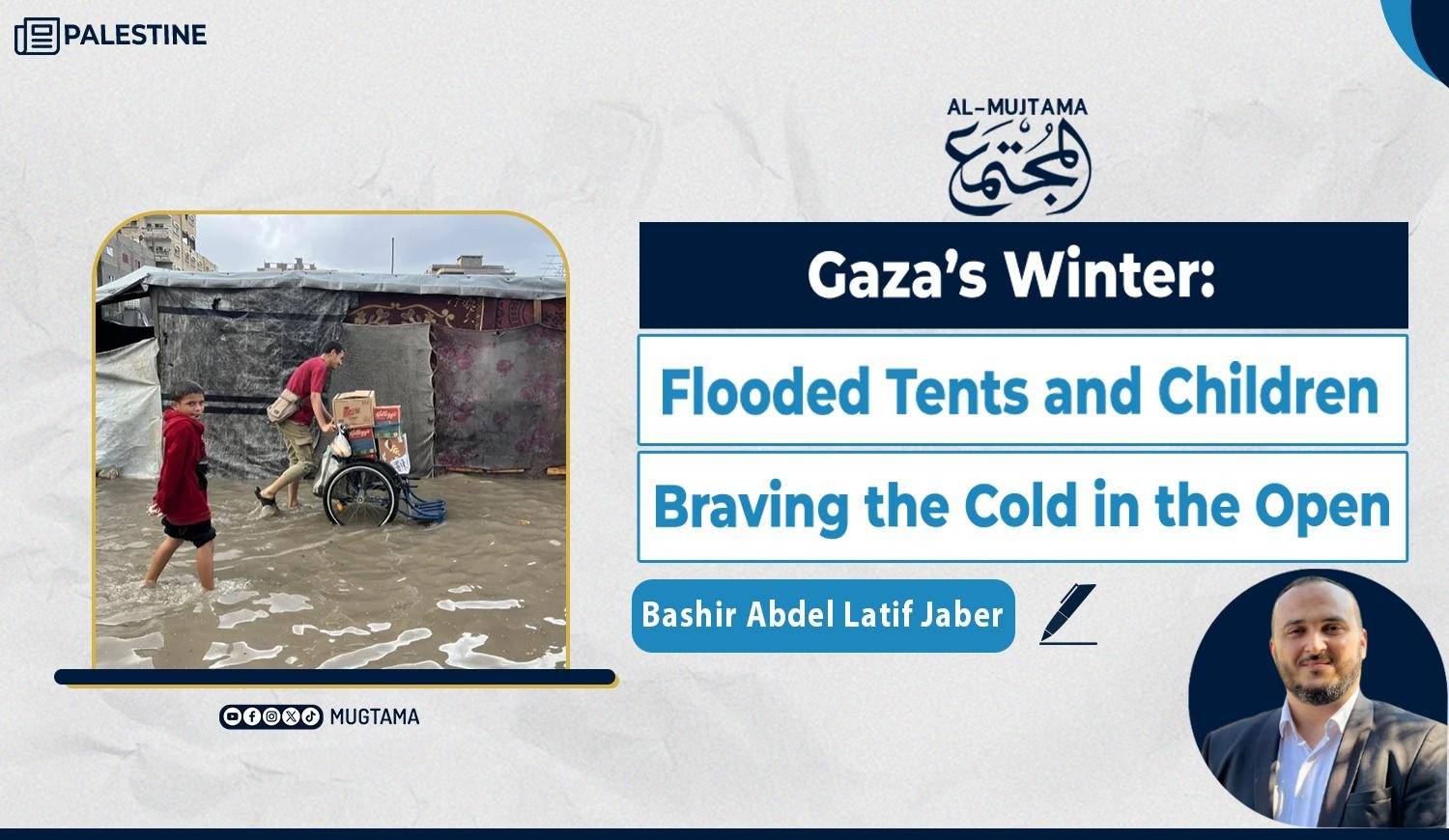
face of the tragedy: flooded tents, soaked blankets, children shivering from
the cold, and families standing helpless as water seeps in from every
direction.
What kind of world leaves a child to sleep on soaked ground,
and then speaks of children’s rights and human dignity?
Gaza’s Winter in Numbers
The figures reflect the scale of the catastrophe left by the
low-pressure weather systems in November 2026. According to the UN Office for
the Coordination of Humanitarian Affairs (OCHA), more than 26,000 families had
been affected by November 8, with over 6,000 family shelters destroyed and
roughly 17,400 others damaged.
In a UN update issued on November 13, the number of affected
families exceeded 46,000—or roughly 226,000 people—while the number of damaged
shelters surpassed 40,000, including more than 9,000 that were completely
destroyed, leaving over 5,000 families without shelter.
Save the Children also reported that roughly 70,000 tents were
flooded within a single day of the first winter storm, and that more than half
a million children are facing critical or catastrophic shelter conditions.
Here, a distinction must be drawn between the number of
flooded tents and the proportion of damaged shelters, as no unified, accurate
baseline figure is available to calculate a reliable percentage.
The gravity of the situation is compounded by the presence of
approximately 1.4 million people living in tents or makeshift shelters,
according to UN estimates. These are not mere cold statistics; they represent
hundreds of thousands of human lives placed in jeopardy with every new
low-pressure system.
A Catastrophe Beyond Flooded Tents
Reducing the tragedy merely to flooded tents oversimplifies
the true scale of suffering. When a tent is submerged, a family does not just
lose a place to sleep—it loses whatever remains of its privacy, dignity, and
stability.
And when blankets and clothing become soaked, the cold turns
into a grave health hazard—particularly for infants, children, and the
elderly—while the mixing of rainwater with raw sewage creates a breeding ground
for gastrointestinal, skin, and respiratory diseases.
The United Nations has warned of these dangers amid damaged
infrastructure networks and a severe shortage of water-pumping and drainage
equipment. Humanitarian reports have documented tragic incidents, including the
drowning of an infant and casualties caused by waterlogged sand dunes
collapsing onto the tents of the displaced.
A child who should have welcomed winter in warm clothes inside
a safe home is now reduced to searching for a scrap of plastic sheeting to keep
water from reaching their mattress.
Why Is the Suffering of the Displaced Deepening?
The crisis is not the result of a passing rainstorm, but
rather the outcome of compounding factors that have left Gaza far more
vulnerable to low-pressure weather systems. Chief among them are:
1. Destruction of Infrastructure: Damage to stormwater drainage and sewage networks has led to
repeated flooding across displacement sites.
2. Deterioration of Tents:
Many tents have been worn down by prolonged exposure to sun, wind, and rain,
leaving them incapable of providing adequate protection.
3. Lack of Suitable Grounding: Pitching tents in low-lying, sandy areas without proper
leveling or drainage channels causes water to pool inside and around them.
4. Shortage of Equipment and Supplies: Limited availability of water pumps, heavy machinery, shelter
materials, and insulation hampers emergency response efforts.
5. Shrinking Safe Spaces:
Diminishing options to relocate to safer ground leave families increasingly
exposed to danger.
Most painful of all is that winter arrives on a known schedule
and rainy seasons are entirely predictable—yet Gaza’s residents are left to
confront a peril whose impact could have been mitigated through early
preparedness.
How Can the Displaced Be Protected from Winter’s Dangers?
We do not need more images documenting drowning children as
much as we need an urgent intervention plan built on practical solutions:
First: Stormwater Drainage.
Forming technical teams from municipalities, civil defense, and humanitarian
organizations to identify low-lying areas, clear drainage channels, erect
earthen embankments, and deploy mobile water-pumping units.
Second: Providing Winterized Shelters. Moving away from distributing worn-out tents toward providing
more durable shelter units, elevated flooring, waterproof tarpaulins, and
structural anchoring materials.
Third: Identifying High-Risk Flood Zones. Producing field maps that pinpoint water accumulation areas,
household numbers, and risk levels so that heavy machinery and emergency teams
can be deployed according to priority.
Fourth: Protecting Children’s Health. Providing warm clothing, blankets, and dry mattresses,
alongside establishing mobile medical clinics to monitor cold-related
illnesses, respiratory infections, diarrhea, and skin diseases.
Fifth: Launching a Unified Winter Emergency Fund. Coordinating the efforts of humanitarian organizations and
donor agencies through a transparent mechanism to finance the repair of
drainage networks, the procurement of water pumps, the rehabilitation of
shelters, and the provision of essential winter supplies.
Yet none of these solutions can achieve their intended impact
without allowing the entry of heavy machinery, fuel, shelter and insulation
materials, and spare parts, alongside ensuring unimpeded humanitarian access.
Who Is Responsible for Saving What Remains of Gaza’s Childhood?
Responsibility does not rest on a single charity alone, nor on
a volunteer wielding a shovel, nor on a father spending the entire night trying
to shield his children with a piece of plastic sheeting.
There is a clear legal and humanitarian obligation incumbent
upon the occupying authorities to ensure the entry of essential supplies. At
the same time, the international community, the United Nations, and
humanitarian organizations bear the responsibility of moving beyond statements
of concern toward concrete action that delivers real protection and shelter.
Meanwhile, local institutions, municipalities, and community
committees are tasked with coordinating efforts and maximizing available
resources to prevent recurring losses.
Who Will Apologize to Gaza’s Children?
Who will apologize to a child who wakes up in the middle of
the night to find their mattress soaked with water? And who will restore a
mother’s soaked children’s clothes, or reassure a father who no longer
possesses anything with which to shield his children from the cold?
Gaza’s children do not need a written apology, another
statement of solidarity, or one more photograph added to the archive of
tragedy. They need a tent that shelters them, a dry mattress to sleep on,
clothes that protect them from the cold, a school that does not flood, and a
home that restores their sense of safety.
Do not let winter become
yet another chapter in the record of lost childhood in Gaza. The rain is not
the enemy of Gaza’s children—leaving them exposed in the open, despite
the world knowing full well what awaits them, is the stain of shame that must
long haunt the conscience of humanity.
