







Gaza After the War: The Cost of Destruction Exceeds Expectations

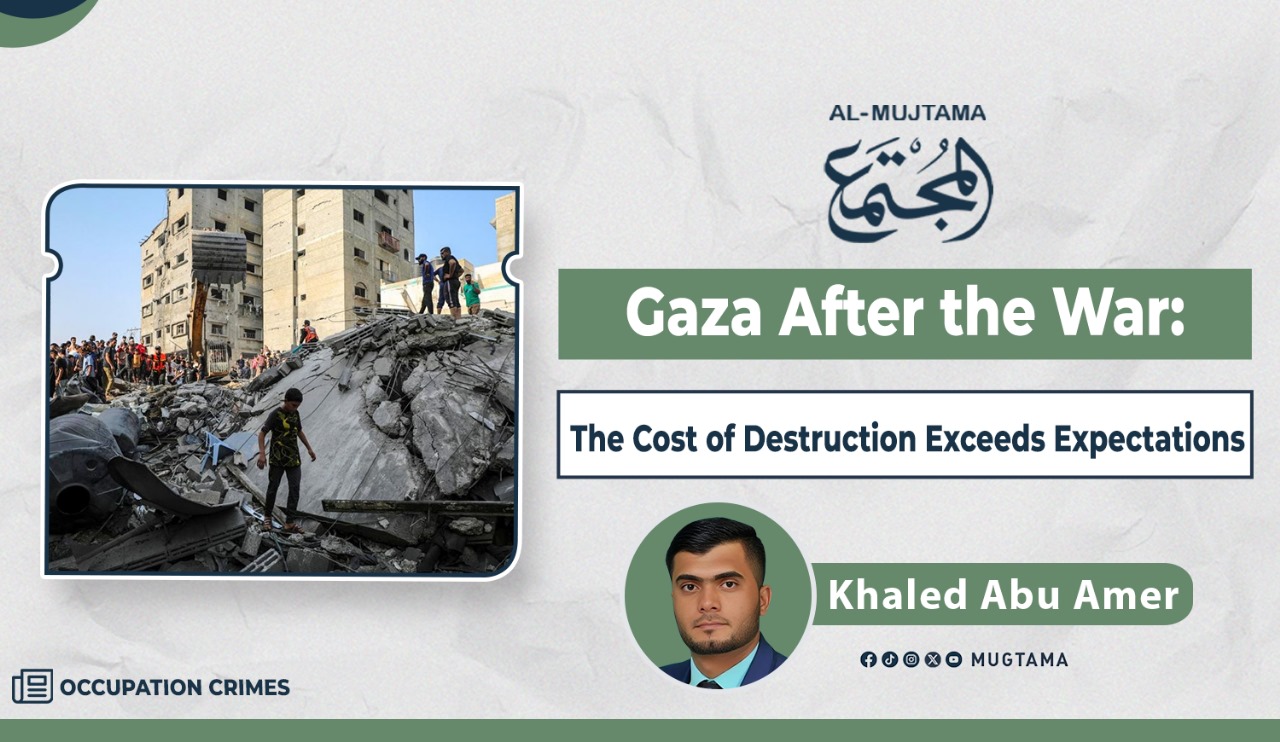
With the end of the Zionist
aggression on the Gaza Strip, which lasted a full two years, the war machine
left behind massive destruction across various economic and social sectors, in
one of the fiercest wars targeting civilian infrastructure in a confined area
of no more than 365 square kilometers.
During this period, the
occupying state carried out systematic destruction aimed at undermining the Gaza
Strip’s economic foundation and dismantling its social and service
infrastructure, rendering Gaza an almost uninhabitable environment for human
life.
With the partial withdrawal
of Israeli occupation forces from certain areas, in accordance with the truce
agreements signed in Cairo between the Palestinian resistance delegation and
the occupying state, and with the return of hundreds of thousands of displaced
people to their destroyed areas, a clearer picture began to emerge of the scale
of losses affecting the residential, service, and economic infrastructure of
the Gaza Strip. This situation forms the main entry point for the
reconstruction file, whose estimated cost exceeds $50 billion, according to
international reports.
Urgent Reconstruction Files… From Housing to Health and
Education
The housing sector is among
the most targeted by the Israeli war machine, as entire cities and residential
neighborhoods were destroyed as part of a systematic displacement policy aimed
at forcing the largest population bloc in the Gaza Strip to leave, in favor of
Jewish demographic dominance.
United Nations estimates
indicate that 90% of residential buildings in the Gaza Strip were severely
damaged, totaling 301,000 homes, of which 148,000 were completely destroyed and
153,000 partially damaged, many of which are now at risk of collapse due to
cracked roofs, pillars, and walls.
United Nations: 90% of
residential buildings in Gaza severely damaged
This situation left around
288,000 families homeless out of 350,000, creating a severe population crisis.
According to the report, multiple families are living in a single house or even
a single room, lacking basic privacy and safety. Concerns are rising with the
approach of winter, as the tents are deteriorating and unsuitable, making
housing a top priority in the reconstruction process and crucial to thwarting
the Israeli displacement agenda unless addressed promptly.
The health sector was not
spared from intensive targeting, with 22 hospitals completely out of service,
14 operating partially, 9 hospitals entirely destroyed, and 25 others damaged,
in addition to the destruction of 144 ambulances.
These attacks resulted in the
martyrdom of 1,242 healthcare workers, including 130 doctors specializing in
rare fields such as cardiac surgery, neurosurgery, burn treatment, and kidney
care, among others.
With the collapse of the
healthcare system, the death toll from the war on Gaza reached 67,000,
including 463 citizens who died from starvation and 17 others from the cold.
Additionally, a quarter of a million people contracted infectious diseases and
epidemics, while more than 20,000 are awaiting treatment abroad.
These data position the
reconstruction of the healthcare sector as one of the core pillars of rebuilding,
to ensure the provision of urgent medical services to the population.
UN Estimates: Debris Removal Operations Will Take 3–5 Years
Israeli shelling destroyed
218 schools, 179 of them completely, killed 770 teachers, injured around 3,200
others, and claimed the lives of more than 17,000 students.
The higher education sector
was catastrophically affected, with 63 university buildings destroyed, 232
academics killed, and 1,450 injured, alongside the deaths of 1,300 university
students and injuries to 2,791 others.
The collapse of this sector
represents a severe blow to human capital in Gaza, necessitating its inclusion
as a priority in reconstruction programs to restore scientific and academic
capacities.
Destruction in the water and
sanitation sector reached 89%, with 330,000 linear meters of water networks and
644,000 linear meters of sewage networks destroyed, in addition to 719 wells
and 2.8 million linear meters of asphalt roads.
This has resulted in water
insecurity for 65% of the Gaza population, with per capita water availability
not exceeding 6 liters per day, making the rehabilitation of infrastructure an
essential condition for any successful reconstruction plan.
War Debris: A Major Obstacle to Reconstruction
The United Nations office
reports that the occupation dropped 125,000 tons of ammunition on the Gaza
Strip, with one in every ten bombs failing to explode. This unexploded ordnance
poses a real obstacle to debris removal operations, which have already exceeded
60 million tons of concrete rubble.
Gaza Faces a Historic
Reconstruction Challenge with Costs Exceeding $50 Billion Over 10 Years
According to estimates,
debris removal operations will take between 3–5 years, provided donor countries
fulfill their commitments. Additionally, the accumulation of 170,000 tons of
solid waste near temporary residential areas threatens the spread of epidemics
and health hazards.
Economic Sector Damages in Gaza
The war damaged 156,000
dunams of agricultural land (67% of farmland) and devastated the eastern agricultural
belt along the border, which was a strategic reserve for key crop production.
Additionally, 1,531 agricultural wells and 78% of greenhouses were destroyed,
delivering a severe blow to local food security.
The electricity sector
suffered extensive damage, with the occupation destroying 80% of the company’s
vehicles and equipment, 90% of its warehouses, 70% of its networks and offices,
in addition to 5,000 power lines, 2,235 transformers, 235,000 meters, 8 storage
and workshop facilities, and 9 service centers.
Overall, losses amounted to
$4 billion in the industrial sector, $4.3 billion in the commercial sector, $2
billion in tourism and hospitality, and $3 billion in the telecommunications
sector.
These figures show that Gaza
faces a historic reconstruction challenge, beyond the capacity of any single
local entity. Reports from the World Bank and the United Nations indicate that
recovery and rebuilding will require funding exceeding $50 billion over a
decade, covering the reconstruction of housing, infrastructure, and public
services, in addition to stimulating the local economy.
_________________________________________
You may read
also:
How do you participate in the reconstruction of Gaza?
Arab and Islamic roles in Gaza’s reconstruction
Out of the rubble, cities are reborn… Lessons from history for Gaza
Gaza’s Reconstruction: The New Jihad of Rebirth and Renewal
_______________________________________