







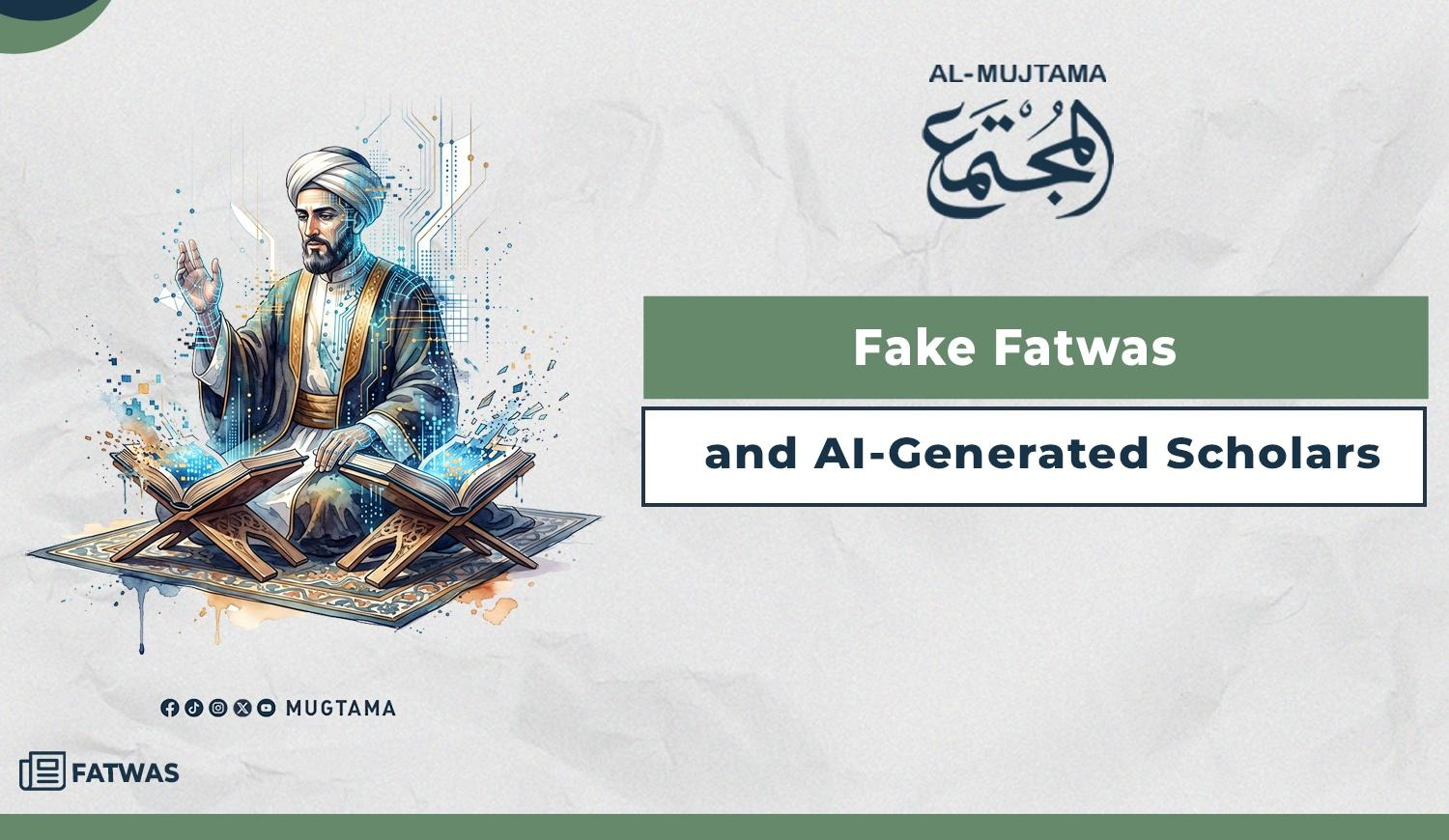
Fake Fatwas and AI-Generated Scholars
A scholar may appear on screen
with his familiar face and recognizable voice, citing a Quranic verse and
delivering a religious ruling. But what if none of it were real?
This is where the danger of AI-generated fatwa manipulation becomes clear. Manipulation is no longer limited to
fabricating information or misquoting someone; it can now replicate a scholar’s
voice and appearance and attribute religious rulings to him that he never
issued.
The problem becomes even more
serious because neither voice nor image can always be treated as sufficient
proof of a speaker’s identity. A 2025 study
found that participants judged AI-generated voices to match the identity of the
real speaker in around 80% of cases, while they successfully recognized an
AI-generated voice in only about 60% of cases.
Faking a Scholar’s Voice
A study published in Nature Communications, involving thousands of participants, found that some
forms of synthetic speech generated through text-to-speech systems were
particularly difficult to detect. In one experiment, participants identified
certain AI-generated audio deepfakes correctly only 72% of the time.
This means that even a religious
clip that sounds familiar may itself require verification.
The Quran gives us a fundamental
principle here: {O believers, if an evildoer brings
you any news, verify ˹it˺ so you do not harm people unknowingly, becoming regretful for
what you have done.} [Al-Hujurat 49:6]
Failing to verify information can
lead to harm and regret. This becomes even more serious when a clip falsely
attributed to a scholar can damage his reputation, fuel disputes between
schools of thought, create conflict among Muslims, or alter public attitudes
toward an entire religious institution.
A Fatwa Is More Than Information
Issuing a fatwa requires an understanding of the relevant texts, knowledge of
scholarly agreements and disagreements, awareness of the questioner’s
circumstances, and the ability to apply a ruling to a particular situation.
Ibn Al-Qayyim relates from Imam Ash-Shafi`i
that a mufti must have knowledge of the Book of Allah and its sciences, the
sayings of the Messenger of Allah (peace be upon him), the Arabic language, the
differing views of scholars, and the jurisprudential qualifications necessary
to speak about what is lawful and unlawful.
This is where the distinction
between a tool that assists a researcher and a qualified scholar becomes clear.
In Resolution No. 258,
issued in 2025, the International Islamic Fiqh Academy affirmed that the basic
ruling on the use of artificial intelligence is permissibility, provided that
its use is lawful, beneficial, avoids harm, protects rights, and adheres to
honesty, documentation, and transparency.
The problem, therefore, is not
using AI for research or indexing. The problem arises when it generates
fabricated fatwas that appear authoritative and then attributes them to a
scholar or institution that never issued them.
AI-Generated Fatwas and the Usurpation of Religious Authority
The danger of AI-generated fatwa
manipulation does not stop at fabricating the words of a real scholar.
Artificially generated religious figures are also beginning to appear on
digital platforms as sources of religious knowledge. In August 2026, Religion News Service reported on AI-generated religious personalities, including
one called Shaykh AI, which openly identifies itself as an artificial system.
A user may know that such a
figure is not a real human being, yet gradually grant it the authority of a
scholar because it is always available, responds instantly, and speaks with
confidence.
This creates another danger: the
ability to produce convincing answers can gradually become a source of
religious authority without the knowledge or qualifications that such authority
requires.
Allah says, {Then ask those who have knowledge ˹of the Scriptures˺.} [An-Nahl 16:43]
The principle is clear: when we
do not know, we turn to qualified people of knowledge, not simply to any source
capable of producing a convincing answer.
The Prophet (peace be upon him)
also warned against unqualified people taking the place of scholars, saying: “Allah does not take away the knowledge, by taking it
away from (the hearts of) the people, but takes it away by the death of the
religious learned men till when none of the (religious learned men) remains,
people will take as their leaders ignorant persons who when consulted will give
their verdict without knowledge. So they will go astray and will lead the people
astray.” (Sahih al-Bukhari, 100)
How Can We Verify a Fatwa Before Sharing It?
In an age of deepfakes, a
familiar voice or convincing image is no longer enough. The original recording
should be sought, along with the scholar’s official account or the institution
he represents. The clip should be compared with the original recording or a
published transcript, and no fatwa should be shared unless its attribution can
be verified.
This is particularly important
for young people. In a global UNESCO
survey conducted in 2024, 62% of digital content creators surveyed said they
did not conduct rigorous and systematic fact-checking before sharing
information.
The Quran reinforces this
principle: {Do not follow what you have no ˹sure˺ knowledge of. Indeed, all will be called to account for ˹their˺ hearing, sight, and intellect.} [Al-Isra’ 17:36]
The Prophet (peace be upon him)
likewise said: “It is enough of a lie for a man
to narrate everything he hears.” (Sahih
Muslim, 5)
The responsibility for
verification does not rest with the public alone. Religious institutions also
need to establish a trustworthy digital presence: archiving fatwas and
lectures, verifying official accounts, preserving original versions of their
material, and providing clear channels for reporting and refuting fabricated
clips.
AI itself can also be used for
indexing, research, and detecting manipulation rather than allowing it to
become merely a tool for deception.
Verify the Source of the Fatwa
Islam has never opposed the
transmission of knowledge; rather, it established principles to protect it. One
of the profound lessons of the science of Hadith is that attributing a
statement to its source is not a trivial matter. This is why Muslim scholars
developed meticulous methods for examining transmitters and chains of
transmission.
A digital clip cannot, of course,
be equated with a Hadith chain of transmission. Yet the underlying principle
remains relevant: statements should not be attributed to people without
verification.
Therefore, confronting AI-generated
fatwa manipulation does not mean rejecting technology or fearing it. It means
placing the technology in its proper position: as a tool that can serve
research and knowledge, but that does not possess, by itself, the
qualifications required to issue religious rulings or the authority of a
scholar.
A real scholar can be questioned,
reviewed, and corrected. His works, teachers, and institutions can be
identified and examined. An artificial persona, by contrast, may be nothing
more than a voice and an image created to deceive you.