









Eritrea: The Untold Story of a 25-Year Liberation Struggle
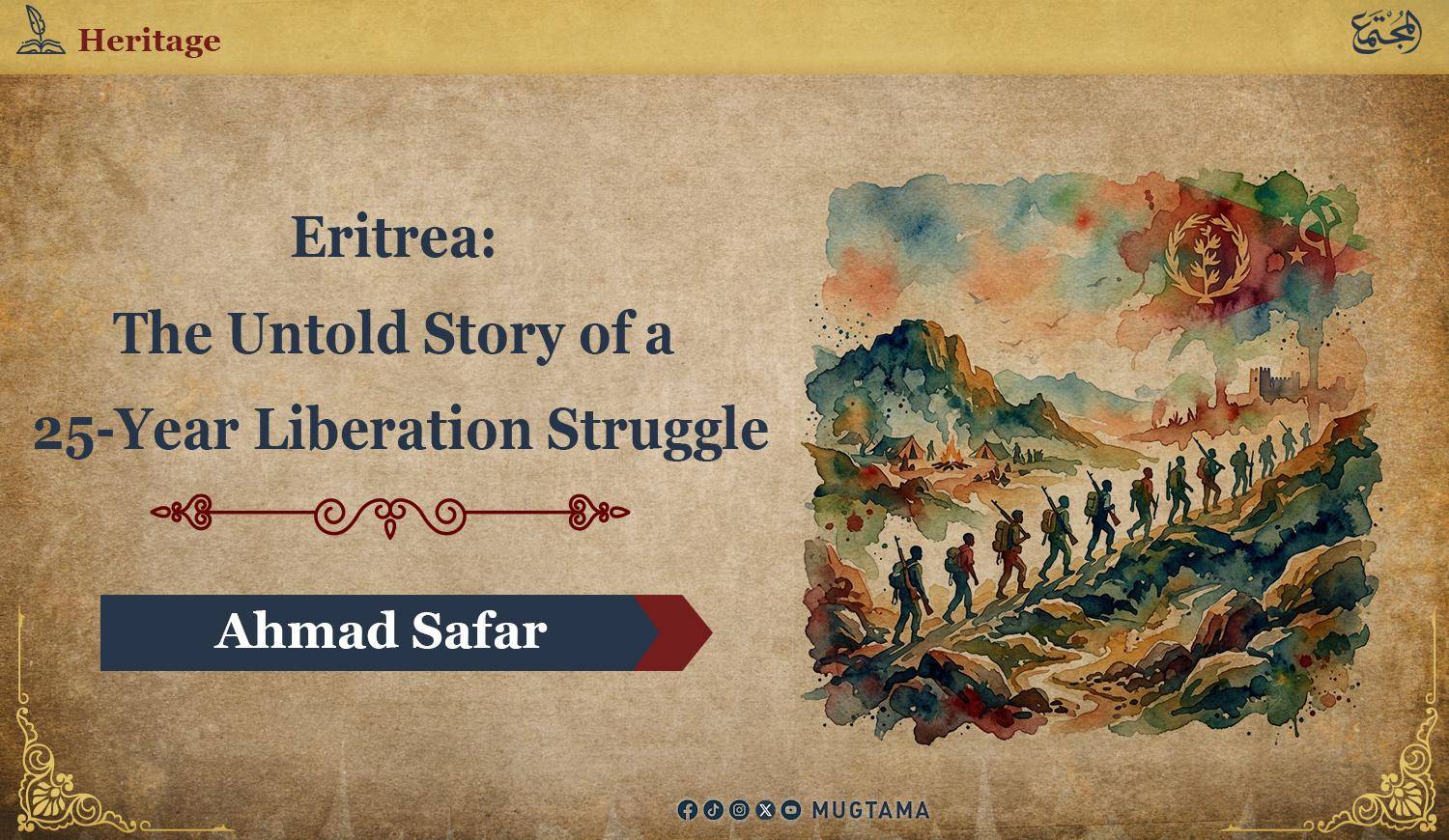
This people, whose struggle and sacrifices I wish to recount to you in defense of their faith, honor, and homeland, is the very people upon whom the light of Islam shone before the Migration (Hijrah), and whose land was trodden by the feet of the Companions, may Allah be pleased with them, during the first migration known to Muslims. This struggling Eritrean people, residing in northeastern Africa, is bordered by Sudan to the north and west, Ethiopia to the south, and the Red Sea to the east. Its land area spans 119,000 square kilometers, with a coastline extending 1,000 kilometers.
Historical Roots
This “people”, of whom very little has
been heard, possesses an ancient past despite their painful present. They
played a prominent role in the civilizations that flourished and vanished both
before and after Christ. The best evidence of this is the famous port of Adulis,
founded during the Greek Ptolemaic era in the 3rd century BC. This port sat at
the crossroads of East-West trade, where large ships arriving from India, the
Arabian Gulf, East Africa, and the Arabian Peninsula traded peacefully with
ships coming from Egypt and the Arabian Peninsula. Ships manufactured there
were called "Aduliyyah" in reference to the port, a term mentioned by
pre-Islamic poets, including Tarafa ibn al-Abd in his Mu'allaqa:
"Like Aduliyyah vessels, or ships
of Ibn Yamin,
Guided now by the mariner, now veering
off course."
This state of affairs continued until the
dawn of Islam, when the land earned the honor of hosting the Companions,
may Allah be pleased with them, as they migrated there following the
intensified persecution by Quraysh. From that period onward, the sun of Islam
began to shine upon it, until the Umayyad era arrived, spreading Islam across
all parts of Eritrea. The land lived under its blessings, prosperity, justice,
and tolerance, becoming a center and launching pad for the Islamic call into
the heart of the African continent.
Ambitions
of Colonial Powers
No sooner had weakness crept into the
body of the Ottoman Empire than enemies descended upon Eritrea from all
directions, with greedy forces multiplying from the East and West due to its
vital strategic location and its status as the western gateway to the Two Holy
Mosques. Its importance surged further with the opening of the Suez Canal,
exposing the country to severe shocks and brutal raids from both within and
without. Colonialists arrived under the guise of companies aiming to revive the
local economy—according to their claims—managed by missionaries known for their
hateful crusade spirit, such as Sapeto, who landed on the Eritrean coast in
1869. This served as the nucleus for modern Italian colonialism in Eritrea.
Once their grip was complete, they
revealed their malicious intentions, wreaking havoc in the land, inflicting
torment upon the populace, slaughtering their sons, sparing their women, and
plundering the riches of the country and its people. They transformed the land
into property to be inherited and gifted—sometimes to close relatives (Britain)
and other times to kinsmen of the same faith (Ethiopia).
All of these powers practiced various
forms and colors of torture and abuse to force submission under their yoke.
Surprisingly, organizations claiming to champion human rights have failed to
raise any notable voice regarding this, even to this day.
Scarcely had the nation caught its
breath, hoping for deliverance from colonial rulers (Italy from 1870 to 1941,
and Britain from 1941 to 1952), when the crusading power of Abyssinia
moved to annex it. However, the Eritrean people refused to live in humiliation
and subjection; instead, they resisted, culminating their resistance in a
sacred struggle (jihad), thereby entering a new phase of their ongoing fight.
The Crusader Reaction
This swift response to the call for
sacred struggle alarmed and terrified the crusader establishment in Abyssinia.
The Beginning of the Struggle
When peaceful methods failed to secure
independence and freedom from the Ethiopian enemy—unlike other Third World
nations gaining liberation at the time—and realizing they had fallen into a
plot devised by hateful crusader forces, the people mobilized for sacred
struggle on September 1, 1961. This movement was led by those enlightened by
knowledge and armed with the experiences of other nations in wresting
independence from the clutches of colonizers. Everyone answered the immortal
call (Hayya 'ala al-Jihad—hasten to struggle), rising for rescue,
sacrifice, and redemption. How could they not answer when living under the
weight of crusader hatred, with their religion at risk, their honor violated,
their homeland occupied, and their dignity trampled?
Ethiopia Adopts Scorched-Earth and Divide-and-Rule Policies in Eritrea
Humanity was humiliated; could life remain pleasant after this?
Absolutely not. Within just three years, most of Eritrea’s countryside and
villages were either liberated or under siege.
The enemy rushed in all directions to
acquire tools of repression against the defenseless, peaceful population,
seeking assistance from experts with prior experience in this field (Israel and
others), while invoking destruction upon anyone aiding the Eritreans.
To dissolve their entity and eliminate
them entirely, the enemy adopted scorched-earth and divide-and-rule policies.
They mobilized external public opinion by portraying the Eritreans as
separatists and rebels who lacked obedience and loyalty, alleging they wished
to become lackeys and agents for the Arabs and turn the Red Sea into an
"Arab lake"—an argument that had a clear impact on African nations.
Domestically, psychological barriers were erected among citizens, classifying
them by religion into Christians and Muslims. Recent measures in this regard
include:
- Building churches and monasteries at the entrances
of cities and villages while prohibiting the construction of mosques,
closing institutes, burning copies of the Quran and educational curricula,
and abolishing the Arabic language in favor of Amharic.
- Granting foreign scholarships exclusively to
Christian youths while barring Muslim students from entering higher
colleges and institutes, even domestically.
- Restricting senior administrative positions in
Eritrean government offices to Eritrean Christians.
This is merely a drop in the ocean.
The objective behind these exposed and malicious measures was to win Eritrean
Christian public opinion over to their side.
Despite this, the Eritrean Muslim
people did not despair, nor did they falter or waver in their struggle.
Instead, their resolve grew stronger by the day, to the extent that the
Ethiopian enemy dared not confront the fighters even in broad daylight. Whenever
defeated and dragged down by disgrace, the enemy retreated to inflict severe
vengeance on defenseless civilians under the pretext that their children were
behind these operations. Indeed, the people of Eritrea were an inexhaustible
source of support, with parents offering their children's food to the fighters,
leaving their families to suffer hunger, grief, and fear of an uncertain fate.
Red Communism Infiltrates the Ranks of the Fighters
As the year 1968 drew to a close, most
of those who laid the foundations and sowed the seeds of the struggle had
fallen as martyrs on the path of jihad, led by Hamid Idris Awate, Wahed Wallu,
Mohamed Saeed Shamsi Taher, Omar Azaz, Omar Nasser Shum, Taher Salem, and many
others who watered the land of Eritrea with their pure blood after establishing
the pillars of armed struggle through their sacrifices.
During this long journey, certain
countries sympathized with the Eritrean people's struggle and began offering
aid. However, the outcome of this assistance proved counterproductive. Those
sent abroad for military training or educational courses were indoctrinated by
foreign ideological currents and ingested their malicious toxins. Upon their
return, they brought back these ideas with enthusiasm, eagerly seeking senior
positions to dampen the fighters' resolve.
Since that time, the Eritrean people have been afflicted with leaderships whose vision does not extend beyond their noses, whose sole concern is pleasing their foreign masters, and whose mindset centers on liquidating anyone standing in the way of their goals—goals that bear no relation to the people. Consequently, they sought to build a solid base for themselves by fabricating civil wars and fishing in troubled waters, leading to the appearance for the first time in 1970 of multiple factions with conflicting orientations and ideas. These factions clashed with one another in attempts at mutual elimination, ultimately scattering national efforts and draining the capabilities of the people.
