






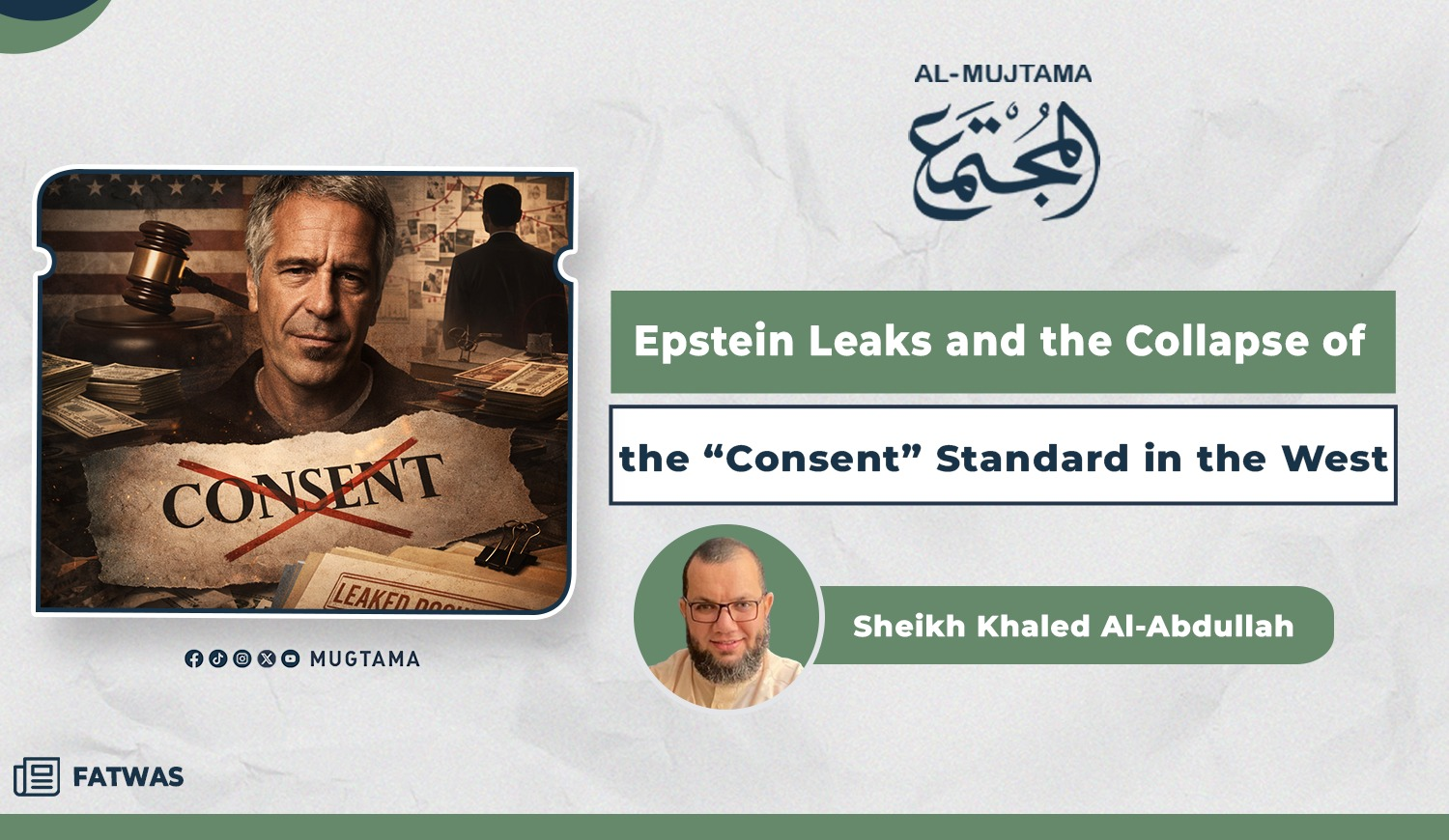
Epstein Leaks and the Collapse of the “Consent” Standard in the West
Just
recently, the entire world awoke to a thunderous moral shock that struck at the
very foundations of a false Western civilization. The “Epstein leaks” exposed the scandals of Western
elites who cloak themselves in the so-called civilization while hypocritically
calling for the protection of animal rights before human rights.
The
“Epstein leaks” consist of judicial documents and victim testimonies accusing
the American billionaire Jeffrey Epstein and a large number of globally famous
elites of operating international networks to exploit underage girls in acts
that violate morality and basic human decency.
The most
dangerous revelation of this case is not merely the crimes themselves, but the
deep and entrenched flaw at the heart of the Western moral and value system.
This is
not a defect that can be explained by weak oversight or the isolated deviation
of a few individuals. Rather, it reflects a corruption of the moral standard
itself and a collapse of its scale—one that has made the commission of vice,
the spread of obscenity, the normalization of illegitimacy, and the
exploitation of minors and the vulnerable contingent upon the principle of
“mutual consent” between the adulterers.
The
Invalidity of the “Consent” Standard Intellectually and Religiously
Western
law views the human body as personal property, granting its owner the right to
dispose of it however they wish, subject to two conditions: consent and legal
age.
Yet age
can be easily falsified or manipulated, and consent can be purchased with
money, extracted through power and blackmail, or exploited in the gray zones of
immature age and limited awareness. This renders the standard of “consent”
false and invalid—and everything built upon it equally invalid.
Islam,
from the very beginning, recognized what materialist philosophy failed to
grasp: that people’s approval of something is not a valid criterion for
determining truth or legitimacy unless it is supported by divine revelation.
Allah Says, {˹O
Prophet!˺ If you were to obey most of those on earth, they would lead you away
from Allah’s Way.} [Al-An`am 6:116]
This
truth is as clear as daylight. A person may consent to what destroys him,
choose what humiliates him, and accept what violates his innate nature. Reality
bears witness that most people love falsehood and accept disbelief, polytheism,
and atheism: {And most people will not believe—no
matter how keen you are.} [Yusuf 12:103]
Consent
is therefore not always evidence of correctness. Otherwise, suicide, drug
abuse, and the sale of human organs would all be legitimate acts if performed
with consent.
Therefore,
Islam does not treat consent as an absolute measure. Instead, it restricts it
within the boundaries of lawful and unlawful, linking it to true human welfare
rather than fleeting desire.
Declaring acceptance or verbally expressing consent does not make an act sound
or valid—even if many proclaim it and the majority approve of it.
The
Danger of “Consent” to the Individual and Society
The
Epstein leaks revealed that a system which makes the consent of a limited
intellect and a weakened soul the decisive line between forbidden and
permissible, crime and legality, is a collapsing system. It opens the door wide
to the exploitation of the weak, the manipulation of minors, and the reduction
of human dignity to a clause in a civil contract—where the body is detached
from values and transformed into a commodity to be bought, sold, rented, or
gifted.
A soul governed solely by desire, without a higher moral restraint, inevitably loses
its meaning and value and descends into animalistic degradation. This bitter
reality is precisely what contemporary Western societies suffer from. Thus, the
activities of Epstein’s networks were not anomalies or violations of an
otherwise sound system, but rather a literal application of its logic and
implications.
The
Islamic Shari`ah Standing on “Consent”
In
contrast, Islamic law is founded upon a radically different basis from Western
materialist philosophy. Its legal reference point is divine revelation, not
desire. Its standard is permissibility and prohibition—not consent. Its
objective is to regulate life and preserve human dignity, not to gratify sexual instincts.
Sheikh Ibn
Taymiyyah stated: “Islamic law came to achieve benefits and perfect them, and
to eliminate harms and reduce them.” (Minhaj As-Sunnah, 1/147)
Ibn Al-Qayyim
said: “The foundation and structure of Islamic law are wisdom and the welfare
of people in this life and the Hereafter. It is entirely justice, entirely
mercy, entirely benefit, and entirely wisdom.” (I`lam Al-Muwaqqi`in,
3/1)
This is
the divine law that aligns with human nature, preserves intellect and body,
safeguards interests, and blocks the pathways leading to moral corruption.
The
Epstein Leaks in Light of the Principle: “No Harm and No Reciprocating Harm”
One of
the gravest realities exposed by the Epstein leaks is that “consent” is used as
a cover for certain harm and overwhelming corruption that damages society at
large. This is why Western societies are now crowded with maternity wards
inside school and university campuses.
In the
name of consent, private parts are exposed, sanctities are violated, lineages
are confused, bodies are traded, and immorality spreads. Thus, Islamic law
established a universal principle that seals this door. The Prophet (peace be
upon him) said: “There
should neither be harming (of others without cause), nor reciprocating harm
(between two parties).” (Reported
by Ibn Majah; authenticated by Al-Albani)
That is,
anything that leads to predominant corruption or definite harm is prohibited in Islamic law—even if
those involved claim consent. Whatever leads to the unlawful is itself
unlawful.
From this
perspective, Islamic law is far more capable of protecting minors and the
vulnerable than any system built on abstract material contracts and vague moral
principles.
Islam’s
Comprehensive Stance on Preventing Sexual Immorality
Islam
placed a strong protective barrier between Muslim society and everything that
spreads immorality, cutting off all paths leading to it so that innate human
nature remains pure and society remains sound and healthy.
1.
It
prohibited seclusion and free mixing between men and women, as the Prophet (peace be upon him) said: “Avoid going in
where women are.” A man said, “Messenger of God, tell me about the relatives of
a woman’s husband,” to which he replied, “The relatives of a woman’s husband
are death.” (Reported by
Al-Bukhari and Muslim) The word “death” is used to indicate a strong
prohibition, the idea being that they are a cause of temptation to a man’s
wife.
And (peace be upon him) also said: “No person
(man) should be alone with a woman except when there is a Mahram with her.” (Reported by Al-Bukhari and Muslim)
2.
It
warned against physical contact, saying:
“For an iron nail to pierce the head of one of
you would be better for him than to touch a woman who is not lawful for him.”
(Sahih At-Targhib Wat-Tarhib)
3. It mandated hijab as a preventive
measure, Allah Says,
{ O Prophet! Ask your wives, daughters,
and believing women to draw their cloaks over their bodies. In this way it is
more likely that they will be recognized ˹as virtuous˺ and not be harassed.} [Al-Ahzab 33:59]
4.
It
prohibited spreading immorality or normalizing it, Allah Says, {Indeed,
those who love to see indecency spread among the believers will suffer a
painful punishment in this life and the Hereafter.} [An-Nur 24:19]
5.
It
categorically forbade adultery and all steps leading to it, not to restrict freedom, but to protect humans from
becoming material commodities.
6. It commanded lowering the gaze for men
and women, Allah Says, {˹O Prophet!˺ Tell the believing
men to lower their gaze and guard their chastity. That is purer for them.
Surely Allah is All-Aware of what they do. And tell the believing women to lower their gaze and guard their
chastity…} [An-Nur 24:30–31]
7. It classified adultery as a heinous
crime—even if consensual, Allah Says, {Do not go near adultery. It is truly a shameful
deed and an evil way.} [Al-Isra’
17:32]
8.
It
prescribed deterrent punishments against adulterers, Allah Says, {As for
female and male fornicators, give each of them one hundred lashes, and do
not let pity for them make you lenient in ˹enforcing˺ the law of Allah…} [An-Nur 24:2]
9.
It
encouraged marriage, facilitated it, and permitted polygamy as a natural, lawful outlet for desire instead of
suppressing it. The Prophet (peace be upon him) said: “Young man,
those of you who can support a wife should marry…” (Reported by Al-Bukhari and Muslim)
Along
with many other safeguards designed to protect society from falling into
immorality.
Which
Standard Truly Protects Humanity?
This
leads to an unavoidable question: which standard is more rational, more in
harmony with human nature, and more protective of minors, the vulnerable, and
society as a whole?
The Western standard that legalizes immorality based solely on consent—or the
Islamic standard that regulates it through lawful and unlawful boundaries after
providing a pure and legitimate path?
The
Epstein leaks have proven that the “consent” standard is fragile, easily bought
and blackmailed, and incapable of protecting human dignity when power
imbalances exist. By contrast, the Islamic principle of lawful and unlawful
remains a firm barrier against moral collapse.
The
problem, therefore, is not a lack of laws or principles—but the absence of a
supreme moral reference.
Thus,
Islam—despite the savage attacks against it—will continue to present humanity
with an enduring truth: human dignity is not
protected by material contracts, nor preserved by consent and personal desire,
but safeguarded by the reformative law of Allah, valid for every time and
place.
For Further Reading:
- How did the Quran Tackle the Epstein Scandals?
- 10 Evidence Exposing Epstein’s Affiliation with Zionist Mossad
- Why Did Epstein Brand Imran Khan as the World’s Most Dangerous Leader?
-------------------------------------------------------------