






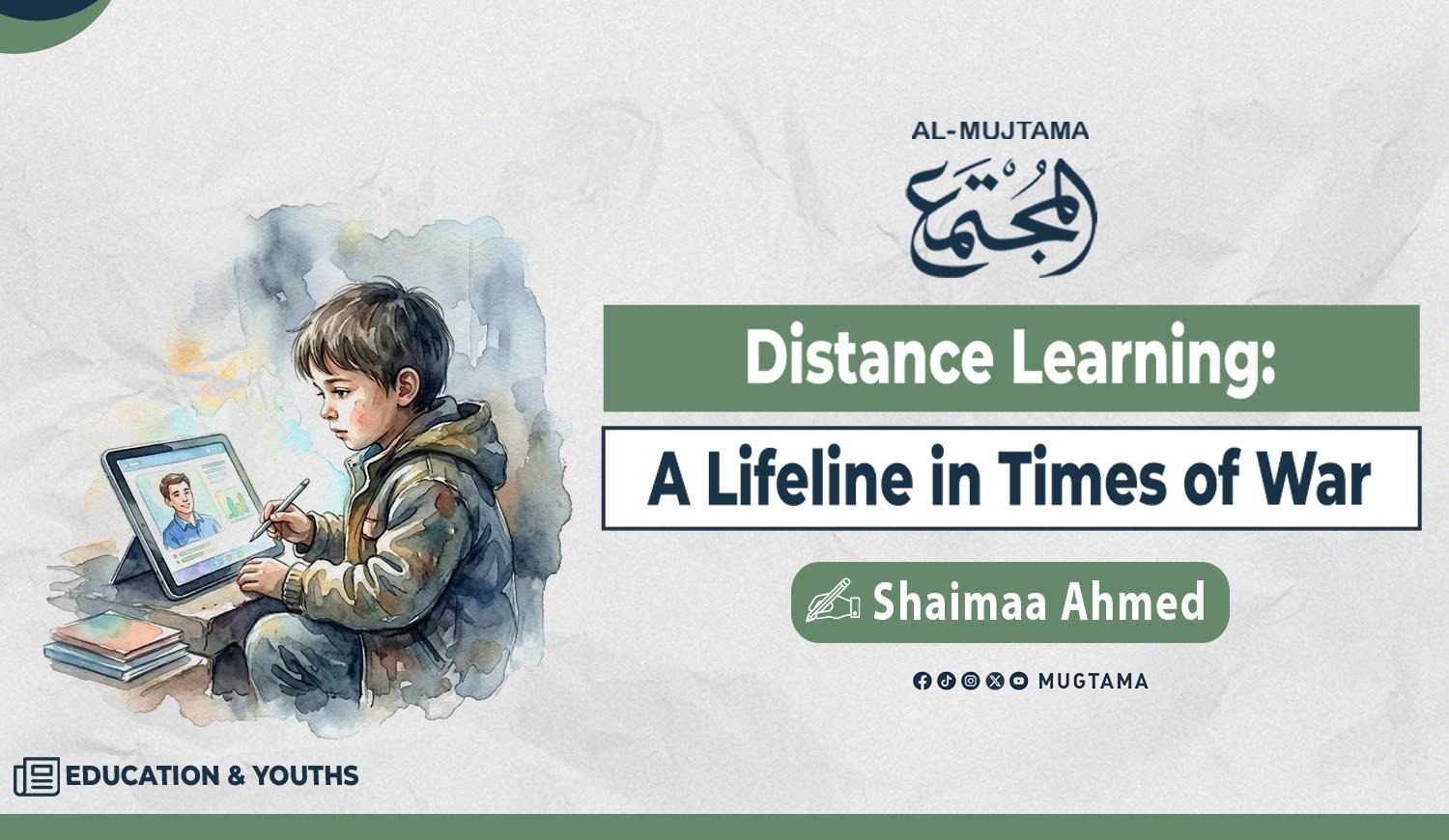
Distance Learning: A Lifeline in Times of War
One day, a
teacher stood in a tent set up in Rafah, in southern Gaza, which has been
subjected to some of the most horrific forms of Israeli and Western-backed
destruction. She asked herself: What does education mean in a time of war? Her
answer was simple: It is the act of insisting that a future still exists, even
when the present is ablaze.
If the
devastating war in Gaza has not prevented school and university students from
striving to continue their education, even through the most basic means,
studying while hungry and frightened and refusing to let the occupation take
away their children's future just as it has taken away their present, then
surely this experience should inspire the wider Muslim world to develop advanced
systems that allow students to continue learning remotely during emergencies
and wars.
Reports by
international organizations such as UNICEF and UNESCO indicate that schools in
conflict settings provide children with physical protection, psychological
support, and a sense of stability. They can also protect children from
exploitation and recruitment by armed groups. Studies likewise show that
education during crises restores children's sense of normality, routine, and
social stability, making it an essential part of psychological recovery after
trauma.
The Gulf
countries have taken a positive step by recently introducing temporary
remote-learning arrangements in response to the circumstances surrounding the
American-Israeli war with Iran and the spread of the conflict's repercussions
across the region. In fact, these countries had already launched a broad wave
of remote-learning initiatives several years ago, particularly following the
COVID-19 pandemic.
Kuwait, for
example, invested heavily in developing its digital infrastructure in 2024,
helping improve the quality of remote education. The Ministry of Education
worked with platforms such as Microsoft Teams and introduced virtual
classrooms. Similar systems were implemented effectively across the Gulf,
reflecting the global move toward hybrid models that combine in-person and
virtual education.
Emergency
Schools
What happens
when your children, and the children of the neighborhood, spend their days
following war news on the one hand and turning to social media and video games
on the other after their schools have closed?
Anxiety and
fear can begin to take root among children and adolescents. Students fall
behind academically, while prolonged disruption can lead to intellectual
stagnation. They may also turn to activities that intensify their fears or
expose them to material that threatens their safety, identity, religious
values, and sense of belonging.
During
emergencies, schools play an important role in reassuring students and raising
their awareness during wartime, rather than simply delivering academic lessons.
School is therefore a necessity, not a luxury, as some parents may assume when
they exclaim in frustration: “Is this really the time for education when
missiles are shaking the sky and terrifying our children?”
The answer is
simple: Yes.
The
Numbers Tell the Story
Across the Arab
world, war has had a devastating impact on children's education.
Sudan is facing
what has been described as the world's largest education emergency. Estimates
published by UNICEF indicate that 19 million children are out of school, while
90% of schools across the country have been closed because of the ongoing
violent conflict.
According to
UNRWA, the war in Gaza has left more than 660,000 children out of school,
following the destruction of 95% of the educational infrastructure. This
represents nearly the entire school-age population of Gaza. With the assistance
of international and local humanitarian organizations, temporary classrooms
have nevertheless been established inside displacement camps, allowing children
to continue learning while also receiving psychological support.
This support is
particularly important because many children have witnessed severe injuries or
the deaths of family members, while their communities face an acute shortage of
even the basic necessities required to remain safe and alive.
Teachers in
Gaza are playing a major role. In Rafah, for example, images have emerged of
students inside tents attending lessons, drawing, exercising, and taking part
in singing activities despite the immense brutality of the war.
Beyond the Arab
world, Ukraine offers another example of a society's determination to keep
children learning amid war. Around five million children face barriers to
safely accessing their schools. Many schools in frontline areas have been
closed or moved online. More than 420,000 children attend school entirely
online, while around one million follow a hybrid model, combining remote
learning with attendance at schools located underground or inside metro
stations to ensure that their education can continue.
A Dual
Approach to Learning
Online schools
cannot, of course, replace traditional classrooms entirely. This principle is
widely recognized across developed education systems. Direct, face-to-face
interaction between students, their peers, and their teachers contributes to
their personal development, behavior, and intellectual and physical growth. It
also provides an environment where students can participate in activities and
hobbies and engage directly with their lessons.
At the same
time, there is a genuine global movement toward combining traditional education
with digital learning, and this approach has been shown to increase students'
motivation and make learning more engaging.
This model
becomes even more important when countries face major crises such as armed
conflicts, wars, natural disasters, or health emergencies that prevent students
from safely reaching their schools.
Online
education offers exceptional flexibility and can serve students from different
social, intellectual, and cultural backgrounds. It can also reduce costs and
effort while helping students with learning difficulties and students with
disabilities continue their education.
In terms of
time, students can attend or watch their lectures throughout the day. Systems
can be put in place to record attendance, submit assignments, conduct
assessments, and administer regular examinations. At the same time, students
can attend a proportion of classes in person on a regular basis, ensuring
meaningful interaction, allowing them to ask questions, and helping break the
isolation created by war and school closures. This can also provide
psychological relief and help students process and contain their fears.
Initiatives
in Wartime
The Gulf
countries are among the leading supporters of education programs in
conflict-affected areas through international initiatives. These include
funding education programs for refugees, supporting education in disaster
zones, and establishing digital schools for children affected by conflict.
Qatari
institutions such as Education Above All, for example, work to support the
education of children affected by conflict around the world. The United Arab
Emirates has also launched programs such as the Digital School to provide
education to refugees and children living in conflict zones.
Such efforts
reflect an understanding of the school as an important safe haven for children
living through war, particularly as they endure multiple forms of trauma,
including the loss of relatives, displacement, and bombardment.
Schools can
provide an organized environment that reduces levels of fear and anxiety while
strengthening children's family and community ties, reinforcing their sense of
identity, and helping them develop the confidence and resilience needed to
overcome danger.
The next step
is for Arab countries, particularly the Gulf states, to accelerate the
development of curricula that meet the demands of the present era, including
artificial intelligence and languages. They must also develop flexible
education systems capable of functioning during emergencies and provide
awareness programs for parents, students, and teachers on how to make effective
use of modern educational platforms.
Our teachers
also need training in how to reassure students, educate them about their
history and present circumstances, and nurture within them the values of their
faith. This includes teaching them to connect resistance to aggression,
patience in times of hardship, and the ability to overcome adversity with
courage and hope to the promise of victory and glad tidings in this life and
the Hereafter.
In this way,
digital and alternative schools can become a shield of protection for a new
generation of Arab children growing up in an age of war and conflict.
-------------------------------------------------------------