









Digital Privacy: Does Suspicion Justify Digital Spying?

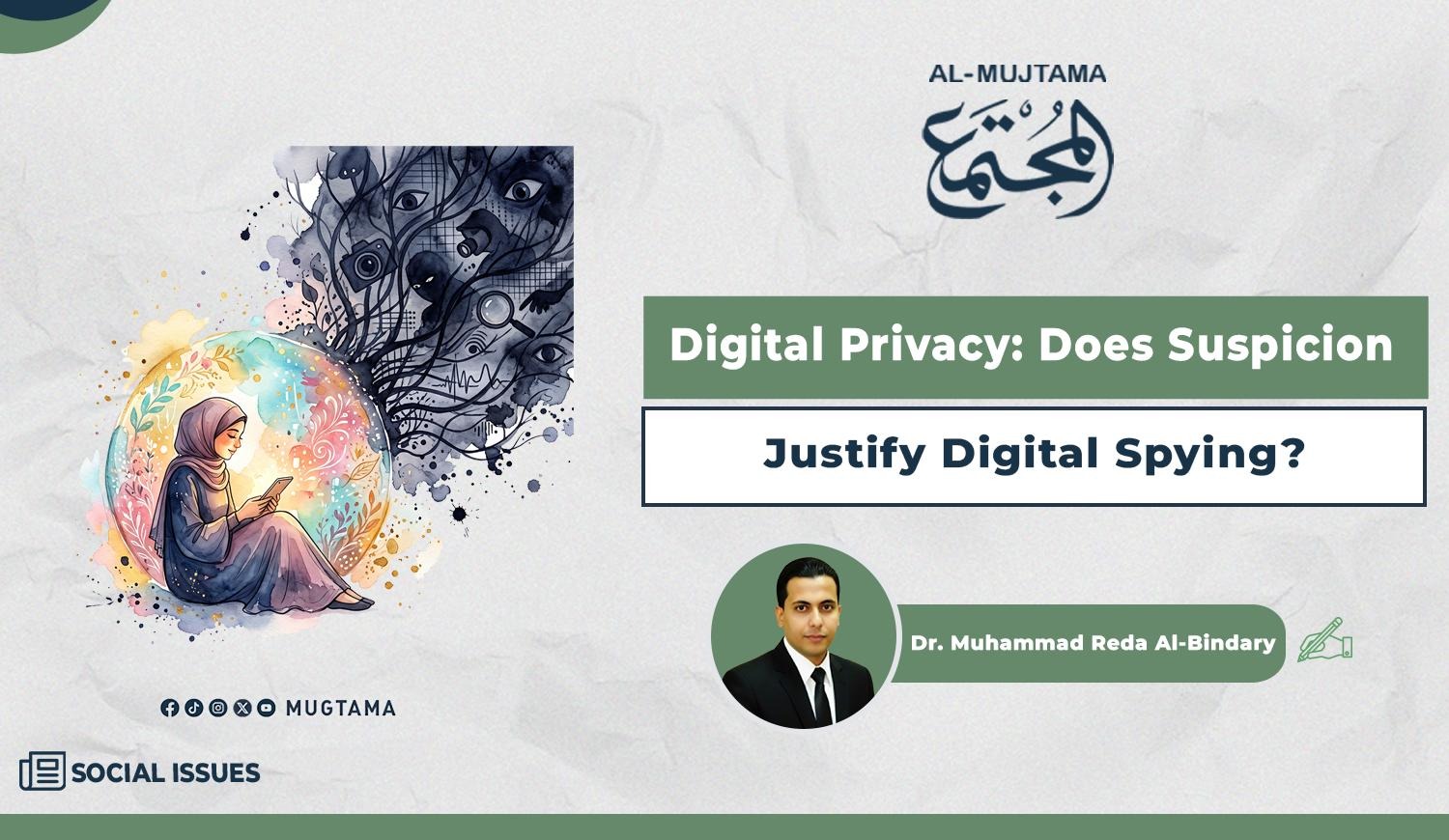
Late at night,
when the household has fallen asleep, a trembling hand reaches for a phone
resting on a bedside table. It is unlocked cautiously, almost like a thief
breaking in, as its messages, photos, and call history are searched. The heart
races between two fears: finding what it dreads and being discovered by its
owner.
In another
home, a father secretly installs an app to track his adult son, monitoring his
whereabouts, reading his messages, and checking whom he speaks to. Meanwhile,
in a third setting, a manager scrolls through employees' private conversations,
claiming to be protecting the company's interests.
Such scenes
have become increasingly common, to the point that people have almost grown
accustomed to their ugliness. In our time, a smartphone has become a second
home, perhaps even a more private one. It holds a person's secrets, fears,
vulnerabilities, and conversations shared only because they were believed to
remain between the people involved.
This raises a
question many people ask, whether openly or implicitly: If I have reason to
suspect someone, am I not entitled to put my doubts to rest by finding out the
truth?
A Chain
That Begins with Suspicion
The Quran
offers a remarkably precise diagnosis of this moral failing in a single verse: {O believers! Avoid many suspicions, ˹for˺ indeed, some suspicions are sinful. And
do not spy, nor backbite one another. Would any of you like to eat the flesh of
their dead brother? You would despise that! And fear Allah. Surely Allah is ˹the˺ Accepter of Repentance, Most Merciful.} [Al-Hujurat
49:12]
The sequence of
prohibitions in this verse carries a profound lesson: suspicion comes first,
followed by spying, then backbiting. They are not isolated sins but links in a
single chain, each leading to the next.
A negative
thought takes root in the heart. If a person entertains it and allows it to
grow, it can turn into an imagined certainty. That false certainty then drives
the person to search for evidence to support it. And once something is found,
or merely mistaken for evidence, the tongue is set loose against another
person's honour.
Spying,
therefore, grows out of suspicion and paves the way for backbiting. Whoever
wishes to escape the end of this chain must break it at its beginning.
The Prophet
Muhammad (peace and blessings be upon him) warned against the deceptive nature
of suspicion, saying: “Beware of suspicion, for suspicion is the worst of false
tales. And do not look for the others' faults, and do not spy on one another.” (1)
Describing
suspicion as “the worst of false tales” is particularly striking. A person
consumed by suspicion may not be lying to someone else; rather, they are
deceiving themselves. They construct an entire story from a passing glance,
interpret a delayed reply as betrayal, or turn an unfamiliar phone number into
evidence of an illicit relationship. Eventually, they begin to believe their
own assumptions as though they had witnessed them firsthand.
A Smartphone Is
a Private Space. Looking Through It Is an Intrusion.
Islam grants
homes a sanctity that no one may violate without permission. The Prophet
Muhammad (peace and blessings be upon him) explained the wisdom behind this
requirement when he saw a man peering through a hole into his private quarters.
He said: “Verily! The order of taking permission to enter has been enjoined because
of that sight.” (2)
Seeking
permission, therefore, is not merely a matter of etiquette. It safeguards what
people do not wish others to see.
If the
underlying principle is protecting people from unwanted observation, it also
applies to the digital spaces they consider private. A locked smartphone is
like a closed door to its owner's personal life. Secretly unlocking it is no
different in principle from peering through a hole in someone's door, even if
the means have changed and the setting is now digital.
Indeed, looking
through someone's phone may reveal far more than looking into their home. A
home offers glimpses of a person's outward life, while a smartphone can expose
the most intimate details of their inner world.
When Is
It Permissible to Investigate?
Classical
Muslim scholars did not overlook this issue. They examined it carefully,
establishing principles that remain relevant to our time.
Imam Al-Mawardi
distinguished between two categories of suspected wrongdoing that may be
concealed from public view.
The first
involves a serious violation whose consequences cannot be reversed once it
occurs. For example, a trustworthy person informs someone that another
individual is alone with a woman intending to commit adultery, or with a man
intending to murder him. In such circumstances, investigating the matter and
uncovering what is happening may be permissible.
The second
category includes matters that fall short of this level of seriousness. In such
cases, spying and lifting the veil from people's private affairs are not
permissible. (3)
Consider the
conditions underlying this distinction:
- Reliable information: The concern must be based on information from a
trustworthy source, not personal anxiety or unfounded suspicion.
- A grave offence: The suspected wrongdoing must involve serious
harm, not a passing doubt or ambiguous behaviour.
- Irreversible consequences: The danger must be one that cannot be remedied
if it is allowed to occur.
When these
conditions are met, investigating may be justified to prevent a greater harm.
If even one is absent, the original prohibition remains in force: Do not spy.
How far removed
is this standard from the conduct of a spouse who becomes uneasy because their
partner spends more time looking at a phone, or a husband who grows suspicious
after hearing his wife laugh during a phone conversation?
Such anxieties
call for honest communication and dialogue, not secret surveillance and
intrusion.
Al-Mawardi also
recounts, in the same discussion, an incident involving Umar ibn Al-Khattab
(may Allah be pleased with him). Umar once entered a gathering where people
were drinking. When he rebuked them, they responded that he had violated
Allah's prohibition against spying and the requirement to seek permission
before entering.
Umar replied,
“These two are for those two,” and left. (4)
Whatever the
status of this report, Al-Mawardi cites it to illustrate an important
principle: committing the sin of spying does not become permissible simply
because the person being investigated may also be committing a wrongdoing.
What
Spying Destroys
A person who
spies may believe they are protecting their marriage, family, or workplace. In
reality, they may be destroying one of the most valuable foundations of all
these relationships: trust.
The Prophet
Muhammad (peace and blessings be upon him) warned: “If you search for the faults of the
people, you will corrupt them.” (5)
This warning is
particularly relevant to married life.
A husband who
discovers that his wife has searched through his phone may never look at her in
quite the same way again. A wife who learns that she is being monitored may
lose the sense of security that gives a home its emotional foundation.
If the person
spying finds nothing, they have sacrificed someone's trust without gaining
certainty. Suspicion is rarely satisfied; it simply demands another search,
another inspection, and another explanation.
And if they do
find something, they have reached it through a prohibited means, undermining
their own moral position and potentially closing the door to a conversation
that could have led to understanding and reconciliation.
The
Difference Between Responsible Oversight and Spying
This does not
mean that every form of monitoring is prohibited. There is an important
distinction between legitimate oversight and blameworthy spying, and it must be
understood.
A father who
monitors the content reaching his young child, openly and with the child's
knowledge, is fulfilling his responsibility of care and protection. He is not
engaging in prohibited spying.
Likewise, an
organisation that monitors its work devices under a clearly communicated
policy, known to its employees, is exercising legitimate oversight.
Spying,
however, occurs when surveillance is carried out secretly against an adult who
is independently responsible for their own affairs, invading matters that
belong to their private life, without sufficient evidence and merely out of
suspicion.
The distinction
rests on three principles: genuine responsibility rather than domination,
transparency rather than secrecy, and a legitimate need measured according to
its actual scope rather than insatiable curiosity.
Privacy
and the Divine Virtue of Concealment
When Islam
prohibits spying, it is not shielding wrongdoers from accountability. Rather,
it is protecting society from becoming a network of watching eyes and listening
ears, where trust dies and every individual lives as though they were a suspect
awaiting conviction.
A society in
which people preserve one another's privacy is not a society that turns a blind
eye to wrongdoing. It is a society that recognises human weakness, understands
that the door to repentance remains open, and appreciates the mercy of allowing
those who have erred a way back without public humiliation.
Perhaps the
most fitting conclusion is this: Allah, who knows what lies hidden in every
heart, conceals the faults of His servants, grants them time, and accepts their
repentance.
Why, then,
should a weak servant appoint themselves as a relentless investigator of what
Allah has concealed?
-------------------------------------------------------------
Footnotes
- 1 Narrated by Imam Muslim in his Sahih, Book of Righteousness, Maintaining Family Ties, and Good Manners, Chapter on the Prohibition of Suspicion, Spying, Envy, Outbidding, and Similar Practices (Hadith 2563). Edited by Muhammad Fu'ad Abd al-Baqi, Dar Ihya' al-Turath al-Arabi, vol. 4, p. 1985.
- 2 Narrated by Imam Al-Bukhari in his Sahih, Book of Seeking Permission, Chapter on Seeking Permission to Protect One's Privacy (Hadith 5887). Edited by Dr Mustafa Dib al-Bugha, Dar Ibn Kathir and Dar Al-Yamamah, Damascus, 5th edition, 1414 AH/1993 CE, vol. 5, p. 2304.
- 3 Al-Ahkam al-Sultaniyyah by Abu Al-Hasan Ali ibn Muhammad Al-Mawardi, Dar Al-Hadith, Cairo, n.d., p. 366.
- 4 Ibid., p. 366.
- 5 Narrated by Imam Abu Dawud in his Sunan, Book of Manners, Chapter on the Prohibition of Spying (Hadith 4888). Edited by Shu'ayb Al-Arna'ut and Muhammad Kamil Qarabelli, Dar Al-Risalah Al-Alamiyyah, 1st edition, 1430 AH/2009 CE, vol. 7, p. 250. The editor graded its chain of transmission as authentic.
