









Culture and Scientific Production in Palestine
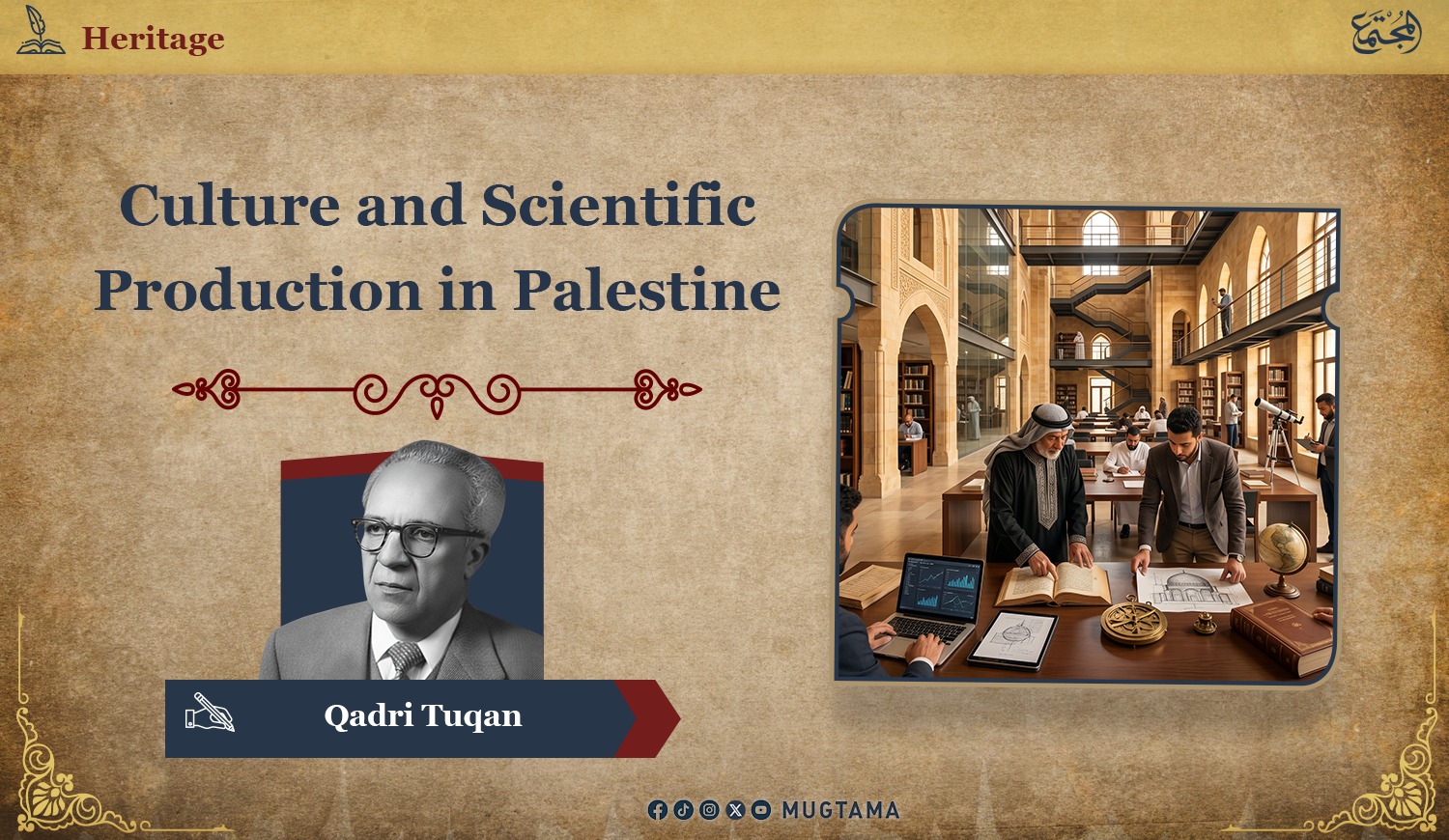
No two people disagree that the present
situation in Palestine is abnormal, and unlike that of the neighboring sister
countries. All suffer painful afflictions at the hands of colonialism and the colonizers,
and all live under the yoke of enslavement and subjugation. I do not find
anyone satisfied with the policies pursued in his country or with what is
happening around him. Yet there remains a difference between Palestine and the
surrounding lands: there, in those lands, there is one tyranny and one despot;
here, however, there are two tyrannies and two despots, both armed with
cunning, deceit, power, and craft. Thus the calamity here is greater, the
affliction more widespread, the danger certain, and extinction looms.
Colonialism… a
suffocation of culture and a killing of ambition
Naturally, a land in such a condition
cannot be prepared for scientific production nor for the flourishing of culture
and literature in the broad sense. It is natural, too, that these circumstances
affect the educated youth, the writers, and the scholars, taking from their
time, effort, and thought, compelling them to devote a portion of these to
political principles—repelling imminent dangers and lessening the disasters
pouring upon us from every side. And how can culture grow, how can an intellect
produce and innovate, if it is not surrounded by an atmosphere of freedom, in
an environment free of chains and shackles—an environment where no one forces
you to serve his interests, nor seeks to crush your morale and kill your
ambition?
And how can a young man devote himself to
learning—seeking growth, discovery, research, and inquiry—if he finds no one to
support, encourage, and guide him? What if he finds, instead, an environment
full of discouragement, full of the weakening of resolve? If we follow the
methods that the colonial governments employ across all their
departments—especially the education departments—we find that they aim to
eliminate the spirit of ambition, the spirit of inquiry, and the love of
acquiring more knowledge and arts. They aim to instill in the youth a reliance
on others, to kill the spirit of patriotism, and to spread contempt for Arab
and Islamic heritage and belittle both through every means. Beyond this, we
find them (the colonizers) occupying people and employees with matters that
bear no benefit, matters that bring neither good nor advancement to the
country.
Thus it is only natural—in this land and in
other lands afflicted with colonialism—that the governments therein do not
encourage knowledge, nor urge its pursuit, nor work to create a sincere desire
for writing and research, despite the nation’s dire need for all of this. So
the astonishment many feel at the government’s stance toward authors, and
toward those who pursue knowledge in its branches, is misplaced. Indeed, the
real astonishment lies in those people’s good opinion of the mandatory
governments and their reliance on them to encourage enlightenment and progress,
though they have ignored or forgotten that these governments follow a
particular colonial program—one that aims to eradicate anything that may raise
the nation’s level or advance its condition.
Reviving the nation
through the gateway of culture
For this reason, Arab scholars must turn
their attention to this matter, give it some care, rely upon themselves before
all else, and draw strength from the government’s stance—strength that pushes
them to expand the cultural movement in Palestine and beyond, and to spread the
spirit of inquiry among the educated. The national duty of hardworking youth
and teachers is to direct the education and upbringing of the young toward a
national, patriotic orientation. They may find this difficult and may face obstacles,
but they must strive, dedicating part of their effort to overcoming such
impediments and guiding education and culture in a direction that instills in
the youth a spirit of pride in their nation and belief in its
potential—creating in the young a strong personality, an independent identity,
and a manliness ready to answer the call of the homeland and capable of
contributing to the service of civilization.
The national duty of researchers is to
steer their studies toward the national dimension as well, to make clear to the
youth the great contributions of the Arabs to civilization—contributions no
other people attained—back in the days when they adhered to the original path
laid down by the Messenger, his Companions, and his successors, the days when
concern was for the essence, not the superficial. Only then can the nation
raise a generation of faithful youth working to elevate the condition of the
country—youth cultured with a national, patriotic culture who know how to serve
the homeland. That is the strongest weapon with which a rising nation may equip
itself, enabling it to navigate life with head held high, dignity preserved,
and attain the honor and glory it seeks.
Readers will be pleased to know that there
are serious efforts underway to begin joint cultural endeavors undertaken by
educated groups who aim to serve the nation by reviving culture and national
education, by reviving Arab and Islamic culture, and by encouraging bright
minds and fertile talents to direct their research and output in science and
art toward a national purpose.
A group of educated youth in Nablus have
established a cultural club called “The Cultural Club,” whose purpose is “to
create bonds and connections among the educated, to unite their scientific and
literary efforts and direct them nationally, and to raise the cultural and
literary level of the town through practical means such as lectures, study
circles, and building a library rich in valuable books.”
People will find in this club a practical
patriotism that will bring great benefits to the country. Similarly, there are
groups in Nablus, Jerusalem, Jaffa, Haifa, and other towns thinking about
establishing a translation, authorship, and publication committee similar to
Egypt’s Committee. We hope these groups succeed in their cultural projects and
lead the nation toward advancement, glory, and the heights of strength and
greatness.
Read Also:
-
Zionism: The Worst form of Colonialism
-
Reality of Zionist Colonialism
-------------------------------------------------------------
Source: Al-Risalah,
Issue (180).