









Biography of Sheikh Ibrahim Hamroush: Scholar, Jurist, and Linguistic Pioneer
Championing Arabic: The Inspiring Journey of Al-Azhar Sheikh Ibrahim Hamroush

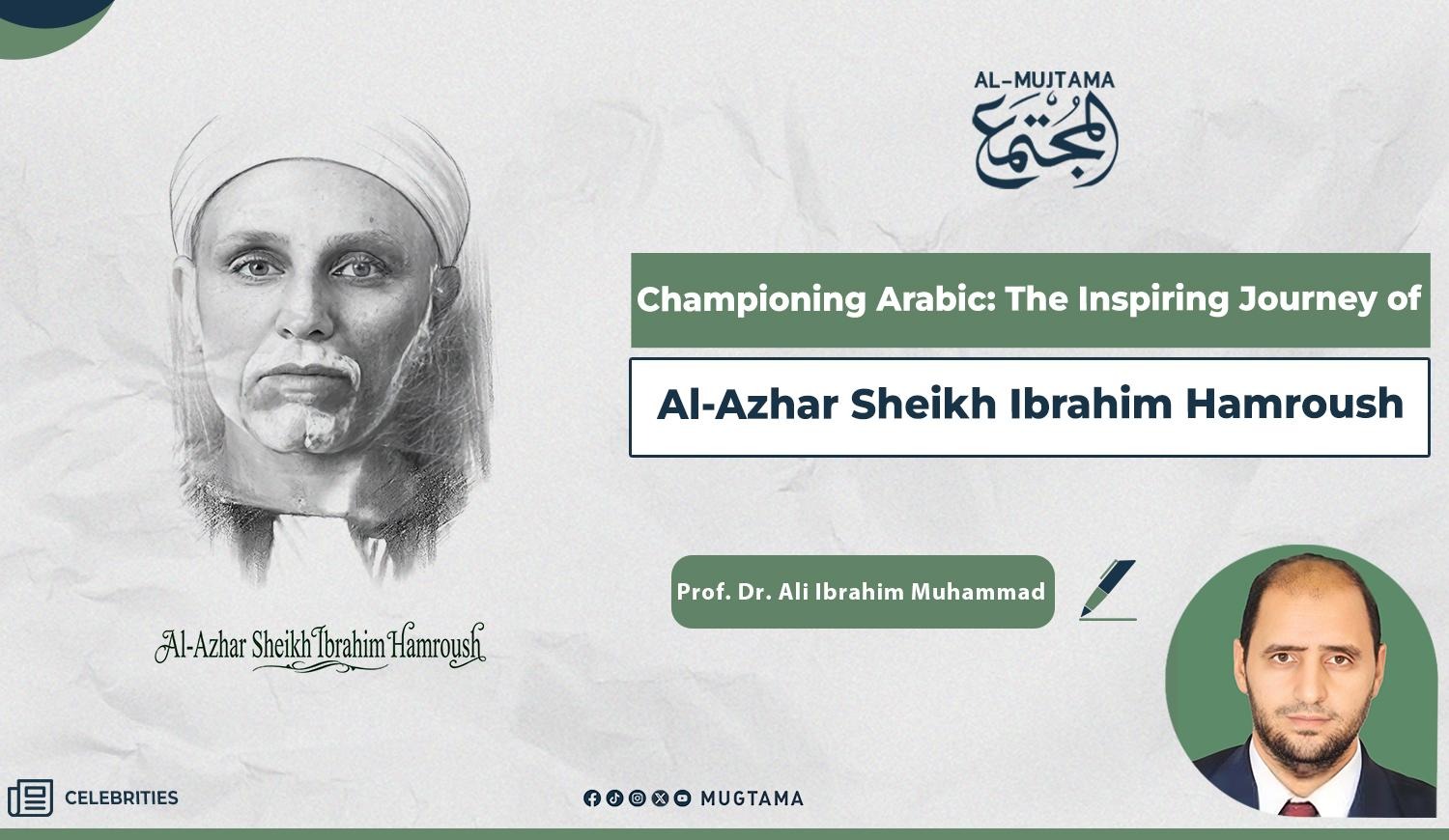
Grand Imam Sheikh Ibrahim Hamroush—may Allah have mercy on him—was not merely an Azharite scholar who combined teaching, judiciary work, and administration; rather, he was one of those scholars who made the Arabic language a field of research and renewal. He believed that the strength of Arabic lies not in marginalizing its heritage or restricting its vocabulary, but rather in understanding the laws governing its growth and exploring the methods of the Arabs in expression, derivation, and generation.
His linguistic works and the researches he presented to the
Academy of the Arabic Language reveal a scientific mind that combines the
preservation of the foundations of Arabic with openness to its evolving needs.
He discussed semantic inclusion and the substitution of letters, major
derivation, blending (portmanteau), and the writing of foreign words. He also
participated in discussions concerning the facilitation of Arabic and the
script of the Quran (Rasm al-Musaf), basing his views on linguistic evidence,
the texts of its scholars, and the requirements of actual usage, as we will
explain in this article.
The Sheikh’s attention to the language was not separate from
his Azharite background and scholarly career; he acquired knowledge at the
hands of the leading scholars of his era, with Imam Muhammad Abduh being among
his most prominent teachers. His scholarly influence subsequently extended to
generations of scholars who graduated under him, foremost among them Imam
Sheikh Muhammad Metwally Al-Shaarawi, who testified to his teacher's abundance
of knowledge and diverse benefits.
Hence, the biography of Sheikh Ibrahim Hamroush appears as
more than just a translation of an Azharite scholar who assumed high scholarly
positions; it is the biography of a scholar who lived through the issues of
Arabic at a time when the language was facing questions of renewal,
facilitation, and the preservation of its origins. He left behind research and
stances on these issues that reveal his vision of the language as a living
entity capable of growth without losing its connection to its roots.
From the Village to the Halls of Al-Azhar
Our Sheikh was born in the village of Al-Khawaled, affiliated
with Itay El-Baroud Center in the Beheira Directorate, on the 20th of Rabi'
al-Awwal 1297 AH, corresponding to March 1, 1880 CE.
He grew up in his village where he was born, and enrolled in
the village kuttab ( Quranic school), memorizing the entire Holy Quran by the
age of twelve. His father sent him to Al-Azhar Al-Sharif, where he enrolled, making
the Sheikh—may Allah have mercy on him—one of the vanguard youths to whom the
new law of Azharite education was applied.
Professor Sheikh Muhammad Abdullah Draz—may Allah have mercy
on him—stated that the new Al-Azhar Mosque law was issued on the 20th of
Muharram 1314 AH / July 1, 1896 CE, issued by Khedive Abbas at the request of
Imam Muhammad Abduh—may Allah have mercy on him. That law stipulated that
certain mathematical sciences such as arithmetic and algebra be considered
compulsory subjects (Article 17), while sciences such as geometry, geography,
and history were optional, with preference and priority given to them (Article
18).
His Teachers: Deep-Rooted Foundations
Among his teachers from whom he acquired knowledge at Al-Azhar
were Sheikh Muhammad Bakhit Al-Muti'i and Sheikh Ahmad Abu Khatwa. He grew
deeply attached to and loved the latter Sheikh to the extent that he named his
son Ahmad Abu Khatwa bin Ibrahim Hamroush. They also included Sheikh Ali
Al-Salhi Al-Maliki and Imam Sheikh Muhammad Abduh, whom he accompanied and from
whom he learned the secrets of rhetoric and the proofs of inimitability of Abd
al-Qahir al-Jurjani, as well as Al-Basa'ir al-Nusayriyah fi al-Mantiq
(The Nusayri Insights in Logic). This latter book was authored by Qadi Zayn
al-Din Umar ibn Sahlan al-Sawi, and Imam Muhammad Abduh had written
commentaries and investigations upon it. The administration of Al-Azhar decided
on the 5th of Rajab 1316 AH / November 19, 1898 CE, to teach this book with its
commentaries in Al-Azhar Mosque.
His Students: Knowledge Spanning Generations
Among his most brilliant students whose fame spread and whose
knowledge brought widespread benefit were His Eminence Sheikh Hasan Mamoun, who
assumed the Grand Sheikhdom of Al-Azhar; His Eminence Sheikh Allam Nassar and
His Eminence Sheikh Hassanein Makhlouf, both of whom assumed the position of
Mufti of the Egyptian Lands; and His Eminence Sheikh Muhammad Metwally
Al-Shaarawi, who said about his teacher: "As for Sheikh Ibrahim Hamroush,
he influenced my life in a way no one else did. This man—you never enter upon
him seeking a matter except that you leave him with a rare benefit, a piece of
wisdom, a general piece of information, a scholarly anecdote, or other
beneficial matters, and he was abundantly knowledgeable in language and other
subjects."
Sheikh Ibrahim Hamroush in the Body of Senior Scholars
The Sheikh’s scholarly life was crowned by his selection as a
member of the Body of Senior Scholars on the 28th of Safar 1353 AH,
corresponding to June 10, 1934 CE. To attain this rank, he submitted a
distinguished treatise titled: Factors of Language Growth. In its
introduction, he stated:
"And after... the Arabic language, thanks to its multiple
factors, has seen a welcoming bosom, expanded scope, increased material, and
diversified structures. It has acquired the beauty of logic, the majesty of
signification, and the elegance of style. Through those factors, it
accommodated the sciences of the Greeks, Persians, and others, and became the
language of science and religion... I have written a word on generation by
augmentation, substitution, metathesis, derivation, synonymy, homonymy,
metaphor, blending, improvisation, and Arabization."
In the Halls of the Academy of the Arabic Language
In the same year the Sheikh entered the Body of Senior
Scholars, he attained membership in the Academy of the Arabic Language. On the
16th of Jumada al-Akhirah 1352 AH / October 6, 1934 CE, a royal decree was
issued appointing twenty members to the Academy of the Arabic Language, among
whom was Professor Sheikh Ibrahim Hamroush.
His Scholarly Works
1. Inclusion and the Substitution of Some Letters for Others
A published research paper in the proceedings of the sessions
of the first term of the Academy of the Arabic Language in Cairo, spanning five
pages. It consists of texts the Sheikh quoted from Hashiyat al-Khudari ala
Ibn Aqil, Hashiyat al-Sabban ala al-Ashmouni, Taqrir al-Anbabi
ala Hashiyat al-Amir, two texts from Mughni al-Labib by Ibn Hisham
(the first from part one, and the second from part two), and a text from Al-Risalah
al-Bayaniyah by Al-Anbabi. He then concluded these texts with his opinion
on inclusion, saying: "We therefore favor the view of the analogical
validity of inclusion (qiyasiyat al-tadamin)."
2. The Response to the Proposals of Professor Ahmad Amin—May Allah Have Mercy on Him—Regarding the Facilitation of Arabic
During the seventh session of the conference of the Academy of
the Arabic Language in Cairo in its tenth term held on 3/2/1363 AH,
corresponding to 29/1/1944 CE, Professor Ahmad Amin delivered a research paper
titled: A Proposal for Some Reform in the Text of the Language. In it,
he mentioned that among the problems of the Arabic language hindering its
mission are its excessive expansion in some places and its excessive
restriction in others. To solve this, he proposed the following:
- A.
Disencumbering the language of many vocabulary words—except historical
lexicons—such as archaic (hawshi) words that are rejected and
disliked by taste, eliminating unnecessary synonyms, and deleting antonyms
to eradicate them.
- B. Opening
the door of ijtihad in the language to expand the restricted via
Arabization, derivation, and analogy.
- C.
Reconsidering the chapter of masculine and feminine, and establishing some
general rules such as permitting the feminization of every feminine by
appending the feminine ta' (tā' al-ta'nīth), and for everything in which
no text has been reported, the feminine form is with the ha' (hâ'), and
anything that is not a true feminine without a feminine marker may be
treated as either masculine or feminine, such as the well (bi'r).
Professor Sheikh Ibrahim Hamroush responded to this proposal
in a six-page research paper published in the Journal of the Academy of the
Arabic Language in Cairo, Part Six, pages 103–108. It was also published in the
proceedings of the tenth term sessions, where the Sheikh presented it to the
academicians in the fourteenth session of the conference in its tenth term held
on 12 Safar 1363 AH / February 16, 1944 CE, and was also published in the
proceedings of this term on pages 385–392.
Sheikh Hamroush agreed with Professor Ahmad Amin on deleting
archaic words and limiting their documentation solely to historical lexicons,
and he also agreed with him on expanding the language by coining augmented
forms of triliteral verbs that have no attested augmented forms, provided that
morphological rules are observed and the meaning remains sound, and that we
apply analogy to non-attested verbal nouns (masadir) based on attested
ones—analogizing al-biradah (filing) and al-niqashah (engraving)
to al-khiyatah (sewing) and al-hiyakah (knitting), and so forth.
He did not limit his support to stating his personal opinion, but rather backed
it with what Ibn Jinni mentioned in Al-Khasa'is in the chapter
"That whatever is analogized upon the speech of the Arabs is of the speech
of the Arabs." However, he objected to the remainder of what was presented
and supported his counter-argument with tangible evidence from the language of the
Arabs and from the linguistic reality of past and present. Regarding the
deletion of numerous synonyms and some examples of homonyms and antonyms, he
stated, for instance: "As for putting to death many of the numerous
synonyms, we do not agree to it because synonyms have run through literature in
both its poetry and prose, and have persisted in ancient and modern literature.
If we were to restrict ourselves to some synonyms, our successors would fall
into confusion..."
3. The Script of the Quran (Rasm al-Mushaf) Between Tradition and the Rules of Writing
In the thirteenth session of the sixth term held on January
25, 1950, the Sheikh—may Allah have mercy on him—delivered a research paper
titled: Rasm al-Mushaf (The Quranic Script), which he began by stating a
foundational principle of script: "The basis in this script is that it
should be a portrayal of the spoken word using its alphabetical letters such
that the written matches the uttered." He then noted that scholars of
script ruptured this principle with a multitude of exceptions in letters,
particularly the hamza.
He then mentioned certain phenomena of the Quranic script,
such as the addition of ya' in (naba' and wara'), the omission of alif
in the raised dual (al-muthanna al-marfu'), the omission of the dual alif
in the raised imperfect verb (al-mudari' al-marfu'), and the writing of
certain connected feminine *ta'*s with the open ta'.
He explained this by noting that the revelation scribes among
the Companions—may Allah be pleased with them—did not possess an equal share of
knowledge regarding the science of script, so each wrote according to what he
knew.
He then discussed certain jurisprudential views regarding the
ruling on writing the Holy Quran in ordinary conventional orthographic script.
These included the view of Al-Baqillani, who was reported to have said: "Whoever
claims that the Mushaf is written in a specific specialized script is required
to provide proof"; the view of Imam Malik, who issued a legal opinion
(fatwa) keeping the script upon its initial writing, but when
questioners returned to him, he issued a fatwa permitting changes in the
writing of chapters for teaching children; and the view of Izz al-Din ibn 'Abd
al-Salam, who held that writing the Mushaf contrary to the prescribed script
induces skepticism.
He then mentioned that in 1937 CE, a proposal was submitted to
the Fatwa Committee at Al-Azhar concerning printing the Mushaf based on the
ordinary writing script followed today. The committee issued a fatwa stating
its view on the necessity of adhering to the traditional, transmitted writing
and spelling of the Mushaf.
4. The Method of Writing Foreign Words in Arabic Letters
This is a research paper he presented to the conference of the
Academy of the Arabic Language in its third term. In the twenty-ninth session
held on Saturday, 19 Dhu al-Qi'dah 1354 AH, corresponding to February 22, 1936
CE, Dr. Muhammad Tawfiq Refaat opened the session by saying: "A research
paper on the method of writing foreign words by Professor Sheikh Ibrahim
Hamroush has been distributed to you, so let us discuss this topic tonight to
finish it before the end of the term."
5. On Major Derivation
A research paper published in the Journal of the Academy of
the Arabic Language in Cairo, Part Two, spanning eleven pages. The Sheikh began
it by discussing the types of inquiry into language, stating that they are of
two kinds: one may be to know the literal and metaphorical meanings of words, noting
that this type does not extend to knowing the unifying aspects and general
common meanings shared among multiple meanings. He mentioned that this type
does not lead to deducing rules or extracting regulations, and its ultimate
goal is knowing disparate meanings without finding a connection between them or
recognizing what common meanings unite their multiplicities. The other kind is
for knowing unifying aspects and general meanings through which multiple
meanings appear as distinct factions and numerous groups, each united by a
general meaning to which its individuals return and share in it, thereby
distinguishing one group from another.
He then stated that this latter kind is the inquiry of
derivationists, which enabled them to trace words sharing a single meaning back
to one another through metathesis and substitution, and unveiled to them the
secret of language generation and growth.
6. Blending (Portmanteau / Al-Naht)
A research paper he presented to the Academy of the Arabic
Language in Cairo.
From Teaching to the Grand Sheikhdom of Al-Azhar: A Journey Full of Giving
Following his successful completion of the Alimiyah
examination, Sheikh Ibrahim Hamroush was appointed as a teacher at Al-Azhar
Al-Sharif on November 21, 1906.
In 1908, he was selected as a teacher at the School of Sharia
Judiciary, where he taught jurisprudence (fiqh) and its foundations (usul),
remaining there until June 12, 1916.
Subsequently, he was appointed as a judge in the Sharia courts
and continued to rise through their ranks until 1928, when he was chosen as the
Sheikh of the Assiut Religious Institute. A few months later, he was chosen as
the Sheikh of the Zagazig Azharite Institute.
In 1931, he was selected as the Dean of the College of Arabic
Language upon its establishment, remaining dean of the college until 1944 when
he was transferred to serve as the Sheikh of the College of Sharia, resigning
from this position in 1946.
In 1950, he was appointed head of the Fatwa Committee at
Al-Azhar, and in 1951, he was appointed as the Grand Sheikh of Al-Azhar
Al-Sharif. He was relieved of this position after serving in it for six months
and three days, before completing a year, on February 10, 1952.
The Sheikh Departed, and the Legacy Remained
Sheikh Ibrahim Hamroush answered his Lord’s call after a life
replete with scholarly giving and national struggle, and after memorable
stances in combating heresies and falsehoods, coupled with fruitful efforts in
organizing Azharite institutes and colleges. This took place on the 26th of
Jumada al-Ula 1380 AH, corresponding to November 15, 1960 CE.
