






Book Review: “The Mature Mind” By Harry Allen Overstreet
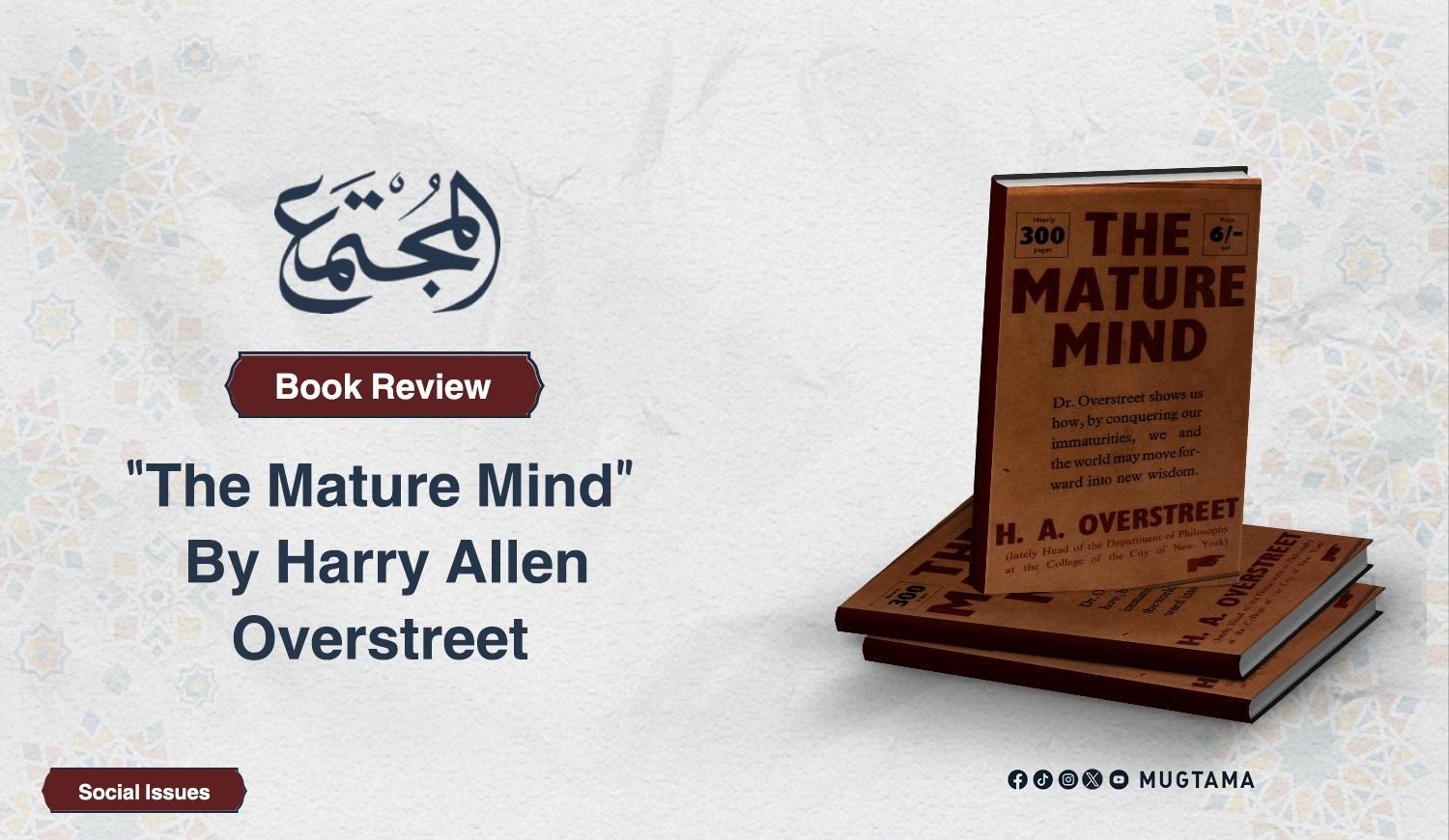
The Mature Mind by American author Harry Allen Overstreet
seeks to answer a thought-provoking question: Are you truly a mature person?
Where do you stand in relation to the qualities of a mature mind, and are you
committed to cultivating them within yourself?
Originally
published decades ago and translated into Arabic in 2017 by Nabta Publishing
House, the book is divided into two main parts. The first explores the
psychological foundations of maturity, the standards by which it is measured,
the contrast between traditional and modern perspectives on maturity, and the
distinction between mature and immature patterns of thinking.
The second part
examines the systems under which we live, the burden of inherited
contradictions, the practical application of maturity, economic systems and
self-fulfillment, the role of politics in the development of thought, the
influence of the press, radio, and television, the family's role in raising
children, the direction of education, the path toward religious maturity, and
where the journey toward maturity should begin.
Comprising
thirteen insightful chapters, the book—one of America's best-selling works,
with more than half a million copies sold during its early years—focuses on
human maturity in its intellectual, emotional, and social dimensions.
Humanity
and the Renewal of Hope
Overstreet
argues that the future of humanity depends on each one of us. While we are
shaped and often constrained by the systems and traditions that govern our
civilization, every individual still has the capacity to contribute to a better
future by responding to life's challenges with wisdom and maturity.
The American
psychologist believes that one of the first responsibilities we have is to keep
hope alive in people's hearts. He emphasizes that our lives become stronger and
happier the more they are enriched by meaningful and positive connections with
the lives of others.
He encourages
readers to pursue knowledge, accept responsibility, speak with clarity and
precision, nurture compassion and a spirit of cooperation, and recognize that
every situation in life presents a choice between responding with maturity or
reacting immaturely.
For example,
when a family member makes a mistake, that error can become an excuse for
anger, harsh criticism, ridicule, or rejection. Yet it can equally become an
opportunity to acknowledge the imperfections shared by all human beings,
exercise patience, and guide the person toward improvement with understanding
and wisdom.
Similarly, when
a teenager comes home expressing ideas that differ from those held by the
family, adults may choose to react with shock and anger. Alternatively, they
can use the moment as an opportunity to encourage open conversation, listen
carefully to their child's thoughts, and respond with maturity and respect.
The
Characteristics of a Mature Person
Overstreet
maintains that a mature person can distinguish what truly matters from what is
trivial. Such a person possesses the courage both to speak when something
deserves to be said and to remain silent when an argument serves no meaningful
purpose.
According to
the author, genuine maturity is achieved by joining communities and groups that
promote dialogue, understanding, and love, rather than those driven by
partisanship, intolerance, and narrow-mindedness.
In concluding
this valuable work, the distinguished American lecturer affirms that
psychological maturity is the surest path to victory and lasting success. As
the old saying reminds us, "Where there is no vision, the people
perish." We have come to realize, he writes, that true vision cannot
exist where maturity is absent.
-------------------------------------------------------------