





Book Review: “The Finest Hotel in Kabul” by Lyse Doucet
In the literature of investigative journalism and political history, rarely do we find a place as fraught with contradictions as historical hotels in conflict zones. In times of war, a hotel is not merely a structure of concrete and decorated ceilings; it is an intense theater where the interests of spies, diplomats, journalists, leaders, and even the humble workers who clean the dust of battles from the luxurious carpets every morning intersect.
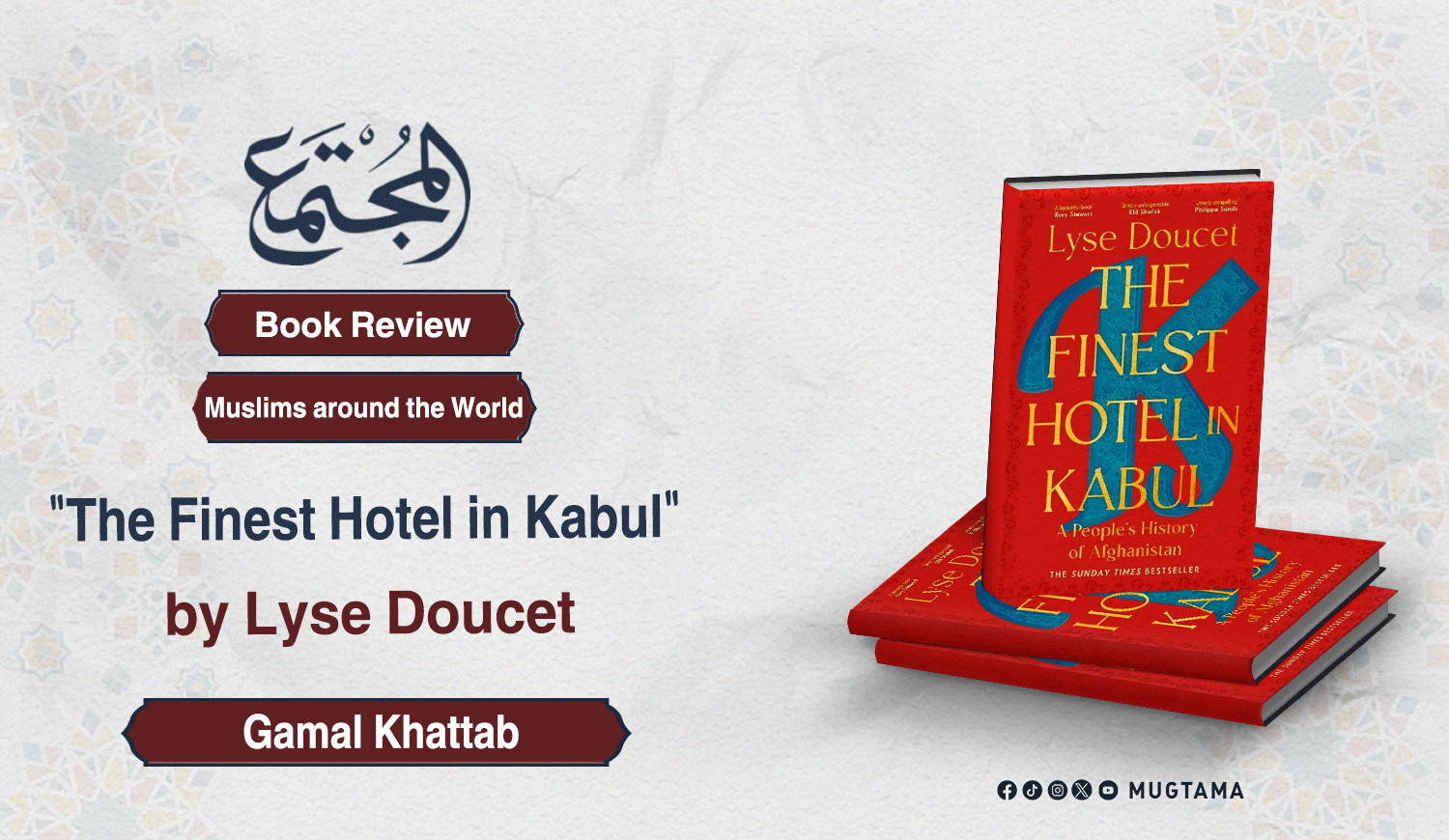
In her extraordinary book, The Finest Hotel in Kabul,
prominent journalist and International Chief Presenter for the BBC, Lyse Doucet, takes us on a decades-long documentary journey. She narrates the
modern history of Afghanistan not through archival documents or politicians'
speeches, but through the biography of the "Intercontinental Hotel
Kabul." Opened in 1969 on a hill in the Afghan capital, the hotel became,
from the moment of its construction, a mirror reflecting every transformation
and setback that has beset the country.
Narrative Architecture: History from the Ground Up
Lyse Doucet’s cleverness shines through in her beautiful
narrative choice. She does not stand in an ivory tower as a Western journalist
analyzing the Afghan conflict in cold, numerical, or detached prose; instead,
she descends into the details of daily life inside the hotel. The author
divides the work into chronological stops where major historical events in
Afghanistan parallel what was unfolding within the hotel’s corridors.
The story begins in the late 1960s, in Afghanistan's forgotten
era—an era of kings, quiet streets, and foreign tourists staying at the hotel
to enjoy the beauty of the Hindu Kush mountains. At that time, the hotel was a
symbol of modernization from a European perspective, filled with lavish wedding
parties and live music. But this European-style modernization did not last.
In the late 1970s, followed by the Soviet invasion in 1979,
the walls of the hotel began to change. The hotel transformed from a gathering
place for elites and foreigners into a crisis management headquarters and a
shelter for international journalists who came to cover the war against the
Soviets. Then came the bloody civil war of the 1990s among the Mujahideen
factions, during which the hotel itself was subjected to direct shelling,
its walls crumbled, and its electricity and water were cut off—yet its doors
remained open!
In the Heart of the Rubble
The greatest literary and human value in Doucet’s book lies
not only in political documentation, but in the characters to whom the author
gives life. She steps away from focusing exclusively on the famous figures who
stayed at the hotel, choosing instead to focus on the "hotel workers and
staff":
- The
chefs who devised meals from the barest available ingredients
under fire and artillery bombardment.
- The
receptionists who maintained guest registries despite
changing ruling regimes—from the Communists to the Mujahideen, then Taliban
in their first rule (1996–2001), to the invading American forces, and
then the return of the Taliban after their victory and the American
withdrawal in 2021.
- The
engineers and guards who risked their lives to protect the
building and keep the power generators running in the darkest
circumstances.
Through the stories of these workers, the author manages to
transform the hotel into a living, breathing entity that falls ill and resists.
These are the people who represent true Afghan resilience; they are the
ones who change the flags flying over the hotel roof according to whoever
controls Kabul at the moment, yet they remain steadfast in their positions,
serving humanity amid the aggression against the land of the Afghans.
Blood and Remains
Lyse Doucet does not overlook the terrifying, tragic aspects
the hotel witnessed. The Intercontinental Hotel Kabul was a primary
target for attacks and armed operations due to its international symbolism. The
author details the famous 2011 attack and the deadlier 2018 assault carried out
by gunmen that lasted for long hours, resulting in the deaths of dozens of guests
and staff.
She narrates these moments with a tense, cinematic tempo,
describing hiding under beds, running through dark corridors, and the sound of
gunfire echoing through the marble lobby. Yet, she does not use violence for
sensationalism, but rather to show how this monument built for comfort turns
into a trap of anxiety and death. The author does not forget to recount how
life returns to the hotel after every attack, thanks to the willpower of the
staff who clean the bloodstains and patch the bullet holes in the walls each
time to start anew.
A Distinguished Author
Lyse Doucet’s prose is characterized by warmth and deep
empathy for the Afghan people. By virtue of her field work over decades in
Afghanistan, she speaks with the voice of someone who understands the
intricacies of the society, its tribal fabric, and its culture. Her writing is
not merely news reporting, but fine literary prose blending strategic analysis
with human portraiture.
She offers a subtle and intelligent critique of Western and
international behavior in Afghanistan, illustrating how foreigners viewed the
country through the hotel’s air-conditioned windows, detached from the complex
reality outside the walls, and how this ignorance of reality led to the
collapse of every foreign political project one after another.
A Sociological and Psychological Study on the Meaning of Survival in Hardship
The Finest Hotel in Kabul is not
merely a history book or a journalistic memoir; it is a sociological and
psychological study on the meaning of survival during national dissolution.
Lyse Doucet succeeds in transforming a cylindrical concrete building into a
miniature Greek tragedy epitomizing the story of an entire nation that has not
known peace for half a century.
The book is an exceptionally important historical and human document, recommended for anyone who enjoys historical investigative literature, and for anyone seeking to understand Afghanistan away from cliché news headlines—through the story of a hotel that refused to close its doors while the world around it collapsed.