







Book Review: Digital Psychology in the Age of Fifth-Generation Warfare
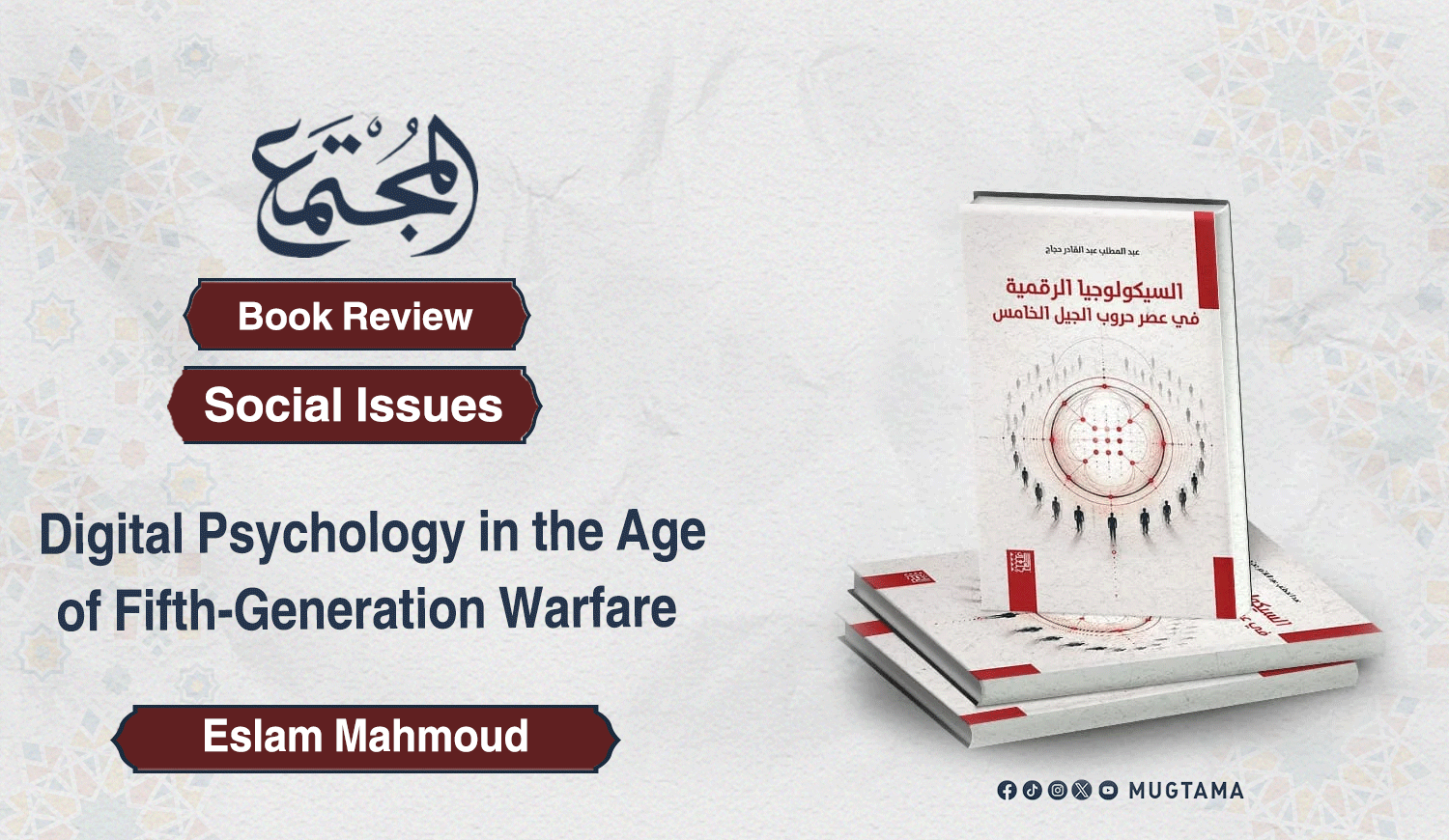
The book Digital
Psychology in the Age of Fifth-Generation Warfare explores how public
opinion is influenced in the algorithm-driven era and examines the mechanisms
behind modern digital warfare.
According to
its author, Dr. Abdel-Muttalib Abdel-Qader Haggag, control is no longer
exercised solely through military force. Instead, it increasingly relies on
psychological influence tools powered by algorithms and artificial intelligence
(AI), marking a major shift in strategies of power and influence.
Understanding
the Mechanisms of Digital Psychology
Published in
2026, the book examines the relationship between digital technology and human
behavior in the context of political and social conflicts, particularly as
algorithms and AI play an increasingly significant role in shaping collective
awareness and political behavior.
The 624-page
volume comprises 11 chapters organized around four main themes: the foundations
of cyberpsychological theory; mechanisms of behavioral and political influence;
cultural warfare and artificial intelligence; and cognitive defense and
practical applications.
The first
section traces the historical development of psychological warfare and examines
intervention strategies in digital conflicts, the psychology of rumors and how
they spread through online communities, as well as hybrid threats and cyber
operations.
The author
explains how contemporary cyber threats have become direct instruments of
psychological warfare, with disinformation and media manipulation techniques
deployed to target societies and undermine their stability.
The second
section focuses on behavioral and political influence, exploring how digital
warfare exploits modern technologies to manipulate individual decision-making.
It examines social engineering strategies and algorithmic thinking as tools for
reshaping social perceptions and influencing human behavior.
Dr. Haggag also
examines the dynamics of polarization and fragmentation, highlighting how
algorithms can deepen social divisions, shape public opinion, and influence
political decision-making.
The Role
of Artificial Intelligence
The author, who
previously served as an assistant professor at Kuwait University, highlights
the dangers of cultural warfare and its role in reshaping identity through the
manipulation of cultural and historical symbols for psychological influence and
disinformation.
The book's
third section examines deepfakes and the manipulation of collective memory,
exploring how artificial intelligence is transforming contemporary
psychological warfare, shaping public opinion, and influencing political
decisions.
The fourth and
final section addresses strategies for developing psychological defenses
against digital influence. These include strengthening individual and
collective resilience, promoting critical thinking in the digital age, and
building societies better equipped to withstand psychological warfare.
The author also
analyzes real-world cases involving political and electoral contexts, the
spread of rumors in public discourse, and strategies for strengthening
psychological security and cognitive defense. These insights make the book a
valuable reference for policymakers and decision-makers.
With 624 pages,
Digital Psychology in the Age of Fifth-Generation Warfare represents a
significant contribution to Arabic scholarship. Its value lies in bringing
together political and social psychology, cybersecurity theories, and
analytical approaches to understanding how advanced digital technologies
reshape collective perception.
Building
Resilient Societies
The book
concludes by emphasizing the need to understand the profound transformations
taking place in contemporary conflict zones and build more resilient societies
capable of confronting fifth-generation warfare.
Modern
conflicts increasingly target the realm of human awareness and perception,
using algorithms and artificial intelligence to manipulate how people interpret
information and understand the world around them.
In his
concluding remarks and recommendations, the author warns of the dangers posed
by emerging technological models, particularly deepfake technologies, which can
undermine people's ability to distinguish truth from falsehood and threaten
national stability.
He calls for
early preventive strategies, stronger digital literacy and critical-thinking
education, and the development of joint defensive tools among countries to
limit the malicious use of these technologies in psychological warfare
-------------------------------------------------------------
