









BJP Out, Hindu Extremism Remains: Fresh Massacres Target Indian Muslims
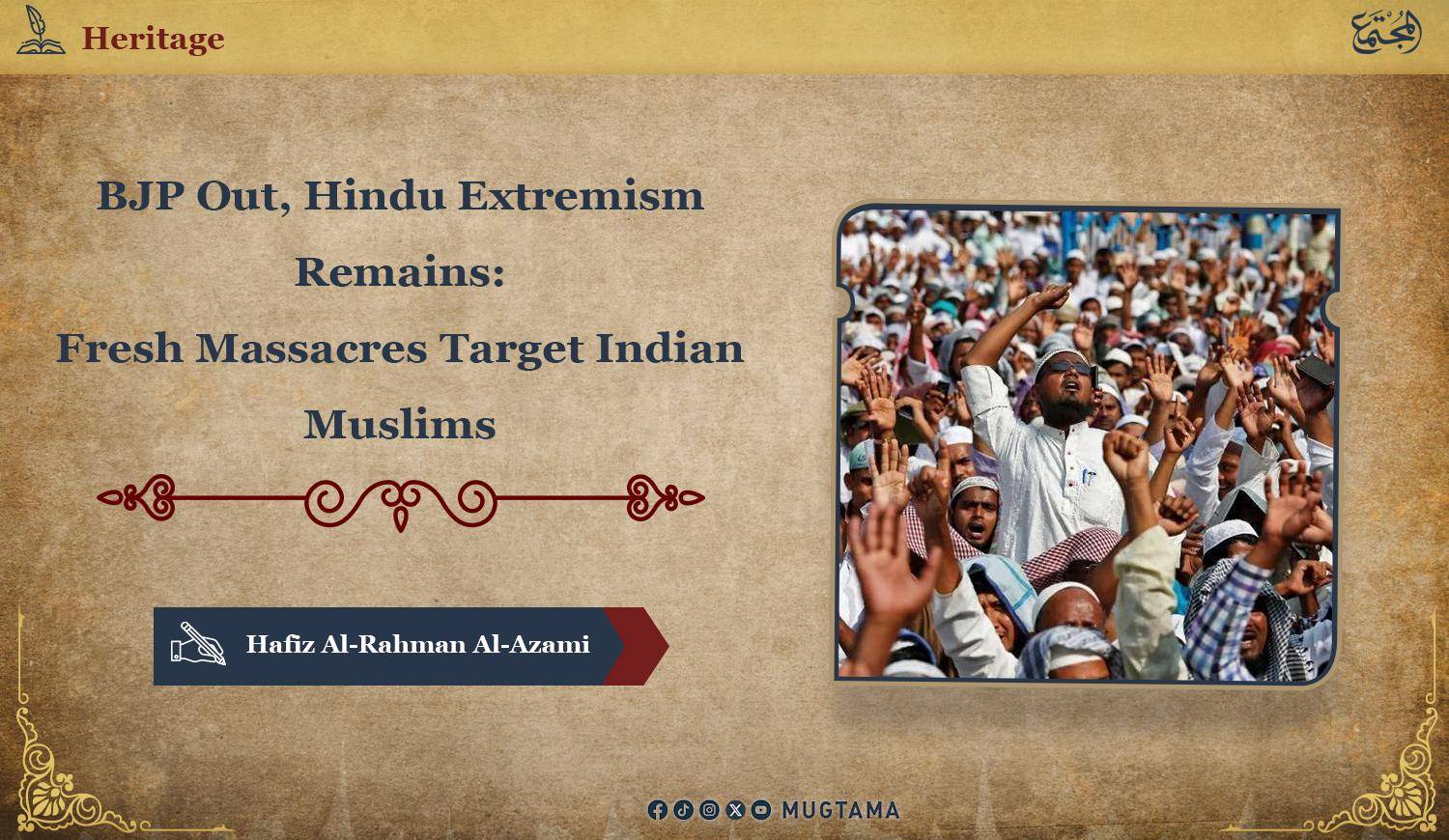
Hindu nationalist organizations
allied with the now-opposition Bharatiya Janata Party (BJP)have recently intensified efforts to stir public sentiment against the Muslim
minority. Seizing on a recent Indian census showing the Muslim birth rate
rising to 3.7%, these groups warn the Hindu majority that demographic trends, left unchecked, will reduce them to a
minority within decades—calling for decisive measures to curb what Hindu
extremists term an 'abnormal phenomenon.'
Targeting of Mosques
Perhaps the sharpest weapon wielded by these extremist
factions to crush minorities—especially the Muslim community—is orchestrating acts of mass extermination. Recently, two
massacres struck the Muslim minority in Maharashtra. One unfolded in the Marathwada
region, where a powerful explosive detonated inside a mosque during Friday
prayers, killing 150 Muslims and wounding 250 others, 50 of whom were left in
critical condition. In the aftermath of the blasts, anti-Muslim violence
erupted across Jalna, Purna, Parbhani, Nanded, and Aurangabad. Hindu extremists
took to the streets and bazaars, attacking Muslims, looting their properties,
torching shops, and desecrating mosques, amid complicity from police who failed
to intervene to protect Muslims—a group regarded as worthless within a Hindu
caste- and race-based social hierarchy. Emboldened by this impunity, the
perpetrators persisted; the following Friday, another high-explosive device was
discovered inside a mosque and safely defused before detonation.
The detonation of a bomb inside the Jama Masjid specifically
during Friday prayers—a time when mosques overflow with worshippers—coupled
with organized anti-Muslim rallies, signals grim days ahead for Indian Muslims. The changing of faces in New Delhi's corridors of power,
marked by the defeat of the Bharatiya Janata Party (BJP) and the Congress party's victory to form
the new government, offers Muslims little cause for celebration; Hindus
perpetually preach peace while concealing daggers. Sympathetic Indian newspapers
raised a piercing, legitimate question: Where were the police forces typically
deployed outside mosques to maintain Friday security on the day of the blast?
How did the culprits manage to escape, and why have no arrests been made nearly
a month after the incident?
It is worth noting that neutral Indian commentators have
pointed to the RSS—a group enjoying political backing from the BJP—as the
primary culprit behind these events. Among their most compelling evidence is
the sudden attack launched by Hindu demonstrators shortly after the mosque
explosion against the headquarters of the Marathi-language daily Lokmat
Times, a publication aligned with the Congress party.
In a related incident, an armed group attacked another mosque
in Karnataka in
early September, opening fire on Muslims inside, leaving 40 dead and numerous
others injured. Suspicion fell on Uma Bharti, a prominent hardliner in the
former BJP government. While police raided her residence in Bhopal, she managed
to evade arrest, subsequently fleeing and going into hiding at an undisclosed
location.
Collusion of the Congress Government
Sensing widespread Hindu sympathy for Bharti, the state's
Chief Minister, Dharam Singh—a Congress party leader—was pressured into
retracting the arrest warrant and quashing all charges against her. This marked
a blatant usurpation of the Supreme Court's constitutional jurisdiction, as it
alone holds the legal authority to grant relief or pardons to wanted
fugitives—underscoring the deep entrenchment of extremism within India's Hindu
majority.
While such impunity might have been anticipated under the
ousted BJP administration—the political arm of the extremist RSS and its
hardline offshoots—it is alarming to witness it unfold under a Congress-led
government widely perceived as moderate and minority-friendly. Compounding the
crisis, the perpetrators of both atrocities against Muslims remain at large
more than a month later. This leaves only two plausible conclusions: either the
current government proved entirely inept in tracking down the culprits, or it
lacked the political will to do so. Under either premise, the administration
stands indicted—either as toothless and unable to protect Muslims, or as
actively complicit against them.
Indian Muslims find
themselves caught in a vicious vise: cornered between the overt hostilities of
extremists who held commanding sway under the previous regime, and the
duplicity of the current ruling coalition. Moving forward, the Muslim community
in India must fundamentally rethink its strategy and assert its collective
weight across the nation's political landscape.
