




Bangladesh Interim Government's Diplomacy and International Relations
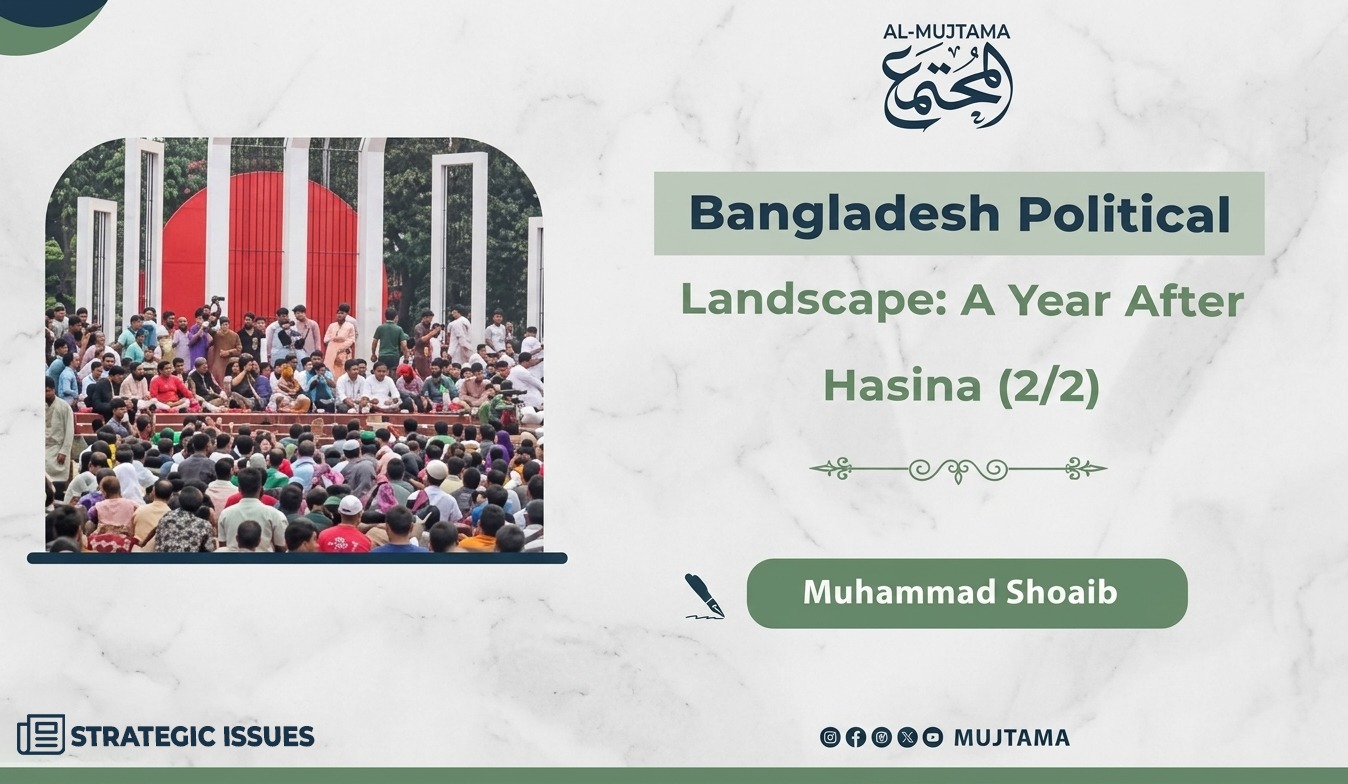
Bangladesh Political Landscape: A Year After Hasina (2/2)
The interim government has been talking about ‘balanced multilateral diplomacy’ from the very beginning. The interim government focused on establishing a strategic balance between the two great powers of Asia, India and China. In addition to increasing economic cooperation with China, the process of renewing the Teesta and Farakka agreements has begun by taking a stand against Indian hegemonic policies. At the same time, the government has been active in the negotiation of the Teesta and Farakka water sharing agreements through inter-regional forums.
The proposal to form a ‘Regional Water Rights Commission’ is
gaining regional acceptance. Bangladesh is creating a new framework for
protecting interests in regional transit and water sharing through BIL, Asian
River Commission and Regional Transit Review Program. Bangladesh was recognized
as a ‘Democratic Transition Model’ at a special session of the United Nations
by highlighting the success of the mass uprising. In this, several African and
Latin American countries cited Bangladesh as an example to follow.
Due to the progress in human rights and democratic
transformation, the United States and the European Union have lifted most of
the sanctions on Bangladesh in a year. The formation of the Tripartite
Investment Board has created opportunities for direct agreements between
expatriate Bangladeshis, expatriate states and state investors.
Restructuring the Security Sector
The major challenge after the July Revolution was the control
of the state security forces. The Police,
RAB, NSI and DGFI have been brought under democratic accountability by
forming a Force Coordination Board. Many controversial officials accused of
human rights violations have been dismissed.
The trial process of RAB members through the ‘Public Safety
Tribunal’ has also begun. Community policing was introduced as part of the
structural restructuring of the police force. Its ‘Anti-Terrorism Operation
Unit’ was abolished to establish accountability in RAB’s activities. Joint
monitoring and human rights monitoring were initiated at the border to prevent
old aggressive attitudes between the BGB and BSF. A strong message was given to
India to stop border killings to prevent violations of civil rights.
The Ministry of Health's Actions
What has the Ministry of Health done? In the first year of the
interim government, the interim government took some quick steps to reduce the
dominance of the long-standing drug syndicate. The ‘National Drug Policy-2025’
was formulated, which encouraged domestic manufacturers and imposed strict
rules on determining the maximum price of life-saving drugs.
A digital surveillance system for drug administration was
launched. E-hospital management was launched in 10 major hospitals in the
country, including Dhaka Medical
College and Sir Salimullah Medical. ‘Health Access Tracker’ was launched to
digitally store patient data, monitor doctors present at the ward level, and
make the supply of government drugs transparent. A tripartite memorandum of
understanding was signed with Gonoshasthaya Kendra, BRAC Health Programme, and
‘Shasthaya Andolon Parishad’ to increase cooperation between citizens and
private healthcare. 12,000 new community clinic assistants were recruited at
the union level. Mobile healthcare units were launched in remote areas of 45
districts, which serve about 50,000 people a day.
The Ministry of Religion: Social Tolerance and Religious Protection
A significant step taken by the Ministry of Religion is
transparency and cost reduction in Hajj management. Hajj package costs have
been reduced by an average of 25 percent compared to 2023. Passports,
vaccinations, training and itinerary have been consolidated by launching the
digital Hajj portal. As a result of a direct agreement with Saudi Arabia,
middlemen have been brought under control.
This time, despite various challenges, all pilgrims have been
able to perform Hajj. As part of the initiative to integrate Qawmi and general
education, a pilot project was taken to introduce science and information
technology courses in Qawmi
Madrasas. Mixed curriculum (religious + general) was introduced in district
madrasas on an experimental basis. The interim government's Ministry of
Religion has moved towards structural reforms in addition to resolving the
crisis. Its impact has been directly reflected in the daily lives of the common
people.
The Ministry of Religion has taken special initiatives for the
security and reconstruction of religious minorities. Increased government
support for religious festivals of traditional, Buddhist and Christian
communities. A culture of religious peace and coexistence has begun to be
practiced anew, which has helped reduce communal tensions.
Major Threats to Bangladesh's Security
The biggest threat to Bangladesh's security and stability at
present is the re-establishment of a deposed autocratic government. This has
become a cause of deep concern for domestic politics and administrative
stability. Analysts believe that India is using various diplomatic and economic
tools to facilitate this process. India's actions aimed at pressuring the
current government of Bangladesh have attracted special attention.
They are trying to create instability in Bangladesh's
internal politics by creating opportunities for autocratic political figures.
In this process, a plan has been detected to destabilize the country by
encouraging opposition political forces and creating pressure at the
international level. This is having a direct impact on the country's internal
security, social cohesion and political stability.
India's influence and irregular interference in the border and
economic sectors are also complicating the country's security situation.
Analysts warn that the biggest threat to Bangladesh is internal instability and
the rehabilitation of an authoritarian government, which could prove dangerous
in the long run for the security of the country's people and Muslim community.
The current government needs to maintain diplomatic awareness, strong security
policies, and social cohesion to maintain the country's stability.
Read also:
Bangladesh
Liberated from Tyranny
August
5, 2024: A Year Since Toppling Bangladesh Hasina Dictatorship