
Muslims in Kosovo
Al‑Mujtama Interviews Kosovo Islamic Community Women’s Department Head Wajida Beniako
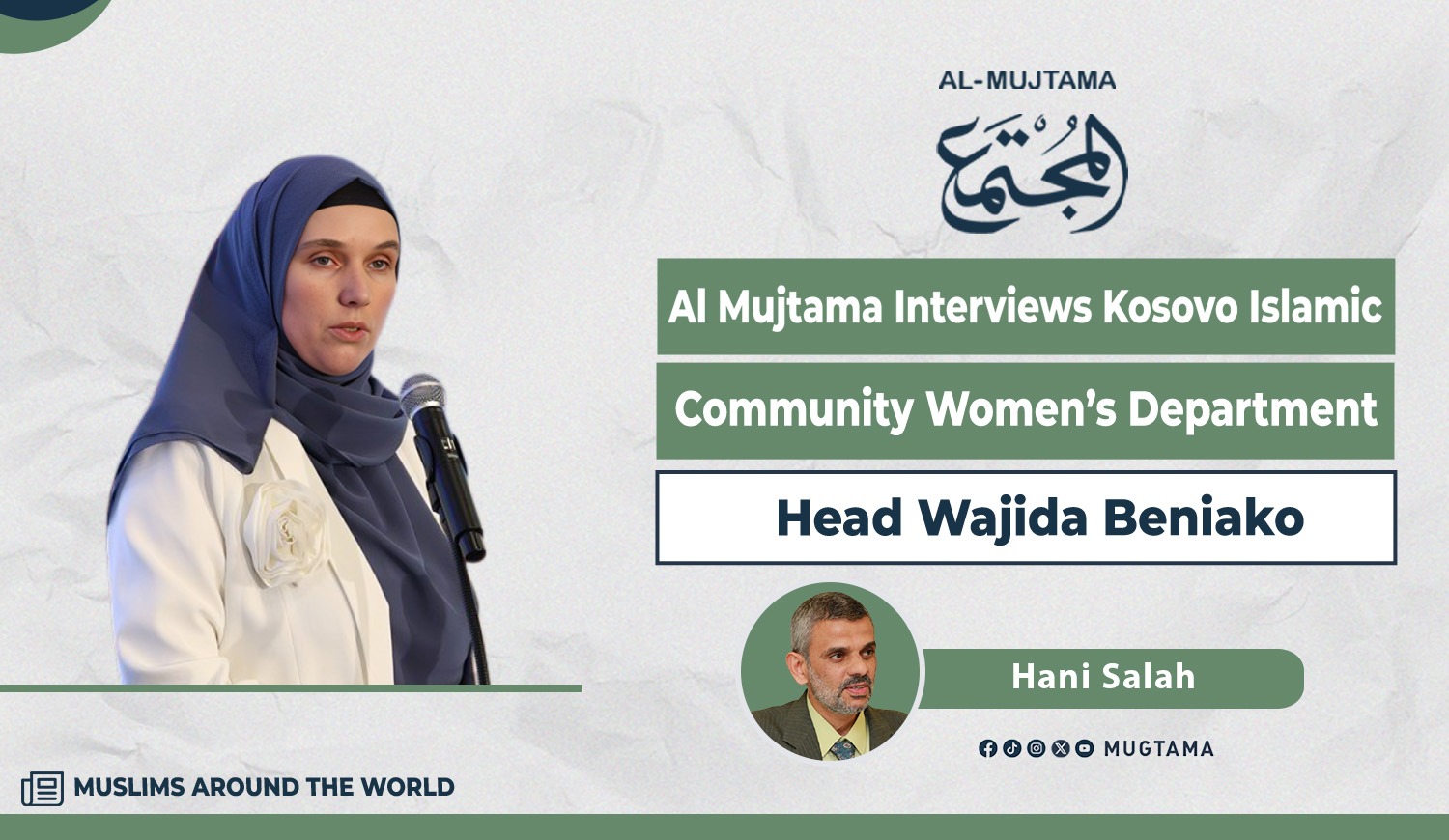
The Women’s Department at the Islamic Community of Kosovo recently celebrated the 20th anniversary of its establishment, highlighting its long journey and its remarkable achievements in empowering Muslim women, strengthening their active presence in religious, educational, and social fields, and building qualified female cadres who contribute to serving society and preserving religious and social values.
To discuss this rich journey and the
department’s accomplishments over the past two decades, we conducted an
interview with Wajida Beniako, Head of the Women’s Department at the
Islamic Community of Kosovo,
to shed light on the department’s experience in empowering Muslim women and
enhancing their role in society, education, and religious outreach.
Tell us about your upbringing and your educational and religious path.
I grew up in an environment that
valued education and religious
principles. I received both my religious and academic education in
Kosovo and abroad, which gave me a strong foundation for understanding the role
of women in Islamic society. My work in religious outreach began at an early
age in the fields of education and religious awareness for girls. Over time, I
gained extensive experience in developing educational and social programs for
Muslim women. I realized that true empowerment begins with a woman’s
understanding of her religious and social role and continues through building
confidence and skills.
Can you introduce the Women’s Department within the Islamic Community of Kosovo and its role in the religious and educational framework?
The Women’s Department is the only
entity dedicated to women within the Islamic Community of Kosovo. It operates
under the Directorate of Religious and Educational Affairs and was established
in January 2005 with the aim of enhancing women’s education, religious and
social awareness, and empowering them in all aspects of their religious,
ethical, and social lives.
What distinguishes this department from others?
What sets it apart is its integration
of educational, pedagogical, and social work, as well as its involvement
of women in shaping community initiatives. It also provides training
programs aimed at building women’s professional and community capacities.
What was the context behind establishing the Women’s Department in 2005?
The department was established in
response to real needs—strengthening the religious and social role of Muslim
women and providing a dedicated educational and pedagogical platform within the
Islamic Community. The decision aligned with the Community’s vision to
highlight women as a fundamental pillar of the family and society and to create
an environment that enables their active participation in religious,
educational, and social activities.
How did the department begin, and how has it developed over two decades?
Over twenty years, the Women’s
Department has evolved into one of the main pillars of the Islamic Community of
Kosovo. Its beginnings were modest, with limited resources, relying on
volunteer work and the dedication of early female scholars and contributors.
Support from the leadership of the Islamic Community
later enabled expansion. In 2011 and 2012, branches were opened in six cities.
Today, the department operates in all cities of Kosovo and includes more than 150
female teachers holding degrees in Islamic Studies—reflecting sustainable
institutional growth and confirming women’s empowerment within the religious
framework.
What are the most notable achievements to date?
Among the key achievements are the
organization of hundreds of religious, cultural, and social lectures throughout
the year across cities and villages, in addition to extensive educational
programs during Ramadan and the Prophet’s birthday. This year alone, more than 10,000
beneficiaries attended our regular religious courses, including 6,000
children and 3,000 women and girls.
The department has also implemented
numerous cultural
and scientific activities, conferences, training courses, community
awareness initiatives, campaigns addressing negative social phenomena, and
ongoing humanitarian and charitable projects.
What challenges do you face?
Challenges include keeping pace with
social changes, strengthening women’s empowerment in traditional communities,
and maintaining the quality of educational and religious programs. We address
these challenges through continuous training, developing educational content,
and collaborating with local and international institutions.
The Women’s Department has become a destination for many government institutions and international organizations. How do you view this growing interest?
These partnerships are essential for
expanding the department’s work and enhancing its credibility. Collaboration
with government institutions and international organizations provides support
for our educational and social programs and enables us to implement high‑quality
projects that strengthen the status of Muslim
women and develop their capabilities on multiple levels.
How do you assess the department’s expansion beyond Kosovo?
Expansion outside Kosovo is a
strategic step to transfer our educational and religious experience to Albanian
communities abroad and strengthen their religious and social identity. It also
reinforces the department’s image as a leading institution committed to serving
Muslim women both inside and outside Kosovo, while strengthening ties between
Muslim communities in Europe and Kosovo.
How has continuous training for female staff impacted the quality of the department’s educational and religious work?
Continuous training has significantly
improved the competence and professionalism of teachers and activists. Among
the most notable outcomes are the increase in the number of teachers from 8
to more than 150 nationwide, the ability to manage diverse educational and
religious programs, and the enhanced presence
of women in social and cultural activities—making the department a
model of excellence in developing female cadres.
What is your future vision for the department in the coming years?
We aim to strengthen the department’s
community impact, expand education and training programs, and launch new
platforms for women and girls, with a focus on religious and social
empowerment. We also plan to develop specialized programs for female leadership
and increase local and international partnerships so that Muslim women remain
active and influential in all aspects of life.
Any final remarks you would like to share with our readers?
I would like to emphasize that the Women’s Department is the result of continuous effort and collective cooperation. Its success reflects the commitment of all participating women and the supportive scholars. We hope our efforts contribute to shaping a generation of women capable of serving society and promoting religious, ethical, and social values while preserving the identity of the Muslim woman and strengthening her role in the community.